![]() |
| Angelika/Mike Schilli |
In the USA, every driver needs liability insurance. Driving without it is illegal and can end badly. When German tourists rent a car, liability insurance with a high coverage amount is almost always included in the rental price, as Germans are accustomed to having liability insurance. However, make sure to read your contract carefully!
In contrast, car rental companies in America will sell "Extended Liability" for about $10 a day. In America, the statutory minimum liability coverage only offers about $30,000 in coverage -- a joke! If you hit just one pedestrian, you'll have to declare bankruptcy. Therefore, it is important to read the contract carefully and ensure a coverage amount of at least $500,000.
And there's another special feature: In the USA, if you own a car and have liability insurance for it, you are generally covered not only for your private car but for any other car you drive. This means that if Angelika or I are driving a rental car (or a friend's car) in the USA, we are automatically covered by our own liability insurance. If we rent a car because, for example, we fly somewhere and want to be mobile there, we get it without liability insurance. However, this must be explicitly stated in your private auto liability insurance contract.
But what if someone steals the rental car or you crash it yourself? In that case, the renter is fully liable and must not only pay for the damage to the car but also fully compensate the rental company for the downtime during which the company can no longer rent out the car ("loss of use"). This can become very expensive. However, you can protect yourself against this scenario: The rental company's insurance, called CDW "Collision Damage Waiver" or LDW "Loss Damage Waiver," offers a type of comprehensive coverage according to German standards for about $10 a day (depending on the size of the car) with a deductible.
If you live in the USA and have certain credit cards, things are easier for you here as well: these cards cover liability for self-caused accidents (only for the rental car, not for the other party in an accident!) and theft, if you pay the car rental bill with them. Our "American Express" card, for example, includes this in the contract--so when we rent a car, we pay nothing beyond the listed price. Even if the salesperson at the car rental throws a hissy fit. They always have us sign a few forms stating that we are now fully liable for everything. But we are always fully insured, one part through private liability insurance and the other part through our credit card. However, not all residents of the USA think this through. They pretend to the car rental agent that they have private insurance, and then drive without any insurance. If something happens, they have to deal with the American legal system.
Memorize this: Never skimp on insurance. However, if you already have insurance, the rental agent might try to talk you into buying a pointless additional insurance policy -- so be cautious and, above all, make sure you are familiar with the contract you signed in Germany (usually with the travel agency). Unfortunately, among the clerks of large car rental companies, there are many bad apples who thoroughly deceive tourists. They take advantage of the fact that most foreigners are not familiar with the American insurance system and, when in doubt, can be talked into buying one insurance policy too many rather than too few. As always, being smart gives you an advantage.
There are two more types of insurance that the agent will probably try selling to you: "Uninsured Motorist Insurance" protects you in case that someone without insurance crashes into your car. This is not all that unlikely, and that's why I have to say that it might be sensible to get this insurance, unless it's already included somewhere else (also note that this won't cover hit and runs). Also, the so-called "Medical" insurance, which costs only about a dollar a day or so, is complete nonsense, as you and your passengers hopefully have extra health insurance when traveling to the USA; otherwise, you're already in a precarious situation.
Conclusion: Don't over-insure, but definitely don't skimp on insurance. You could really ruin yourselves. However, this doesn't mean you shouldn't negotiate hard with car rental companies over the price. Rule of thumb: A small rental car costs $25 a day, CDW/LDW and liability together add another $20. Then there are $10 in taxes and other small fees... so if a German travel agency includes extended liability and comprehensive insurance and charges DM 110 a day or less -- go for it, because you won't get it cheaper in the USA either.
Upon arriving at the counter, the salesperson will immediately try to talk you into a "better," meaning larger, car. They will argue that, for example, for $10 more per day, you could get a convertible. However, this only applies to the base price, turning $25 into $35, but the comprehensive insurance will also become significantly more expensive, as will the tax, which is calculated as a percentage of the total price. So when the salesperson says "$10 more per day," it might actually end up being $20.
And another tip: If you insist on the smaller car you originally ordered, it often turns out (surprise!) that the company doesn't actually have it in stock. If you remain persistent, the salesperson will eventually inform you with a beaming smile that you're getting a free "upgrade," meaning a larger car for the price of the smaller one. Of course, this is a bit of a gamble. For example, it might be worth waiting at a small airport until all the tourists with small cars have left before calmly heading to the car rental desk and insisting on a small car. Our biggest coup so far was in Scotland, where we got a Volvo 440 for the price of a small car for a four-week vacation. We laughed so much!
Then the salesperson asks if you would like to buy discounted fuel from the car rental company. Gasoline in the Bay Area currently costs about $1.35 per gallon at the gas station (approximately 0.40 Euros per liter), but the car rental company will sell it for $1.10 if you take a full tank. Sounds good, right? But it's a scam. The renter has the option to either a) return the car with a full tank, or b) buy a full tank of gas so that you can return the car empty to the rental lot.
The problem, of course, is that you can never run the car completely empty (unless, of course, your name is Günter Speckhofer, who, with his iron nerves, is known to leave only homeopathic amounts in the tank), because who would risk running out of gas on the highway? Even the most cunning driver will always leave at least five liters in the tank (by then, the needle is already deep in the red) and give that to the car rental company -- which, of course, totally ruins the cheaper fuel price. Or, you might not be driving enough to empty the tank at all. A person from Portland, whose identity we won't reveal here (Richard Patten), once chose the "I buy a full tank" option for a two-day stay in San Diego. The only way to empty the tank would have been to leave the engine running overnight.
Therefore: Always choose the "Return full" option, meaning return the car with a full tank, to ensure you don't end up paying extra. Some car rental companies let customers drive away with a half-full tank and require them to return it half-full again with the "Return full" option. This is also a scam because no one can accurately estimate how many liters you need to fill up to make the tank of an unfamiliar car exactly half full.
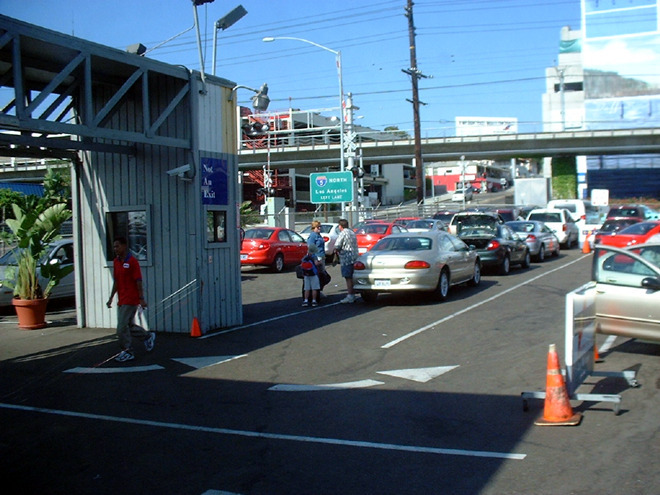
What about scratches and dents? The large car rental companies "Dollar," "Alamo," "Avis," and "Budget" are not very strict about them. When returning the car, they usually don't even check if there's an additional scratch. You drive up with the car, an employee takes the contract, reads the odometer and fuel gauge, and prints a receipt on a mobile computer -- and that's it. You take the shuttle bus to the airport and you're on your way. Some smaller companies (e.g., Enterprise) create a small diagram of the existing dents when you pick up the vehicle, which you have to sign (illustration 3), and this is then compared to how the vehicle looks upon return.
How can you find a good car rental deal when you're in the USA? You can either read the Sunday newspaper and study the large-format ads from the major providers mentioned earlier. But be careful, there is always a so-called "code" next to the offer. If you call the car rental company, the representative will quote you a higher price than the one listed in the ad. However, if you provide them with the "code" (e.g., "AQ7"), you'll get the price shown in the ad. You need to be careful, though, as some ads are only valid for specific locations--sometimes only at airports, sometimes only in Florida--so read carefully.
One more thing: Cars are always rented on a daily basis. So if you pick up the car at 7:00 PM, you should also state 7:00 PM as the return time. If you say 6:00 PM as the return time, you'll have to return the car an hour earlier unnecessarily, without saving any money. If you do show up at the car rental at 6:00 PM, it's not a problem. Conversely, if you pick up the car at 7:00 PM and state 8:00 PM as the pickup time, the car rental company will charge you for an entire extra day! By the way, if you want to keep the car longer than planned, just call them; they'll usually allow it. The same applies in case of an accident: call the car rental company immediately and ask for advice, as their call centers are staffed around the clock.
When making a rental reservation by phone, you don't have to pay anything upfront. They will only ask if you will be paying later with a "major credit card" -- such as American Express, Visa, or Mastercard. You will then receive a reservation number, which you can use to simply show up at the car rental location later. By the way, the websites have also improved recently. I've found some great deals on www.dollar.com. You can make a firm booking there and then go to the respective branch with the printed reservation.
There, you present your driver's license and credit card and acquire the necessary insurance. By the way, the agent might ask you not only to sign the contract at the bottom but also to place your "initials" at certain spots. By putting your initials (e.g., "M.S.") there, you agree to the respective clauses, and you can't later claim you hadn't read them. If there are two or more of you, you need to inform the agent who will be driving. Usually, only the person listed in the contract is insured. There are exceptions for married couples, but always ask and present the driver's license -- all drivers must be present in person. Often, an additional driver costs money, $3 per day is common. And a warning to our dear youngsters: Those under 25 or so have to pay more. Then you get the key, go to the garage, and are assigned a car. By the way, it always comes with automatic transmission and perfumed with an interior spray -- phew! And off you go!
So, that should be enough to keep you from falling for the car rental scammers. Yes, I am not afraid to shout this out to the world: All American car rental companies are trying to take advantage of you! Or are very, um, business-savvy, as the Americans say. Fight with tough measures!
But that brings me to an interesting topic: the incorporation of German words into the English language, and that's not as uncommon as you'd think. In Germany, people often use English words to appear cool. "Networking" instead of "Kontakte knüpfen," for example. On the other hand, German words in the English language mainly serve to make the author of an article, who is already using unusual words, appear particularly educated, as perhaps only 5% of Americans understand them.
The "New Yorker," for example, is a weekly magazine read not only in New York City but nationwide, featuring lengthy articles that even I, after five years in America, still have to work through with a dictionary. Or do any of you newsletter-reading know-it-alls perhaps know what "impetuous," "to imbue," "swashbuckler," "prescience," "apt," or "to rummage" mean? "Portend," "putative," "to loathe," or "tizzy"? Ha! But what I actually wanted to say is: Americans sometimes use German words to express things for which there is no English word. "Schadenfreude," for example. It's mentioned in the book "Word Freak" by Stefan Fatsis (figure 6). You heard that right, there is no English word for the most beautiful of all joys! Or "Doppelgänger." It was recently in The New Yorker (illustration 7).
Now, there actually is the word "look-alike" for people who bear a striking resemblance to others (usually celebrities), but the eerie notion that there is someone who not only looks like you but also leads a similar life and perhaps has even stolen the original's identity is a nightmare expressed only by the word "doppelgänger." I don't need to elaborate on "Kindergarten," as everyone knows that one anyway.
Some American expressions that sound somewhat German also originate from Yiddish. For example, when the well-known film critic Roger Ebert writes about the old film "Dead Poet's Society", stating that the main actor Robin Williams oscillates between "restraint and schtick" (illustration 8), educated Americans understand that Williams fluctuates between restraint and gimmicky routine. In colloquial usage, a "schtick" is either a characteristic "piece" of something or a gimmick that someone repeatedly performs. What, you don't believe me? In illustration 9, you can see the entry in Webster's Dictionary, the "Duden" of the English-speaking world. It explains that "schtick" or "shtick" is Yiddish and originally comes from German. Another example is "to schlep" for schleppen: "I don't like to schlep my bags!" is quite understandable English if you encounter someone with at least a basic education. On the Koshernosh website you will find the most common phrases.
And some expressions may sound like their German "doppelgängers," but they mean something slightly different: "Spiel," for example. When an American says "we went through the same spiel again," they mean that the same performance or routine happened again. And the English word "angst" doesn't exactly mean the German fear, but rather existential anxiety with a Freudian (or whatever kind of psychological) undertone.
Recently, in a meeting where Dieter (the other Bavarian at Netscape) and I were sitting with about ten other people, the head of quality assurance wanted to report on something a manager with the rather German-sounding name "Rick Gruenhagen" (an American) had said -- and accidentally called him "Rick Grugenheimer." Grugenheimer! Dieter and I couldn't hold back. We laughed until we both had tears in our eyes. And for the next 15 minutes, no one could say anything because every time we looked at each other, one of us would start laughing again. The participants in the meeting who had dialed in over the phone had no idea what was going on. And even today, when I say "Grugenheimer!" we burst into laughter.
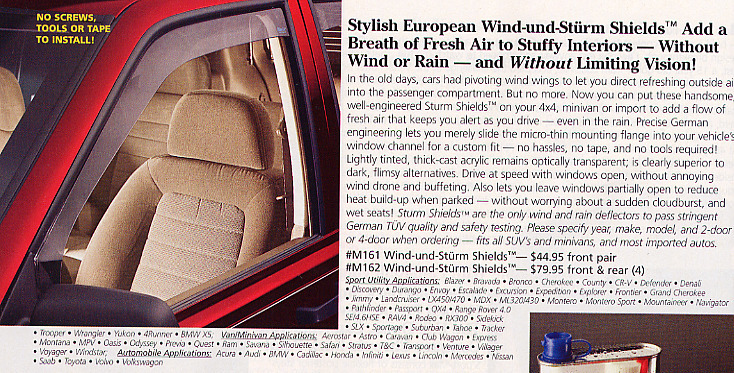
And something else: Sometimes advertisements come to the house by mail that make me laugh my head off. Maybe it's because I'm easily amused, but a vacuum cleaner named "ORECK" -- I just can't help myself.
I scanned the direct mail item for the dear newsletter audience in illustration 10 -- please send your humor ratings! In Germany, it probably wouldn't sell, as the risk of confusion with the word "Dreck" (dirt) is too great. This reminds me of the story about the German cat food "Kinky," which an advertising agency supposedly withdrew at the last moment in the eighties because "Kinky" simply means "perverse" in English.
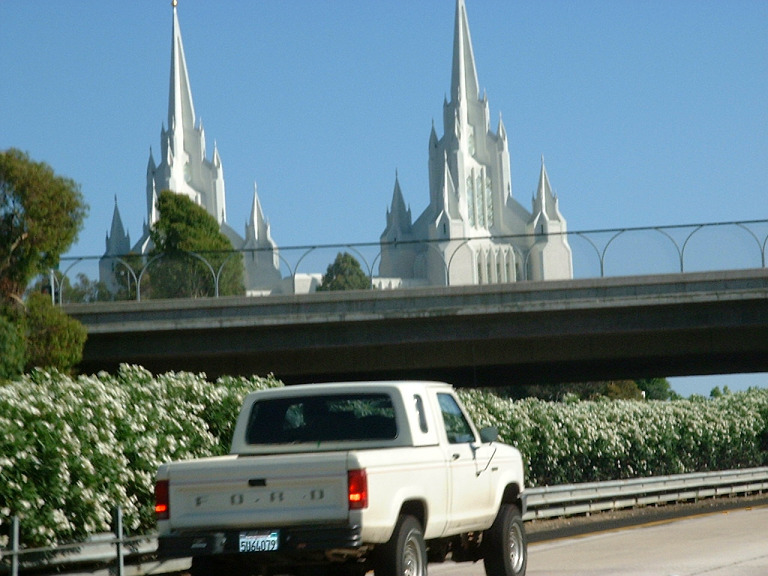
Michael Some time ago, we flew down to San Diego for a few days. A drive on the highway down there took us past the pointy temple shown in illustration 11. We remembered our journalistic duties as newsletter reporters, took the next exit, and approached the brilliantly white structure. It turned out to be a Mormon temple, or as it is called here in the USA, the "Church of Jesus Christ of Latter-day Saints." The building was surrounded by a tall white fence, but a sign invited us to a free tour of the grounds and pointed to the gate, which looked like the one at the Federal Constitutional Court in Karlsruhe. We parked, walked along the fence to the gate, where we were greeted by an older gentleman who introduced himself as "Bob" from "Utah." He said that "Sister Rebecca" would take care of us shortly, as soon as she was finished with the other group she was with. Despite Angelika's eye-rolling, I asked (but politely!) how long it would take, but was reassured that it would be soon.
"Sister Rebecca" turned out to be the wife of "Bob" and guided us through the temple's gardens. The temple is the sanctuary of the Mormons and is visited by followers of the religion only on special occasions, such as for weddings. Otherwise, the faithful gather in more ordinary buildings for Sunday church services. We were not allowed inside the temple, but upon inquiry, we learned that as a Mormon, you receive a small card that grants you access. Angelika was somewhat informed and knew that Mormons do not consume alcohol or caffeine, and as a coffee enthusiast, she asked how it was with coffee and such. Alcohol and coffee are indeed taboo, came the response (at this point, I had already dismissed the whole thing), but Coca-Cola is quite acceptable in America. Interesting! We found it difficult to leave, as various people kept offering us a video they wanted to send to our home address -- but we stood firm and left.
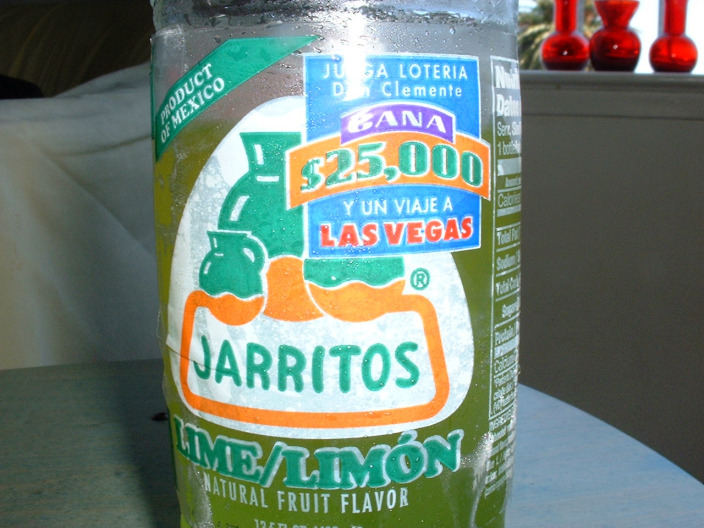
A genuine "Product of Mexico," as the label indicates, and certainly made with additives that are not permitted in Germany. How else could this delicious lemonade in the "Lemon" version taste like the woodruff soda that was available at kiosks in German swimming pools in the seventies? If you ever find yourself in California or Mexico, you absolutely must try it. Oh, all the sweetness of youth is contained in this bottle!
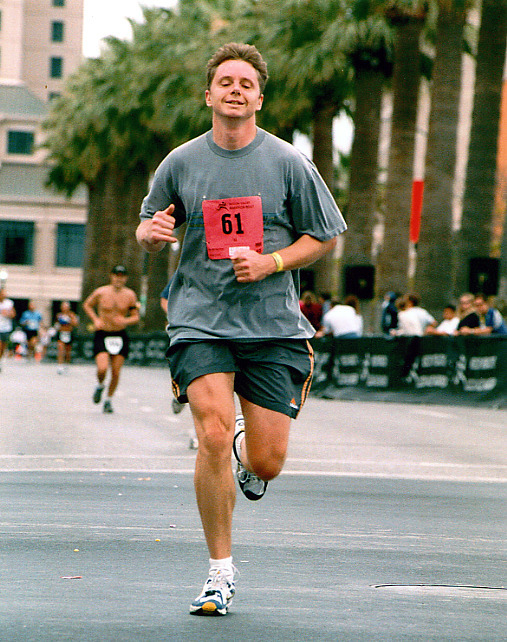
Michael If you can't complete a full marathon, you can also divide it into four parts and run it as a relay in America. Some colleagues at Netscape had urged me to run the last 6.9-mile leg of the Silicon Valley Marathon in San Jose. For an old marathon veteran, 11.1 kilometers are, of course, not a challenge, so I completed them in just 57 minutes. If you enlarge image 14, you can see my brutal leg muscles during the final sprint!
Shortly before Christmas, our mailman had to carry a heavy load because all the packages that arrived from Germany -- our neighbor's children were already getting really curious. Thanks to everyone who showered us with gifts -- apparently, word got around that we love Milka chocolate, which isn't available here. Figure 15 shows the haul -- we're well-stocked now, many thanks to everyone! Make way for Angelika!
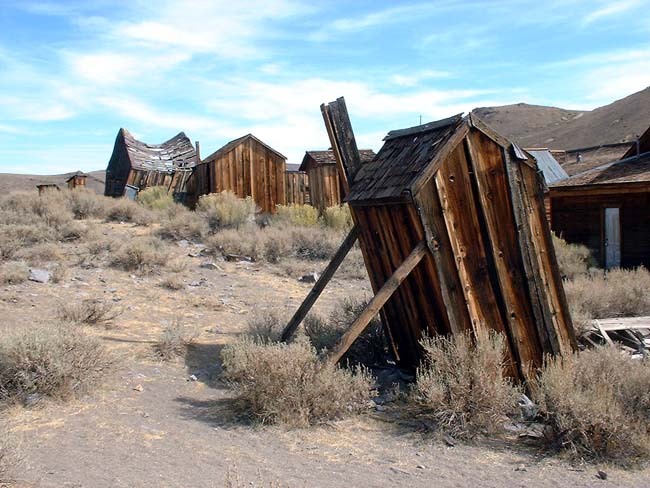
Angelika Currently, a campaign is sweeping across the country with the goal of attracting more tourists to America. American celebrities are promoting the beauty of the United States and hope to halt the decline in tourism following the terrorist attacks and to stimulate the sluggish economy. Traveling and shopping are now considered patriotic behaviors here in the USA! However, we are not driven by patriotic motives to explore the world -- our goal is to discover as much of California as possible while we live here. During one of our short trips in California, we visited the former gold mining town of "Bodie" recently -- a so-called ghost town.
Bodie is located in the middle of the Californian outback, close to the Nevada border and about 100 miles northeast of Yosemite National Park. As our somewhat aging car struggled over mountain passes and the last three miles of unpaved road, we kept asking ourselves what had motivated people back in the day to pitch their tents in this rugged terrain. Naturally, it was the lure of gold. But the winters in this region are extremely harsh (yes, that exists in California too). Even today, the towns are cut off from the rest of the world for months because the passes over the Sierra Nevada mountain range are impassable. In 1859, gold was discovered in a town called Bodie. At the height of the gold rush, around 1879, about 10,000 people lived in Bodie. It had, among other things, 65 saloons. After the gold mines were exhausted, the residents gradually left Bodie, taking what they could carry but also leaving a lot behind. Due to its isolated location, much has remained as the residents had left it: in some cases, the dishes are still in the cupboards. Although only about five percent of the buildings still stand today, it took us hours to see everything. The buildings are not restored, but only minimally maintained, for example, they're supported if they are in danger of collapsing. Western movie enthusiasts or die-hard fans of the TV series "Little House on the Prairie" will be in seventh heaven in Bodie. I wouldn't have been surprised to run into Laura Ingalls. If you're in the area, check out Bodie.
Angelika Regarding the State of the Nation: There is currently a lot of commotion in San Francisco and its surroundings about John Walker, who has been exposed as an American Taliban fighter by the media. The 20-year-old American grew up in wealthy Marin County, the district just outside San Francisco (north of the Golden Gate Bridge), and had converted to Islam in his early teenage years. After stops in various Arab countries, he eventually ended up in Afghanistan, where he was captured by US troops in early December. Walker is suspected of having fought alongside the Taliban and Al Qaeda and is therefore charged with conspiracy and the murder of Americans, as well as aiding terrorism, which could result in a life sentence if convicted.
In San Francisco, we occasionally hear some sarcastic comments on Marin County having produced a Taliban member. This is because San Francisco has always looked down on Marin County: "too white" and "too rich" is the unanimous verdict. John Walker, offspring of a wealthy lawyer, fits this image. On a national level, "Johnny" sparked a heated debate about the honor of being an American citizen. Many were so outraged by his behavior that they would prefer to strip him of his citizenship immediately: John Walker as public enemy number one. Others were more charitable, emphasizing that he is a young man ideologically confused, but one must not forget that he is an American. As a neutral observer, I find it interesting that Walker was not taken to the American military base in Cuba like the Afghan prisoners, but rather kept on American soil. He is also expected to face the federal court in Alexandria, Virginia, and not a military tribunal. This raises the suspicion that the US government sees him more as a lost son.
Regarding confused young men: Surely you've also heard in Germany that a 15-year-old in Florida attempted to imitate the terrorist attacks on the World Trade Center in order to commit suicide. He flew a small plane into the Bank of America building in Tampa. Allegedly, he expressed admiration for Osama Bin Laden in his farewell letter. Immediately, there was a discussion about security regulations at airports with private planes and an investigation into what led to the suicide. Even the 15-year-old's acne medication was scrutinized, as it is suspected of causing severe depression. I was amazed to see that no one questioned the fact that a 15-year-old in this country is allowed to learn to fly, even though in most states he couldn't legally purchase alcohol because he was under 21. Surely he was only allowed to fly with an instructor, but it shows how easy it was for the 15-year-old to outsmart the instructor and take off alone in the Cessna.State of the Nation