![]() |
| Angelika/Mike Schilli |
Angelika Today I am opening our travel journal again: This time we drove with the "PERL MAN" (our car's license plate) for two hours on Highway 101 North to Ukiah, to the "Vichy Springs Resort." There, you can find a natural healing spring, where warm, carbonated, and mineral-rich water comes from the depths of the earth. This water is safe to drink and also promises various benefits when you bathe in it. It not only helps with stomach ulcers, gout, rheumatism, and arthritis but also soothes sunburn. Burns and skin injuries heal faster. And for those who do not yet suffer from the various ailments described, the soothing water helps to simply relax and unwind. By the way, the place is called "Vichy Springs" because their water is remarkably similar to the French original--showing America's pragmatic nature.
The healing properties of the spring water have been known to the ancient Pomo Indians for millennia. The current resort opened its doors in 1854. By American standards, that's ancient, a historical sensation. Vichy Springs attracted notable figures such as Mark Twain, Robert Louis Stevenson, Jack London, and even a few American presidents. Back then, it was considered "mega cool" in San Francisco to head to Vichy Springs. There was even a dance hall to ensure that the fun didn't come to an abrupt end after a refreshing bath. Today, things are a bit more tranquil, and you're more likely to encounter famous Perl book authors (haha!). We slept in a cozy room that was renovated not too long ago and enjoyed long walks on the vast grounds in addition to extensive baths.
Bathing in the healing water proceeds as follows: Since it would be somewhat impractical and perhaps not very environmentally friendly for everyone to gather in the not-so-large spring for bathing, there are various bathtubs fed by the spring. Some of these bathtubs are outdoors, while others are in a covered, long hut divided by walls, so that there are always two bathtubs next to each other in a small room. Even in the covered huts, it is required to keep your swimsuit or swim trunks on, which at first glance doesn't seem unusual in prudish America. However, there are several places in Northern California with natural springs where you are allowed to enter unclothed ("clothing optional" is what it's called here). This might also be because these places attract many freedom-loving old hippies or "New Age" people.
But I digress. The bathtubs have a huge metal plug that you simply pull out on one side and then plug back in on the other side. As soon as you do this, the water starts bubbling and the bathtub fills to the brim, limited by the natural water pressure of the spring. When you get into the water, it initially doesn't feel too warm. The trick is to stay completely still. Then, small bubbles slowly form around your body like a second skin. Your veins expand, your blood starts to circulate more vigorously, and your body warms up from the inside, so to speak. Usually, the stomach area warms up first, followed by the other parts of the body. It's a funny feeling. By the way, the bathtubs are brownish in color due to the minerals in the water. On our first evening there, we got into the baths at dusk, and Michael amused me with stories about what might be at the bottom of the bathtub. It's a good thing I'm not easily scared. If you ever find yourself in the Ukiah area, stop by Vichy Springs. By the way, you don't have to be a hotel guest to enjoy the healing waters. A day pass grants you access.
Making an appointment was not easy at all, as the person who answered the phone spoke hardly any English, a very common phenomenon in Chinatown. However, I eventually managed to snag one. Now, you shouldn't imagine the whole thing as a doctor's office. Quite the opposite, the specialist sat at a desk in the back of the herbal shop. In front of her desk were a few chairs for those waiting, meaning everyone could hear everything, including customers standing at the counter buying something. When I entered the shop, it seemed like I traveled from San Francisco to China at light speed. The shop was filled with Chinese customers, and snippets of Chinese words were flying around me. Being in an environment where you suddenly find yourself in the minority is an extremely interesting experience. Although everyone was very friendly to me, I felt a bit out of place because I didn't understand anything.
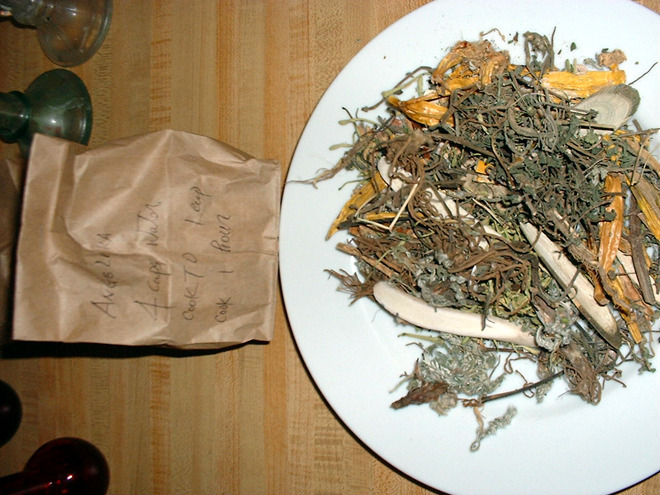
Eventually, I reached the herbal specialist and described my symptoms to her. She asked me a few questions and quickly wrote Chinese characters down on a piece of paper. I turned pale with envy, as we were just struggling through our first Chinese characters in our third Japanese course. Then she measured my pulse, looked at my tongue, and handed the note to her colleague standing behind the counter. He then opened all sorts of drawers, weighed herbs on an old-fashioned scale, and distributed everything into five brown bags. I paid 32 dollars (5 dollars for each bag of herbs and 7 dollars for the consultation) and left. At home, I first took a good look at the herbal rarities in peace. There were things I had never seen in my life. I then made a tea from the whole thing by mixing the herbs with four cups of water and boiling it for about an hour. Of course, I also had to drink the tea. It didn't even taste that bad. Unfortunately, my throat is still bothering me, but the experience was definitely worth the visit to the herbal specialist.
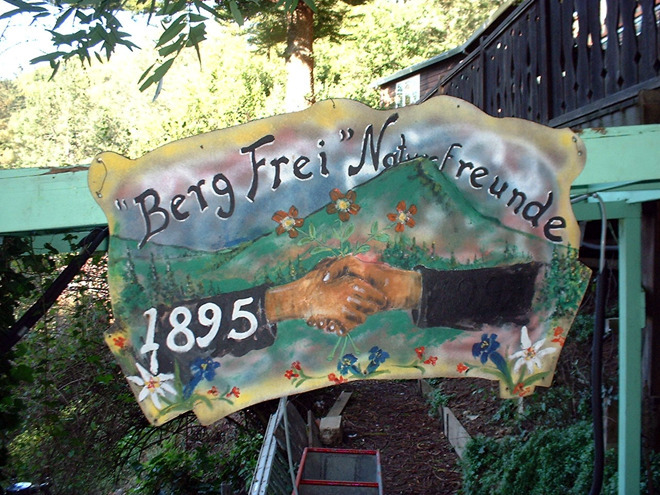
Angelika A unique feature of a completely different kind was what we were looking at recently during one of our weekend hikes in the Mount Tamalpais area. The Mount Tamalpais region is about a 45-minute drive north of San Francisco and offers great hikes in hilly landscapes with beautiful views of the ocean. We had known for some time that there is a mountain hut hidden in the forest there, where you can picnic and drink beer on the terrace. Unfortunately, we had not yet managed to find it. However, since I always read all kinds of travel blogs, I found a description in a hiking guide on how to get to the hut. So, one Sunday, we set off. Now, this might not seem like anything special to you. Therefore, it should be noted that the concept of mountain huts has not yet caught on in America. No one here is hiking in mountainous areas, expecting to find a mountain hut at the end of the trail, to satisfy their hunger and thirst.
Now, how did this particular mountain hut end up here in California of all places? The "Touristen-Verein Die Naturfreunde" (Tourist Club The Nature Friends) is behind it. Founded in 1895 in Vienna, as a movement of the Austrian Social Democratic Workers' Party, the Nature Friends aimed to enable workers and their families to spend their leisure time in nature. The club quickly gained immense popularity in Europe. By 1914, the first club house in America had already opened its doors--naturally, as you might have guessed, near San Francisco in the Mount Tamalpais area. Today, the "Touristen-Verein Die Naturfreunde" is a union of hikers and mountaineers. There are about 1,400 club houses in 21 countries. This is how we came to enjoy freshly tapped German beer in the sun while taking in the view. However, the food was limited to American potato chips and the like from a bag, as the hut is not a professionally run restaurant but is maintained by club members. Only the Californian landscape reminded us that we were not sitting somewhere in Austria or Bavaria, as the Nature Friends house could easily be transplanted there. We're always surprised what kind of strange things we're running into in San Francisco and its surroundings!
Angelika Scene change: Recently, I was once again strolling up 24th Street in our neighborhood and ran into a schoolchildren at every street corner selling cookies or chocolate. I never understood what that was all about. But after our neighbor's kids also knocked on our door to sell their chocolate, I got the idea. Those kids aren't trying to help the chocolate industry; no, they are raising money for their school by marking up bars that cost 60 cents, selling them for $2.00, and donating the difference for a good cause. This is called "fundraising" in America.
For example, our neighbor's school needs new computers. The kids aren't collecting money because their school is in dire straits. Fundraising is a quintessentially American principle. It runs like a red thread through the life of every American. Since the American government only helps when there's no other option, American non-profit organizations rely on donations. Americans are not only world champions in donating but also extremely creative when it comes to raising money. There are marathons and ballroom events where participants gather sponsors to pay high entry admissions (sometimes amounting to several thousand dollars), which then go to the good cause. People cycle from San Francisco to Los Angeles, and kids sell lemonade on the sidewalk. On weekends, we often see teenagers waving signs to direct cars into a parking lot, where they then wash the cars for a contribution that goes to their charity. Donations are made on a large scale: entire museums and universities have been created this way. In such institutions, you will usually find at least one employee whose sole purpose is to solicit donations from the industry and wealthy citizens.
Additionally, it is a societal obligation in the USA to engage in volunteer work. I know people here who work full-time, more than 40 hours a week, have children, and still dedicate several hours a week to voluntary community service. Working for the welfare of the community is instilled in Americans from an early age. In the Tenderloin, for example, we often have schoolchildren who work with us for an entire week without pay. The school organizes this. It is not intended for career exploration, but rather that children learn to do something for the community ("give back to the community").
The possibilities for volunteering are limitless. A well-known program in America is called "Big Brothers, Big Sisters." In this program, you act as a mentor to a child. You go on outings, help with academic difficulties, and so on. By the way, San Francisco has an organization that coordinates volunteer activities (the "Volunteer Bureau of San Francisco"). Organizations announce there when and for what they need helpers. Interested individuals can view this information and then decide where they would like to volunteer. By the way, I found the Tenderloin Childcare Center through this bureau, where I have been volunteering twice a week for four and a half years now. Oddly, European politicians forget this aspect of private willingness to help (donations and volunteer work) when they blindly try to transplant elements of American minimal social policy to Europe.
Let's go back once more to our neighborhood children selling cookies. The chocolate sale was not exactly voluntary. Every student had to sell two large boxes. Practice makes perfect ...
Clear the way for Michael!
Michael When watching TV in the USA, the question arises: cable or satellite dish? After AT&T (which owns the cable) aired TV commercials with funny stories suggesting that satellite dish owners are not very bright, we decided to get cable. With cable, you receive about 60 different channels. However, that's so many that the TV Guide, the weekly television magazine in the USA, is as thick as the phone book of a small German town! In the book Understanding USA, I read that the TV Guide, this completely useless magazine, publishes 12.5 million copies every week and earns $1.17 billion a year from advertising! By the way, "Understanding USA" is a very interesting book. For example, it reveals that Florida is mostly home to people over 60, and in South Texas, hardly anyone goes to college. Or that white men over 50 make up about 10% of the population but account for 33% of all suicides. Or that between 1990 and 1998, the costs for attending college in the USA increased by 54.2%, while during the same period, the prices for televisions fell by 52.2%. Or that 30% of all Black males between 20 and 30 years old in the USA have been in prison at some point. Or that 43 million Americans have no health insurance. Or that New Orleans holds the national record with 37% of its population being overweight. But I digress.
Currently on TV
Figure 9 shows the selection of the TV program for a single day from 6:00 PM to midnight -- completely unusable if you don't already know what you want to watch. But luckily, as explained in one of the recent newsletters, we have TiVo, the thinking TV computer that scans through all the channels day and night, records everything its owners like, and always has it ready to play.
This has led to us having no idea anymore about what program runs on which channel, as TiVo just recorded somewhere it at some point. You simply click on the show based on the title in the TiVo list and enjoy it. Of course, no normal person goes through channels 40 and above--that's something only people can do who sit on the couch all day in their underwear, drink "Budweiser" beer, and channel surf with the remote control. I, of course, don't do that.
The TiVo box also has nothing to do all day except search for interesting shows on behalf of its owners, and explores the most absurd channel numbers. This works, as I have written before, by the box learning what its owners like, and it can sometimes happen that the box discovers something its owners would never have found themselves. "Travels with Harry" (Channel 47) is, for example, such a lucky find. Since we like to watch travel magazines like "Back Area Backroads" (about the San Francisco area), the TiVo box thought we might also enjoy "Travels with Harry," a show where a certain Harry Smith travels around small-town America, uncovering traditions and absurdities. And TiVo was right; we now enthusiastically watch the show every week! Another example is "Louis Theroux's Weird Weekends" (Channel 48), where a British reporter from the BBC travels around the world discovering the most eccentric things.
With so many TV offerings, there are also shows for niche groups, like people who paint pictures of moose standing in front of mountains. In illustration 11, you can see Bob Ross who spends hours explaining and demonstrating how to paint such pictures. TiVo now knows that I enjoy watching this kind of nonsense and records it to Angelika's annoyance, even when "Oprah" is on!
Before airing a TV show, the broadcasters always have to display how much sex and violence will be shown. In Figure 12, you can see that "mild violence" (mild violence, haha!), "adult content" (it could be about drugs or something), and "adult language" (someone might say "shit" or "fuck") will be featured. There are also additional categories for nude scenes, which are handled particularly strictly in America. On regular programming you will never — and I mean never — see anyone naked or even half-naked. The scenes are either cut out entirely or blurred at the relevant spots. On pay-TV (that is, the channels you have to pay extra for, like HBO, the American version of "Premiere"), things can get a bit more permissive. There you'll find "brief nudity" (just a vague outline), "full nudity" (you actually see something), and even "strong sexual content." Although in prudish America that doesn’t mean much -- one single evening on RTL in Germany would be nonstop, full-on "strong sexual content."
Furthermore, television here is highly regionalized. Similar to how ARD in Bavaria airs Bavarian programs in the early evening, each city here has its own television programming. So, it can happen that the 10 o'clock news on Channel 5 leads with the story that the city plans to increase the toll on the Bay Bridge by one dollar. When we had only been in San Francisco for a few months, we once made the mistake of buying a television program during one of our trips just past the Golden Gate Bridge -- which turned out to be useless because Tiburon and Sausalito have completely different channel numbers.
In the USA, there are four different time zones: If a nationwide broadcast airs at 8:00 PM (Pacific Time) in San Francisco, it has already aired at 7:00 PM in the Mountain Time Zone (Chicago), at 6:00 PM in the Central Time Zone (Texas), and at 5:00 PM Eastern Time (New York). This leads to conflicts, especially with highly anticipated shows like the finale of "Survivor": Since the shows must air at the local prime time due to high advertising revenue, people in New York already know the outcome three hours earlier.
Regionalism is also reflected in advertising: It can happen that suddenly a Chinese dentist from San Francisco, with an incredible accent, promotes his services. Unlike in Germany, doctors and lawyers here are allowed to advertise like any other company. I regularly roll on the floor laughing when at the end of the "Jang and Associates" dental team commercial, all their staff lines up, and the boss shouts "Jang and Associates!" and they all put on a smile on cue, while his dental team murmurs "We'll take gooood care of ya!" (Figure 13). For the first dental examination, including X-rays and a written cost estimate, these diligent dental entrepreneurs charge only $18 instead of the regular price of $135, as I've learned from their commercial (Figure 14).
Since San Francisco is home to many foreigners whose native language is not necessarily English, television reserves channels for Japanese, Chinese, and Spanish programs. The latter are for Mexicans and have the pleasant feature of broadcasting sports like soccer, which is ignored by regular channels even during the World Cup! However, the "Gooooooool" for every goal takes some getting used to. On the Japanese channel, I once saw an American football player who, in a commercial, promoted a certain brand of green tea in fairly good Japanese. A cult show on Japanese television is the so-called "Iron Chef." In this show, two chefs, usually one Asian and one European/American, compete against each other. Both must create a 4-course menu within an hour to impress the Japanese jury (who, of course, chatter in Japanese, with English subtitles providing the translation) with their exquisite delicacies. Due to the show's great success, which also attracted many Americans to the Japanese channel, the American network UPN launched the show "Iron Chef America," hosted by the now elderly and bloated William Shatner (Captain Kirk from the Enterprise), whose wife drowned in a swimming pool. A disaster, of course.
For the few Germans in San Francisco, there isn't a dedicated channel, but KMTV on channel 32 often airs something. Sometime around four in the morning, there's a program called "Germany Today" from "Deutsche Welle," which brings the most important news and some special reports weekly. The program is available in both German and English. In the English version, German celebrities often appear, stumbling through with their clumsy English, which makes me laugh until I cry. Recently, mountain climber Reinhold Messner (see illustration 16) was on, telling his story of Nanga Parbat for the umpteenth time. Although the English version was grammatically at the level of a fifth-grader and the pronunciation worse than Helmut Kohl's, he didn't care and delivered an amazing result -- the man has class, hats off!
TiVo knows that I'm interested in everything related to Germany and records it just in case. Most of the time, it's about some nonsense, like recently about an older German lady who participated in a marathon at the South Pole. Some Germans have been living here for 40 years or more, and for them, it's surely entertaining. The other German show, "Germany Live," always focuses on a German city. Recently, it was Lübeck's turn. I sat electrified in my TV chair! Lübeck! Wow! But these productions are so endearingly unprofessional (apparently produced on a very small budget) that I actually watch them sometimes.
Another source of pure television enjoyment is the commercials for the US Army, which officially has to recruit its professional soldiers and cannot rely on free cannon fodder like in Germany. Accompanied by heavy metal music, F-16s piloted by happy pilots land on aircraft carriers, and camouflaged combat swimmers coolly slide into the water from inflatable boats with rifles at the ready. Woe to the one who has to clean the gun afterward, I say as an old veteran! "Accelerate your Life" is the current slogan. And "Paid for by the US Navy" is written underneath.
Overall, the amount of advertising that American television includes is absolutely unbearable. I believe that during prime time, there are 25 minutes of commercials for every hour of television. This means that a 90-minute movie can stretch to almost three hours. In the first hour, the commercial breaks are still cautious so that not too many viewers drop off, but towards the end, when it gets exciting and everyone wants to see the outcome, the movie is interrupted every five minutes for five minutes. Incidentally, if not all the planned commercial breaks fit into the available broadcast time, the movie is often shortened. Sometimes you don't even understand the movie anymore because important scenes are missing. The only solution is to either subscribe to a premium channel like HBO (similar to Premiere in Germany) for $30 a month and let TiVo record everything, or rent videos.
This brings me to another topic: Five years ago, while still living in Germany, I didn't realize that German-dubbed American films lose valuable information. Sure, back then I often went to the "Atlantis" cinema on Schwanthaler Street in Munich to watch films like "Terminator" in the original version--Arnie Schwarzenegger is famously priceless when he rumbles in his harsh Austrian-English. But until then, I was unaware of the fact that Americans use dialects and accents to add subtle nuances to films. Just as you can immediately recognize Munich and Hamburg residents by their dialects on German television, there are easily noticeable differences in the English-speaking world between Californians, East Coast residents (New York, etc.), Southerners (New Orleans, etc.), hillbillies (corn and potato states of the USA), Canadians, Australians, Irish, British, Scots, and foreigners who speak English with an accent: Asians, Indians, Italians, Spaniards, Russians, and Germans.
This tradition is still maintained in Hollywood. When a previously unknown character speaks in a movie, an American sitting in the cinema can determine within three seconds which continent the person comes from. Just as someone in a Hamburg bakery saying "Gehm's mer mol zwoa Semmel, bittschön!" would immediately be identified as Bavarian, it is noticeable in films like "Crocodile Dundee" that the hero greets people with an Australian "G'Day Mate," which is unheard of in the USA. Such nuances are naturally lost in the German translation--unless Crocodile Dundee were to speak Bavarian in New York, which could, of course, unleash unexpected comedic energy if he were to throw a firm "Grüß Gott!" at the doorman.
In the numerous Nazi films made in the USA, the ringleaders speak short German phrases that every American knows: "Schnell, Schnell!" (Quick, Quick!), "Marsch!" (March!), "Blitzkrieg!" -- and otherwise, of course, English with ludicrous grammar. They pronounce the "th" in English as a hissing "s" (American "z"), and the English "r," which usually resides in the back of the throat with a rolled tongue, is either rolled Bavarian-style or rasped North German-style. The English "w," typically pronounced as "uua," is pronounced like the German "w," similar to how Americans pronounce "v." So, if two flustered Nazis in a film wonder where their leader is, they say in correct film English, "Vere is ze Hauptmann?" (Where is the captain?).
One must realize this: All actors in American films, regardless of nationality, speak English for obvious reasons. However, the Nazi in war films speaks with a German accent, the Australian with his broad sing-song, the Black character in hip-hop clothes with a street dialect, the Wall Street guy from New York with his dry East Coast accent, and the Brit, of course, with school English, while the Scot rolls the "r." Someone told me that in the latest "Star Wars" episode, all the villains speak either with a Japanese or German accent. Or who among you knew that the man from the engine room of the "Starship Enterprise" is called "Scotty" only because he rolls the "r" like a Scot?
In the course of the Olympic coverage, television aired a report about the Bavarian national hero and bobsled athlete Georg Hackl, who is also called the "flying white sausage" and unfortunately messed up the gold medal this time. Schorsch's English is, of course, a bit, um, limited. He spoke German while an American voice provided a translation of his audible remarks in the background for the American viewers. But the fascinating thing was: the translator spoke American with a German accent! Not even artificially -- the broadcasters specifically hired a German expatriate to present the interview with Hacklschorsch in such a way that even the last American would understand: Schorsch is from Germany.
And American TV series, as you all know, are often adapted and adopted by German broadcasters. I read that more and more Germans who are arrested in Germany insist on having their rights read to them ("Anything you say can be used against you in court, blah blah..."). These dummies probably don't know that these are the so-called Miranda Rights, which are only valid in the USA! People just watch too many American crime series.
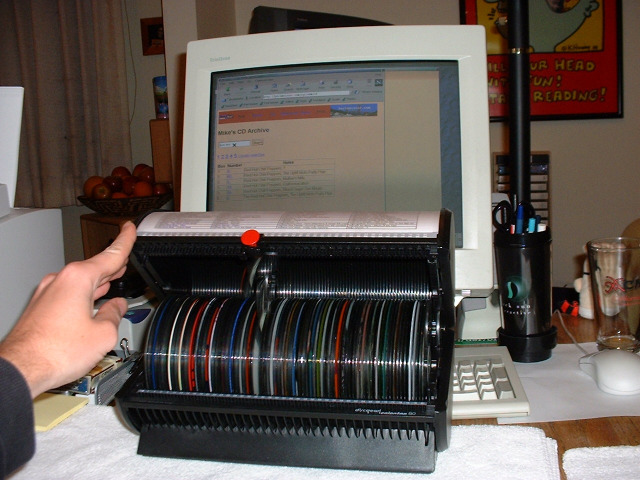
But that's not all: On the front of the case, you can attach a table of contents that assigns a title and an artist to each number. However, the software that comes with Discgear is somewhat subpar and not recommended. But since I'm in the field, there's more: On my website, there's a program that searches for a keyword you enter (for example, "Red Hot Chili Peppers") and then tells me in which of my Discgear cases and at which positions CDs from this band are located. If anyone is interested, I'd be happy to send them the small Perl program. And in my monthly column for the German Linux Magazine, which I've been writing columns for for almost five years, I've introduced a small program for labeling the case ( https://www.linux-magazin.de/ausgabe/2002/03/perl/perl.htm ). The Discgear storage is available at www.discgear.com, not particularly cheap, but very practical. Drives the yuppie stores to ruin!
Today, I'm going to exclusively share with you my personal theory on why the glaring difference between the rich and the poor in America hasn't yet sparked a revolution: It's because you can get by with very little money here if you systematically take advantage of special offers. Just take McDonald's, for example: A hamburger costs about 29 cents. In a traditional restaurant, a (admittedly better) hamburger costs 6 dollars. 100g of ground beef in the supermarket costs 50 cents. However, 100g of filet mignon costs 6 dollars. The cheapest options in the USA are extremely cheap, even by international standards. But if you want something that's just a little bit better, it immediately costs ten times as much.
In addition to the coupons in newspaper ads, we receive an envelope full of coupons for our local stores once a month. While I usually throw the envelope away unopened, I took a closer look this time, simply for my report to our newletter readers: As you can see in illustration 24, there's coupons for anything you can imagine: From rabies vaccinations for cats ($4) to Japanese sushi ($5 discount on a bill of $25) and a coupon for a dentist who whitens teeth and offers a special rate of only $99 instead of the usual $250. The joint practice of Terry Nguyen (sounds Vietnamese) and David Barrelier (obviously of French descent), both DDS, meaning dentists, are running this special. Well, but the team at Jang Associates probably can't be outdone by those two!
That's it for today, dear friends in faraway Germany! To all of you:
Happy Easter!
Angelika und Michael