07/23/2002   English German

Previous
edition
  Edition # 38  
San Francisco, 07-23-2002
Next
edition


Figure [1]: Achievement unlocked: The Green Card.

Michael And here we are again -- your intrepid newsletter reporters Angelika and Michael, who have been living in one of the most exciting cities in the USA for more than five years now, studying the country and its people, and still earnestly trying not to become completely Americanized! And I'm bursting to share the sensational news: We recently, after years of hoping and worrying, finally received our Green Card in the mail! Angelika will describe in detail how the final steps went -- but first, a few local news updates:

Addendum to the Soccer World Cup

Michael I rarely manage to sit through a soccer game on TV these days. While I can run around on the soccer field for hours, I just don't have the patience to watch the usual back-and-forth in the midfield during the usual soccer games on TV. I always think to myself: Oh my, the time, the time! I could have written three Perl programs by now!

This year, however, we couldn't resist: We actually got up at 4:30 in the morning and watched the World Cup games live. Probably because no one does that here. Although the USA made it to the round of 16 this time, "soccer," as the Americans call it, remains an exotic sport.

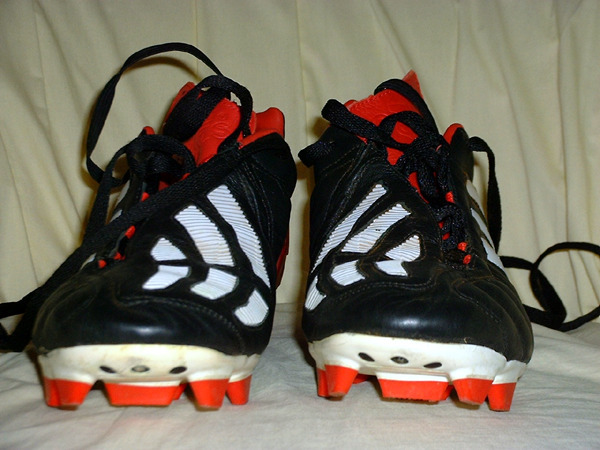
Figure [2]: David Beckham and I wear the same football boots.

Except for our Mexican neighbor, of course, who was watching enthusiastically. And suffered along when Mexico lost to the USA. Mexicans are not highly regarded in the USA, as most have to work in minimum-wage jobs due to a lack of alternatives, and very few manage to escape the vicious cycle.

In California, Mexicans harvest citrus fruits and grapes, cover roofs, and carry out private demolition work, clean cars, mow lawns, and wash dishes in restaurants.

Figure [3]: Union leader Cesar Chavez on a postage stamp

Without Mexicans, the Californian economy would immediately collapse. On Cesar Chavez Street in San Francisco, which ironically bears the name of a man who advocated for fairer wages for low-wage workers, hundreds of Mexicans stand every day waiting for a wealthy homeowner in a pickup truck to drive by and pick up three or four people so they can do jobs for five or six dollars an hour that no one else wants to do. But in soccer, they had been ahead so far -- and then the overlord USA comes and wins, which was bitter and was discussed as such here and in Mexico.

Figure [4]: In California, almost only Mexicans wash cars.

What I actually wanted to say: The Mexicans here are absolutely passionate about soccer and speak very highly of the German team. Our neighbor recently told me that the German superstar goalkeeper Oliver Kahn is called "el gato volador" on the Spanish channel in San Francisco -- the "flying cat," who pounces like a predator and deflects the balls. Recently, the Mexican commentators on TV have not only been extending the word "Gooooool" for 20 seconds (no joke, I timed it), but the latest trend is to chant "Gol Gol Gol Gol Gol Gol," which sounds like an American police siren. By the way, it doesn't matter which team scores the goal, the "goool!" celebration happens in any case.

And in San Francisco, as is well known, there are more foreigners than Americans, and that's why some bars were even open in the early morning hours to give soccer fans the opportunity to watch the games live. However, there was no beer, because there is a ban on alcohol sales between 2 and 6 AM in San Francisco, which is strictly enforced.

Personalized tickets

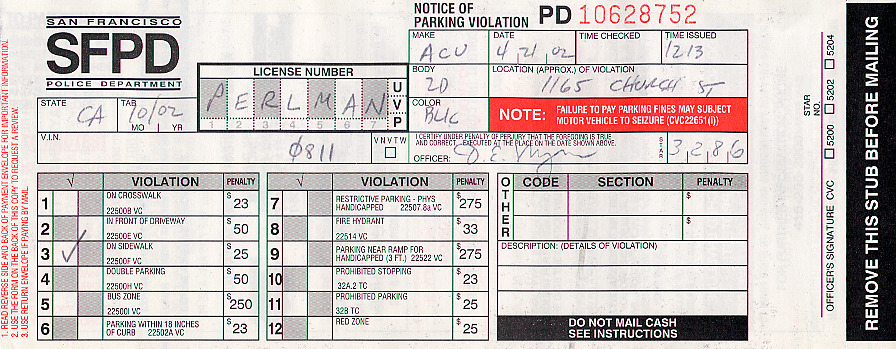
Michael Recently, I thought to myself: It would be nice if we got a parking ticket as a memento of our time in San Francisco, with "PERL MAN" on it -- the personalized police license plate of our car (Rundbrief 03/2000). On Sunday afternoon, it finally happened: I came home from the supermarket and boldly parked the trusty "PERL MAN" on the sidewalk to unload it. Upstairs in the apartment, Angelika signaled to me that she was on the phone with Oldenburg and that we could set off to an outing in two minutes. In high spirits, I turned on the TV. An hour later, it happened, and we had a parking ticket on the car, hooray! At $25, it wasn't exactly cheap, but it's a unique souvenir, as you can see in illustration 5!

Figure [5]: A ticket for PERL MAN

You can also see that it costs $250 if you park at a bus stop or $275 if you park a car without a disabled permit in a disabled parking space -- or come within three feet (about one meter) of a ramp for the disabled! Similarly draconian penalties are imposed for driving in the carpool lane (Rundbrief 07/2001), a fine of $274 is imposed if you are driving by yourself instead of carrying the mandatory passenger. "Parking within 18 inches of curb" costs 23 dollars--I assume this means that you must not park more than 18 inches (45.54 cm) away from the curb. And parking in front of a hydrant costs only the everyday low price of $33--I can afford that, just wait, maybe soon in the newsletter!

By the way, all of the absurd numerical values that every Californian driver must know when applying for a driver's license are listed on a Website by Søren F. Ragsdale: For example, you may only park 7.5 feet away from railroad tracks, 15 feet from a fire hydrant, and 3 feet from a curb ramp.

The Raging PERL MAN

Michael During the week of the American national holiday on July 4th, many companies in Silicon Valley were closed due to the ongoing economic crisis, and the streets were unusually empty. So, one morning, I drove quickly to the office, which is located 60 km south of San Francisco in Mountain View. On Highway 101, as usual in the leftmost of four lanes, just before the Mountain View exit, I suddenly saw a police car appear in the rearview mirror and routinely slowed down to the prescribed 65 miles per hour (about 100 km/h).

After following the "PERL MAN" for a while, who didn't seem to notice and was leisurely drinking his coffee from a commuter mug, the cop suddenly turned on his siren. At first, I assumed he just wanted to pass, so I moved to the next right lane. But he followed, and in the USA, that means: pull over to the right shoulder and prepare to be pulled over. Since routine checks are not allowed in the USA, it generally means you've done something wrong and will have to pay a fine.

So I changed lane by lane to the right, slowed down, and finally stopped on the unpaved shoulder of Highway 101. When the cop got out and approached the car on the passenger side, I rolled down the window and took out my driver's license, insurance certificate, and vehicle registration from my wallet. The cop leaned in through the window and informed me that he had stopped me because someone had called the police station and complained about the "PERL MAN" for "reckless driving." I was unaware of any wrongdoing, insisted that I was driving as fast as usual, and truthfully answered "no" when asked if I had consumed alcohol or taken drugs that morning. Then he wished me "safe holidays," and I was allowed to drive off, which I did, kicking up dust on the shoulder.

That's crazy, just imagine! An obviously mentally challenged person calls the police because they can remember the personalized license plate "PERL MAN," and the police actually find it among tens of thousands of cars on one of the busiest highways in the world! If this happens more often, I might have to give the license plate back and speed around incognito with something like "4-ZAP 437".

The Newsletter Top Product

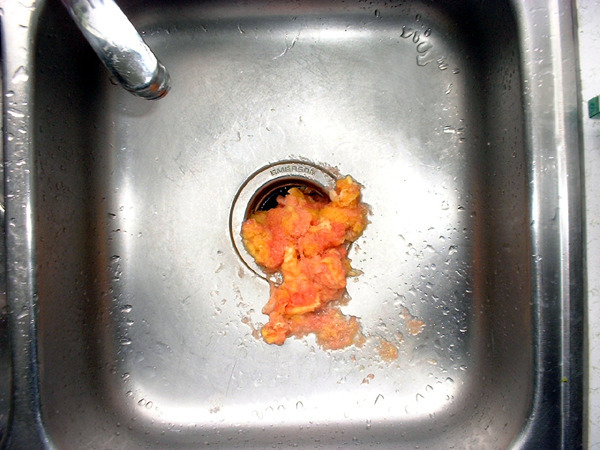
Figure [6]: A little fruit waste from the juicer poured into the sink ...

Michael Today: The Garbage Disposer E20 by Emerson. I have previously written that it is common in American kitchens to have a so-called garbage disposer installed under the sink. Between the drain and the drainpipe, there is a small grinding mechanism that starts at the push of a button and grinds waste that could clog the pipes into pieces small enough to pass through the drainpipe. Whatever you chop up in the kitchen, you simply dump into the sink, turn on the water and the grinding mechanism--and whoosh, it goes down the drain!

Figure [7]: ... naturally clogs the pipe.

Figure 6 shows how I poured fruit waste into the sink, and in Figure 7 you can see the resulting moderate pipe blockage. However, a solid half horsepower in the Emerson engine mercilessly eliminates even stubborn waste (Figure 8). Powerful. Reliable. Emerson.

Figure [8]: At the push of a button, the Emerson E20 clears the pipe again!

Some time ago, I overdid it and dumped too much waste in, and Emerson promptly stopped working. Oh no, I thought, now I have to call the landlord and wait for a garbagge disposer specialist to kindly come by. However, a look under the sink revealed that the Emerson E20 comes with a small Allen wrench, which you just insert at the bottom, turn it around once to manually reduce the waste, and it works again! What a great product!

Figure [9]: This newsletter's top product: The Emerson E20

Figure [10]: The album "Is This It?" by The Strokes

Michael Eagerly anticipated, but recently absent: There just haven't been any compelling new records. But today it happened: I bought the album "This Is It" by "The Strokes," which was released half a year ago! I already knew the song "Last Nite" from the radio, but I had no idea that "Hard to Explain" and "SOMA" were also on it -- for both songs, the best way to listen is on a hot day in San Francisco in an 11-year-old Acura Integra without air conditioning, with the windows rolled down, wearing shorts and barefoot, speeding up the hill trio on Church Street between 17th and 22nd Street. Then it sounds as if the music was invented in California, even though it comes from New York City. Buy it immediately and listen to it nonstop! Until we discuss the new one from the "Red Hot Chili Peppers," my favorite band, in the next newsletter.

The Osbournes on TV

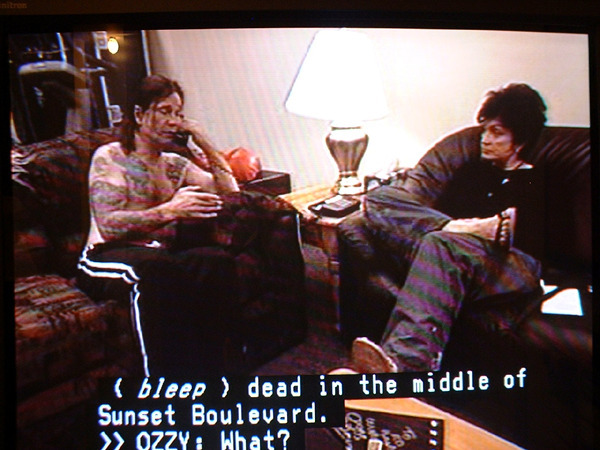
Michael The most popular show on American television at the moment is called "The Osbournes." The TV channel MTV came up with the idea of placing a camera crew in the home of Ozzy Osbourne, the former singer of the band "Black Sabbath," to follow Ozzy, his wife Sharon, and their two rambunctious teenage children every step of the way and capture the everyday life in this unusual household.

Figure [11]: In the living room of the Osbournes

The Osbournes are British, but they live in an ugly mansion for the nouveau riche in the upscale suburb of Beverly Hills in Los Angeles. Ozzy Osbourne is now 53 years old and a total wreck. With "Black Sabbath"--absolute superstars of the hard rock scene in the seventies--it was wild: Ozzy consumed drugs like a centrifugal pump. Today, he shuffles around the house like a zombie, mutters incoherent things, and yells for his wife (Sharon! Shaarooooon!!) when he can't find something, the TV is acting up, or the dog has pooped on the carpet again.

Figure [12]: The luxurious house of the Osbournes

Parents and children constantly use terrible swear words that wouldn't even go unpunished in a ghetto family. However, with the Osbournes, it's completely normal to use the so-called F-word. Because of this, US television stations have to bleep it. (reported previously in Rundbrief 12/2000) Ozzy: "What the --BLEEP-- is that?" Daughter Kelly: "The --BLEEP--ing dog --BLEEP-- on the --BLEEP-ing carpet again!".

Figure [13]: Cursing, Ozzy chases after the cat that has hidden in the bushes.

It gets interesting when the completely tattooed Ozzy presents himself to his offspring as the responsible father and insists, for example, that the children come home from a party at a certain time. Or when he confesses to his lovely wife in a Midlands English working-class dialect: "Sharon, I love you more than life itself...". That's what makes the show so charming.

Figure [14]: The defiant 16-year-old son wants to go to the rave, but he is not allowed to!

MTV produced it with a small budget and did not expect it to be successful at all. However, it was a huge hit and even surpassed the mega-million productions on other channels in the ratings. MTV recently extended the contract with the Osbournes for a second season. The people in charge reported that the negotiations were utterly chaotic, with Ozzy's wife Sharon repeatedly stalling the MTV people and making wild back-and-forth decisions. Ozzy himself only catches half of what's going on anyway and will surely be satisfied with the negotiated fee. You will find more about this unusual family here.

Clear the way for Angelika!

Finally, the Green Card

Angelika Hooray! Hooray! The Green Card is here! Miracles still happen. We are now "Permanent Resident Aliens," as it's called in the finest bureaucratic American English. We still can't believe it. The word "Alien" always amuses us greatly because no one in everyday language refers to a foreigner as an "Alien." That would raise eyebrows and be politically incorrect. The term is "Foreigner." When people hear "Alien" here, they think of extraterrestrials and the movie "ET," but the "INS" (INS = Immigration and Naturalization Services = American immigration authority) doesn't care about that. Oops, I'm digressing.

Some time ago, I announced that I would report on our third and final - extremely nerve-wracking - Green Card step. If anyone would like to read my previous explanations about the Green Card again, they can do so here: Rundbrief 09/2001.

And since I don't want to be difficult, here's a quick summary of steps one and two: We were allowed to apply for the Green Card because Michael's professional qualifications are beneficial to the American economy, as there is (or was) a shortage of American software engineers, which they sought to address with well-educated foreigners--this is known as immigration for employment reasons ("green card through employment").

AOL applied for Michael's Green Card. The first step was to prove to the relevant labor authorities that Michael was not taking a job away from any Americans, meaning that there was indeed a labor shortage in his field. The authorities issued the highly sought-after "Labor Certificate," which is needed to proceed to the second step. By the way, it has become significantly more difficult to obtain a Labor Certificate. Due to the weakened American economy, there have been many layoffs, which have eliminated the shortage, meaning that there are now enough Americans entering the job market.

In the second step, the American immigration authorities checked whether Michael really had the necessary qualifications to fill the position at AOL. The third and final step was to transition from non-immigrant status (people with visa status) to immigrant status (people with green cards). The application is usually submitted to the relevant immigration authority in America and is called "Adjustment of Status." Throughout this process, I once again played the "apron strings card" (original quote from Michael). By this, Michael means that I only got the green card because I am married to him. Family is a big deal in America.

Even at the last step, it was all about filling out form after form. If you woke me from a deep sleep, I could still recite off the top of my head the exact dates of Michael's military service, the companies he has worked for and for how long, including the corresponding company mailing addresses, how long we've lived at each address, and so on. But don't panic, I won't write about every single form required in the third step. I'll just share the milestones with you.

Priority Date

Angelika Before we could even begin the third step, our so-called "Priority Date" had to be current. It's best to think of it like a place in the Green Card queue, similar to taking a number in some grocery store or government office. Since most Green Cards in the various categories are subject to an annual quota, bottlenecks occur when the quota for the respective year is reached - the queue keeps growing. The number of Green Cards issued by the immigration authorities each year is then evenly distributed among the individual countries. For example, people from India usually wait longer because the U.S. receives many applications from Indian citizens - the number of Green Cards available to them each year are logically gone more quickly. If you come from Germany, you are among the lucky ones who can essentially jump right to the counter without waiting, as there are not as many Germans applying for Green Cards.

Medical Examination For the Green Card

Angelika I had already mentioned that the INS (Immigration and Naturalization Service) does not like it when immigrants with contagious diseases like tuberculosis come to America. Therefore, for us, it meant going to the doctor as step number three to rule this out. You can imagine the whole process as being similar to a medical examination by a public health officer. We were not allowed to go to our family doctor; instead, we had to choose one from a list provided by the INS, who could conduct the examination according to INS regulations and also fill out the corresponding form correctly. These doctors do not work exclusively for the immigration authorities; they usually run a regular private practice. However, they don't earn much from these examinations, which is why the list mainly includes "doctors for the poor" from typical immigration countries.

Figure [15]: The medical practice of the Filipino Green Card doctor in the Mission.

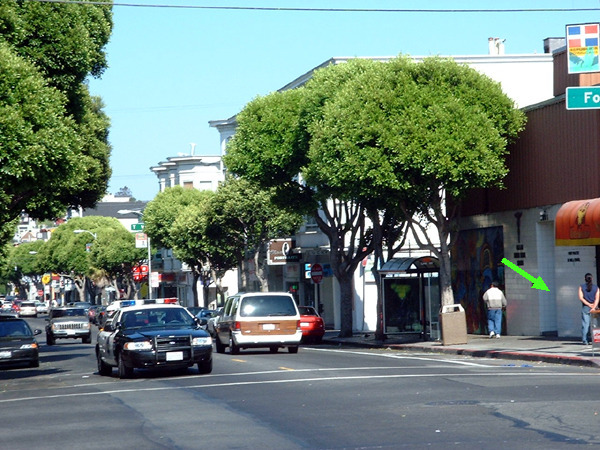
I quickly looked for a doctor in our immediate vicinity and ended up in the heart of the Mission, the Latin American neighborhood that is, as you know, just around the corner from us. We went separately, and each of us told the same story afterward: In the waiting room, no one spoke English except for the receptionist, but the doctor, who was from the Philippines, spoke it quite well and seemed experienced.

He first underwent a very general examination. You know: looking in the throat, listening to the chest, measuring blood pressure, determining height and weight, etc. Then he injected us with the substance for the tuberculosis test and inquired in detail which vaccinations we had received in our childhood and adulthood, as well as which childhood diseases we had gone through. On his list for our age group were: mumps, measles, rubella, tetanus, diphtheria, polio, whooping cough, chickenpox. Oh, how pleased we were that, as an organized person, I could present all the vaccination records (even those from childhood). However, Michael had to bite the bullet: he had skipped rubella as a child and therefore had to get a vaccination. We paid $125 for my examination, and $175 for Michael's due to the additional vaccination.

Figure [16]: Typical: San Francisco's "Mission" Neighborhood

Then it was off to the AIDS test. In the USA, by the way, the doctor sends you to special labs for blood tests. It's a bit inconvenient, but the people there are blood-drawing professionals since they do nothing else all day long. Our doctor sent us to a branch of St. Luke's Hospital right on Mission Street. When I arrived there, I initially thought something was off. I had to pass by shop windows that, in typical Mission tradition, advertised cheap, colorful goods with a South American flair, walk down a dark hallway, and finally stood in front of an office door. It didn't look like a lab at all. However, the sign on the door indicated that I was in the right place. Bravely, I entered and found myself in a tiny room containing a desk, a table with blood-drawing equipment, a chair, and a person in a white coat. The first thought that crossed my mind was: Oh dear, I hope they work diligently here and I don't catch anything (Michael had the same concerns). Don't think we're arrogant, but the American healthcare system is really in such a bad state, you have no idea what I've experienced, but maybe more on that some other time.

Figure [17]: The blood test lab in the Mission

Before the medical assistant started drawing blood, I signed a form stating that I understood it was for an HIV test. By the way, everyone signs this, not just Green Card applicants. In general, it's questionable to undergo such a potentially life-changing test just because it's required for the Green Card. Just imagine the scenario of testing positive for HIV. Of course, we also had to pay in advance. The whole thing cost $126.90 per person, with $77 of that amount being for the HIV test alone. The rest was for the test that detects syphilis and some other unclear items. In typical American fashion, there was a discount if we paid in cash or by check, a hefty 40%. Naturally, we did that. "HIV test on sale!"

Figure [18]: San Francisco's "Mission" neighborhood.

A few days later, we set off again to see the doctor so he could tell us the results of our tuberculosis skin test. Naturally, we were also interested in the results of the blood test. When we arrived at the doctor's office, I asked the receptionist about the results. She rummaged through our file and cheerfully said that they hadn't received anything in writing yet, but she would call St. Luke's Hospital to inquire about the results. She then made a phone call. I turned a bit pale when she put the call on speakerphone, we were located at a waiting room filled with patients. However, she reconsidered and turned off the speaker when someone answered on the other end. Unfortunately, it took forever for the person to find the results, and I felt a chill run down my spine--you never know.

Finally, the receptionist ended the call but didn't bother to tell me the results. I shyly asked, and she shrugged nonchalantly, saying everything was okay. Unbelievable! The rest was quick and painless: the doctor read the TB test and filled out the form for the immigration office with shaky hands, with the receptionist occasionally correcting him. We still wonder today if everything was handled correctly.

We had already read one or two horror stories on the internet about how the immigration office, upon later reviewing the form, had vetoed such reports as being submitted incorrectly, which as a Green Card applicant this means you'd have to repeat the medical examination, but also that the process was further prolonged. What happens is that the results form is placed in an envelope, and the doctor seals the envelope with a stamp. Only the honorable immigration office is allowed to open the envelope later.

By the way, not every detection of an illness leads to the Green Card applicant being disqualified. If it is a curable disease, it must be proven that the person is healthy again, which, however, means: paperwork, paperwork, paperwork.

Passport Photos

Angelika No green card application goes without photographs. And the green card photos are subject to the strict regulations of the immigration authority. The lawyer gave us a typewritten DIN A4 information sheet with instructions, along with a list of photo studios that are familiar with the regulations and have experience in implementing them. Here are some excerpts from the information sheet, for your amusement: Glasses, earrings, and hair clips are not allowed. The photo should be 30 mm (1 3/16 inches) long--from the hair to below the chin--and 26 mm (1 inch) wide--from the right ear to the left cheek. The background must be white. The photo must not have shadows or be retouched. Polaroid film #5 is acceptable, but SX-70 film is not. The photo must show the entire face of the person (3/4 pose). The right ear and left eye must be visible.

Affidavit of Support

Angelika And no immigrant should evolve into a burden on the American state: the "Affidavit of Support" (which can best be translated as "sworn declaration of financial support") is one of my favorite forms in our Green Card process. You may recall: I received the Green Card because I am married to Michael. Michael not only had to assure that he could support me so that I would not be a burden on the American social system, but also that he had sufficient financial means to support both of us: a highly official matter with a sworn notary.

In the third step of the Green Card process, there is also the opportunity to apply for a provisional work permit ("Employment Authorization Document") until the actual Green Card application is approved. This is because the third step typically takes a very long time, and for many applicants, the time comes when their visa and the associated work permits expire before the Green Card gets approved. This EAD card allows one to work temporarily as if they had a Green Card. The only catch is that if you use the work permit, you lose your H-1B visa status even if the visa is still valid. Therefore, we applied for the provisional work permit (for emergencies) but did not use it.

If you are in the process of "Adjustment of Status," meaning you're going from a visa holder status to a Green Card holder status, you are not allowed to leave the USA without special permission from the immigration authorities. This also applies to travels to Canada and Mexico. Therefore, it is better to apply for what is known as "Advance Parole." This can best be translated as provisional release. It is a travel document that you need to re-enter the country after traveling abroad. By the way, in America, the term "parole" is also used to refer to when a prisoner is released on probation from prison. H and L visa holders fall under an excemption. As long as the visas are still valid, entry and exit are permitted while holding them.

Not only did the immigration authority burden us with forms, but the tax authority (called the "Internal Revenue Service" in America, abbreviated as "IRS)" also insisted on participating in our Green Card process. The tax authority checks whether we dutifully paid our taxes in America and if we submitted our tax return on time. To do this, we answered questions on the "IRS Form 9003." The immigration authority then forwarded the information we provided to the IRS.

Finger Prints

Angelika Before one receives the Green Card, the American immigration authority wants to ensure that the applicant has not committed any crimes or is listed as a wanted terrorist. Just as one applies for a certificate of conduct in Germany, fingerprints are taken in America. For the Green Card, the FBI uses fingerprints to check whether one has been and is a law-abiding citizen. In practice, it works as follows: After our lawyer sent the required documents (and a few more) to the Immigration Office, we patiently waited for the confirmation of receipt. However, we had to bite the bullet again, as countless applications flooded the responsible immigration authority in California, causing week-long delays in opening the incoming mail and thus also adding delays to sending out the confirmation of receipt.

Just so you believe me: Our documents for the third step were received by the immigration authority on July 23, 2001, and the confirmation of receipt was sent out by the authority on September 6, 2001. Weeks later, we received a letter with the appointment date (November 30, 2001) for taking our fingerprints. Everyone eagerly is awaiting this letter because it indicates that one's file is not gathering dust in a large pile and that something is happening. By the way, the FBI does not take the fingerprints directly; instead, the immigration authority sends the applicants to a designated third party processing center. The fingerprinting is done digitally: no annoying ink on the fingers. The fingerprints appear immediately on the screen and are promptly sent to the FBI. The FBI works quite efficiently in this regard and sends the results back to the immigration authority relatively quickly.

After the fingerprint procedure, it's back to waiting. The immigration office is sometimes not technically stuck in the Stone Age, as there is the possibility to call and check on the progress of your case. To do this, you dial into an automated system, listen to announcements for several minutes, and eventually enter your case number to finally hear a computer-generated voice. In January 2002, we heard the voice saying that the results of our fingerprint check were available to the immigration office and that our case was being processed further. The system sounds brilliant, doesn't it? However, there's a catch: firstly, the phone lines ares busy all the time (you can usually get through well at 2 a.m.), and the announcement is not always up to date. At some point, we've had long received our Green Card approval by mail, yet the phone announcement was still stuck at the fingerprint stage.

Processing Fee and Passport Stamp

Angelika Anyone who thinks that the immigration office immediately sent us the actual Green Card is greatly mistaken. That would be far too easy. First, a letter arrived at our home, stating that the application had been approved. In April 2002, our mail carrier delighted us with the aforementioned notice. Along with the joyful news, the letter instructed us to appear at the immigration office in San Francisco with two brand-new passport photos, our current passports, etc. The intent was to receive a stamp into our passports, which served as a temporary Green Card, and entitled us to work and travel.

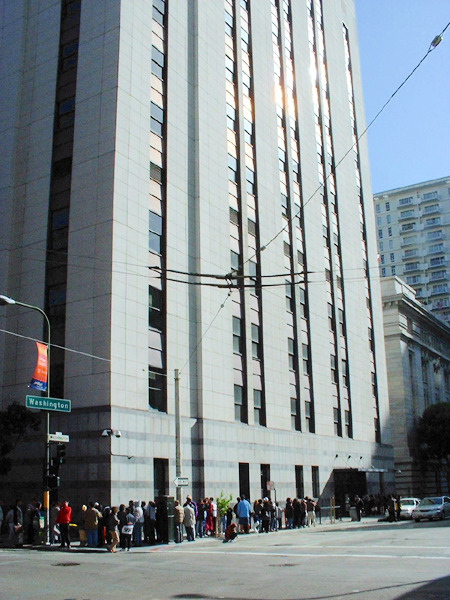
On a Tuesday in April, we set out early in the morning, armed with thick jackets, all necessary documents, and reading material, to join the line at the immigration office in San Francisco. We had already heard that there are two lines in San Francisco: one for people with an appointment (e.g., for an interview) and the other for the unfortunate souls without one (which is notoriously long). Unfortunately, there was some confusion about which line we should join. The immigration office is located in San Francisco's "Financial District," specifically at the corner of Sansome and Washington Street--a huge building. To be seen early, we arrive at the INS building at 6:10 AM. The line for those without an appointment already winds around the block. No one is standing at the other entrance, where people with appointments are processed. Dutifully, we join the line behind about 80 people, grateful for our warm jackets as the wind is blowing quite briskly around the corner. Naturally, we immediately start asking the people standing in front of and behind us in line. In front of us is a married couple. He is American, and she is a foreigner in the process of obtaining a green card through marriage. They seem like pros to us, as this is not their first time in line. They assure us that we are in the right line. Behind us is a software engineer from India, who, like Michael, received the green card through an American employer, so he is in the same boat as we are. He is just as uncertain as we are about the line issue.

Figure [19]: The line at the INS building in San Francisco

After 10 minutes, I decide to wander over to the other entrance, hoping to find someone competent who can solve the line puzzle for us, even though the doors for the general public are still closed (Did I mention that there are no signs anywhere providing guidance?). I encounter security personnel standing at the entrance. Patiently, I explain that the immigration office has approved our I-485 (people always throw around form abbreviations; it makes it seem like you know what you're talking about) and that we are here to get our stamp in our passport. Prompt response: "Do you have an appointment?" Somewhat desperate reply: "No, not really," because the letter we are holding does not specify a concrete date or time for our appearance. Expected response: "Then you have to line up with everyone else!" And just like that, I'm back in line next to Michael, which is steadily growing. While we wait patiently, I wonder why no one has thought of selling coffee and bagels (something like a roll with a hole) to those waiting. A real market gap. Behind our Indian fellow stands another Indian compatriot with his family and child--everyone must appear in person at the INS. Once again, the line problem arises, someone else wanders to the other entrance, asks the questions I had already asked, and returns with the same answer. Slowly, our skepticism fades, and we begin to believe that we are indeed in the right line.

At 6:45 AM, the crowd of people starts to stir. The doors open. About 10 people are allowed into the building at a time. Everyone must show identification, bags are scanned, and you go through the metal detector. The line moves at a snail's pace because there is only one metal detector and one scanning machine. Hooray, at 7:30 AM, we enter the hallowed halls. The security personnel confiscate Michael's digital camera (don't worry, he got it back when we left the building), and we navigate through a maze of barriers, eventually reaching three counters. We hand our papers to the man behind the counter. He initially looks a bit confused but then wants to direct us to the next counter, where there apparently are waiting numbers. Suddenly, another INS officer (apparently a supervisor) next to him intervenes and informs him that we could go directly to office 200-B, as our positive notice is equivalent to an appointment. You can guess what that means: we had been standing in the wrong line. After a few quiet sighs, we make our way through the maze of corridors and stand in front of office door 200-B. It is now 7:50 AM. A sign on the office door instructs us to drop the letter indicating our appointment through the designated slot in the door. The only problem: we don't have a set appointment. By now, many people are sitting in the waiting area--some with appointments, some without--and the discussion begins about what those without a fixed appointment should drop in the slot, because how else will the responsible officers know that we are waiting outside the door? The only option is to drop the original (!) of the positive notice we are holding. However, many are distressed about this because the notice is the only proof that the immigration office approved the Green Card application. Naturally, Michael makes silly jokes about a shredder being behind the slot, destroying all the papers.

Shortly before 8 o'clock, a female officer slips out of one of the back doors, and although there are signs everywhere with the inscription "NO QUESTIONS, NO INFORMATION," I bravely approach her to find out what we are supposed to drop into the slot. At first, she remains silent, but after I look at her desperately, she shows her generous side -- the official notice is to be dropped in. At 8 o'clock, the office door opens, and INS officers call the first people in for interviews, just like in the movie "Green Card." Those waiting not only have family photo albums ready to prove, for example, that the marriage to an American citizen truly exists, but they also usually have a lawyer in tow. If you apply for a Green Card with the help of an employer, the interview is generally waived, as was the case with us.

At 8:05, another officer directs all individuals who already have a positive Green Card notice (including us) to the waiting area of another counter and begins his work. At 8:30, he calls us up. We hand over our passports and photos, a fingerprint from a single finger is taken twice (this time with ink), and we sign a designated form twice. The fingerprint, signature, and photo will later appear on the actual Green Card. The officer also confirms our address, to which the Green Card should be sent, and then we take a seat in the waiting area again. By the way, it's better not to move between residences until the Green Card arrives in the mailbox, as the postal service is not allowed to forward Green Cards to a different address. Although there is an option to notify the immigration authorities of an address change, based on our experiences, we wouldn't dream of taking that risk--who knows where the notifications might end up at.

At 9:30 AM, another officer calls us. She holds our passports in her hands, shows us the stamp that serves as a temporary Green Card and is valid for one year (with the possibility of extension after the year expires). She also informs us that the actual Green Card will arrive in six to twelve months. Michael later claims that the red stamp looks like a potato print, which is true. Our names are handwritten under the stamp, which is a bit disappointing after all the waiting. At 9:40 AM, we leave the building beaming with joy and go for a royal breakfast to celebrate the day before Michael heads to the office.

In the Same Line With Americans

Angelika We tested our coveted stamp for the first time when we re-entered the USA coming from Japan. At the immigration checkpoint at the airport, there are usually two lines: one for American citizens and Green Card holders, and the other for visa holders and tourists, meaning one short and one very long line. This time, we lined up with the Americans and breezed through immigration. Michael initially doubted our "potato print stamp," but everything went smoothly. The immigration officer just grumbled about where we got the stamp. We dutifully replied, "From San Francisco!" And I held back my comment that it was obvious from the stamp itself, as Michael had strictly instructed me not to start arguing.

All's Well That Ends Well

Angelika And, on July 8th, the moment had finally arrived: Lost in thought, I opened our mailbox and two letters from the immigration office greeted me. I already suspected it: The arduous journey of the Green Card process had finally come to an end. And indeed, I opened the envelope and found our brand-new Green Card plastic cards. Hooray! By the way, they are sent via regular mail and not by registered mail.

Hard to believe that we already started the formalities for the Green Card application in July 1999! The process was finally completed in July 2002. Currently, you have to expect it to take three years, which is quite average. However, there is a fear that wait times will be increasing again, because the files are piling up at the immigration office due to the tightened security measures after September 11th. In any case, we are very relieved that the paperwork madness is now over and we can hang around in California a bit, freely and casually. Stay tuned!

Michael und Angelika

RSS Feed
Mailing Liste
Impressum
Mike Schilli Monologues


Get announcements for new editions

New editions of this publication appear in somewhat random intervals. To receive a brief note when they're available in your mailbox (about once every two months on average), you can register your email on the 'usarundbrief' Google Groups list.

Your email address


All Editions:


Send us a comment
We'd like to hear from you, please send us feedback if you want to comment on the content or have suggestions for future topics.

Simply write your your message into the text box below. If you'd like a response from us, please also leave your email. If you want to stay anonymous, simply put 'anonymous' into the email field. This way we'll get the message, but we have no way to respond to you.

Your email address


Message

 
Contact the authors
Latest update: 29-Sep-2025