![]() |
| Angelika/Mike Schilli |
|
|
Angelika Why does every random actor in America believe that the Hollywood experience qualifies them to hold political office? This question has been bothering me since muscle man and film star Arnold Schwarzenegger entered the race for the position of Governor of California.
Yesterday, on October 7th, the decision was made that California voters bid farewell to the incumbent Governor Gray Davis in the recall election and instead allowed "Arnie" to take the reins. It is hard to believe: The world's fifth-largest economy and the most populous state in the USA is now being led by a politically inexperienced Hollywood star with an Austrian accent.
Has the abundant sunshine gone to Californians' heads? Much of it has to do with how election campaigns are conducted in America. There is hardly any detailed information about political programs of individual candidates. Instead, short campaign ads from the leading contestants are constantly being aired on television. However, these ads offer little more than platitudes. Arnold's statement was simple: "Politicians have let us down."
Cruz Bustamante, the only Democratic candidate and a Latino, who is therefore more popular among the Spanish-speaking population, sat in front of the camera with a tense smile, accompanied by his family. He also had a hard time getting his campaign slogan across, as he wanted voters to vote against the recall of Gray Davis and, in the second step, for him, to ensure that California would not fall into the hands of a Republican governor. I mentioned the peculiar election procedure in the last newsletter (0). Eligible Voters could pick a candidate, even if they had expressed opposition to Davis's resignation in the first step of the election process.
In the television nation of America, by the way, there are hardly any election posters, like the ones known in Germany. Not a single one could be seen in all of San Francisco. However, there was the obligatory televised debate with the main candidates, where political concepts were actually being discussed. In California, everyone was eagerly awaiting this debate because voters especially wanted to see how Arnold would perform without delivering rehearsed lines. Unfortunately, the debate format was disappointing. The discussion topics were announced in advance, which is unusual, allowing the candidates to prepare, and participants were allowed to interrupt each other. Many were annoyed that the organizers had not invited incumbent Governor Gray Davis. Only candidates who had approval ratings of at least 10 percent in the polls (a total of five) were on the guest list, and Gray Davis was excluded.
In such debates, it is not only important what an individual is saying, but also how they present themselves. You have to give Schwarzenegger credit for that: he has learned how to market himself and he also has the necessary funds to do so. Naturally, it worked to his advantage that, among 135 candidates, he was a familiar face, event to those who are not particularly politically savvy, and the press pounced on him like vultures.
In American election campaigns, it is generally true that those who do not present themselves effectively in the media have no chance of winning. Arnold understands this better than anyone. Initially, he kept a low profile and did not reveal whether he would even run, only to then announce his intention to become the next governor of California with great fanfare on Jay Leno's talk show (a format similar to Harald Schmidt's show in Germany).
To improve his poor image regarding the treatment of women--after all, he is considered a womanizer and a "breast groper"--he and his wife Maria Shriver moved in with the black talk show host Oprah Winfrey and presented himself as a caring father of four children as well as a loving and attentive husband. This appearance certainly earned him many female votes, as the "Oprah" show not only achieves fantastic ratings but is also regarded by many women as the holy scripture.
This PR stunt was marred by the fact that just a few days before the election, the Los Angeles Times published the stories of six women who confirmed that Schwarzenegger had groped them, after which Arnie apologized contritely for his past boorish behavior on camera.
The New York Times took it a step further and quoted some foolish remarks by Schwarzenegger: In the seventies, he had expressed admiration for Hitler's rise and his oratory skills on several occasions. Being portrayed as a harasser of women and as a Nazi -- that doesn't go over well in America. However, voters here also know that airing dirty laundry is part of every American election campaign.
Additionally, Americans love all kinds of conspiracy theories. So, right after the article was published in the Los Angeles Times, it was suspected that only a political opponent could be behind this story, trying to bring the "Terminator" to his knees just before October 7th, because he was leading in the polls. But let's forget these soap opera dramas for a moment and focus on the political aspect: Arnold Schwarzenegger belongs to the moderate wing of the Republican Party (Please do not confuse with the German Republican Party). He supports existing abortion rights, known in America as "Pro Choice," to distinguish himself from the anti-abortion movement "Pro Life."
He is in favor of gun control and advocates for the rights of homosexuals. These are all issues supported by the vast majority of California's population. With this more liberal mindset, he certainly appeals to Democratic voters. On the other hand, he argues that Californians are being overtaxed and vows not to fill the California budget deficit by raising taxes, which seems almost impossible considering the size of the gap.
Environmentalists and pacifists hate that he drives a so-called "Hummer," a military jeep modified for regular road use (just like the former soccer player Stefan Effenberg).
Immigrants, of whom there are quite a few in California with American citizenship and thus the right to vote, like that Schwarzenegger embodies the American Dream like no other: A nobody from Austria not only made a name for himself as a bodybuilder but also became a famous movie star, despite his terrible accent, raking in millions in the process. And to top it all off, he is married into the Kennedy clan, probably the most well-known family in America.
Unfortunately, our previous governor Gray Davis made the faux pas of joking about Arnold's accent by remarking that no one should become governor who cannot pronounce the word "California" correctly. He seemed to have temporarily forgotten that he is leading a state with a high percentage of residents who do not speak English as their first language. But Schwarzenegger also ruffled some feathers, especially with Mexican immigrants. He criticized a new California law that Gray Davis had just signed, which allows illegal immigrants to obtain a California driver's license.
The entire "recall" process that led to this special election can be characterized as something typically Californian, although this political mechanism is also permitted in other states. California likes to present itself as radically democratic, following the motto: The people decide. And what could be more democratic than voting out a politician who is not doing his job properly?
The whole thing is somewhat short-sighted. If a politician is always acting out of fear that a recall process is looming, all progress eventually comes to a halt. Already, there are threats circulating that the next "recall" is in turn targeting Arnold Schwarzenegger.
Political events in California are also hindered by a provision in the Californian constitution that you in Germany have probably never heard of. Voters can directly pass or repeal laws through a popular initiative (called an "initiative") or a referendum (called a "referendum"). As a result, there are constantly various initiatives here that are poorly thought out and hardly financially viable -- moreover, they often contradict each other.
One of the most famous referendums, the so-called Proposition 13, was passed by voters in 1978 with the aim of keeping the "Property Tax" (comparable to the property tax in Germany) low: Since then, the "Property Tax Rate" has been limited to 1 percent of the assessed property value with very limited yearly increases except if the property's ownership changes. You might say: a dream for every homeowner. However, it must be noted that the rapid deterioration of California's public schools is attributed to Proposition 13, as local schools are largely funded by the property tax. And so the circle closes: Because California's budget has become more dependent on the revenues from California's income tax due to Proposition 13, the general deterioration of the American economic situation and the bursting of the dot-com bubble hit California particularly hard. Company closures, layoffs, and the lack of tax revenue from sold employee stock options caused the budget deficit to grow significantly, which was one of the main arguments for the recall.
But back to Arnold: I'm just glad that the man can't become President, because the American Constitution states that one must be born in America to qualify. However, for some time now, there have been efforts by some politicians to amend the Constitution in this regard. The following proposal by Republican Senator Orrin Hatch from Utah, allegedly a friend of Schwarzenegger's, is currently circulating: An American citizen who has held American citizenship for 20 years should be allowed to run for the presidency. And guess when Arnold Schwarzenegger exchanged his Austrian passport for an American one. 20 years ago! What a coincidence!
But back to Hawaii: This time we decided to explore urban Hawaii. After all, we're not getting any younger and need to scout out potential retirement homes. As seasoned travelers, we no longer stay in hotels in Hawaii; instead, we always rent small houses from private individuals.
We also explored the less attractive sides of Hawaii: The main island of Oahu, with the capital Honolulu, already shows some significant architectural sins. Honolulu always reminds me of San Jose, a typical American city, built up in the 50s and 60s without any historical context. As a result, an entire city can quickly end up looking like Landsbergerstraße in Munich.
However, if you head out to the east or up to the north coast, the concrete jungle disappears, and you're back in surfer's paradise. You hang out on beaches where mainly locals and surfers from all over the world who have retired from working life hang out. It's quite fascinating: on one hand, having a hut on the beach, and on the other, having a huge supermarket like "Costco" within reach, where you can buy a pack of 20 shrimp for 8 dollars, which you can quickly throw on the gas grill, naturally set up in front of the hut, and devour in no time. Oh yeah.
Michael To recommend this album, I waited a few months at first, because sometimes I end up liking something that later becomes embarrassingly cringeworthy. But after thorough consideration, I'm letting it out: "So Long, Astoria" by "The Ataris." A bunch of 18-year-old guys playing exactly how you'd expect 18-year-old guys to play, a kind of slightly serious fun-punk. Of course, I can't go to the concert; I'd be kicked out immediately as the old guy. I may quote: "Being grown up isn't half as fun as growing up." Ah, youth! (No, I'm not having a midlife crisis).
Michael When I was a little boy, it was incredibly difficult, if not impossible, to get answers to simple questions. I had a 24-volume encyclopedia from some book club that explained the most important words and contained interesting discussions on historical events, but my questions were different: "What is the name of the song currently playing on the radio?" "Why is the sky blue?" "Why does the stack on the HP-41CV have no more than four registers?" No one knew the answers to these questions.
With the internet, now suddenly everything is available. Because there's always someone somewhere who knows exactly what you're looking for. However, the internet is typically American: a bunch of chaos and half of it isn't true. But Google outsmarts this by using clever algorithms to prioritize information that more people find useful.
This is how the internet solves problems today that were difficult to solve in the past: A provider that cheats its customers will be exposed and done for within days. Well-informed consumers quickly put an end to shady providers. Or take eBay, for example: This system of mutual self-regulation actually makes it possible to conduct business by mail with people you've never seen in your life and probably never will meet.
Or when I recently watched the excellent film "Crouching Tiger, Hidden Dragon," and I wondered if I had already seen the actress Zhang Ziyi, who is starring in it, in the Jackie Chan kung fu movie "Rush Hour 2." In the past, no one could have researched such questions. Today, it takes 20 seconds. The answer is: Yes!
And often it happens that I don't understand the lyrics of a song. What an effort that used to be! I can still clearly remember the hours spent rewinding and fast-forwarding to catch even the last scrap of content. Nowadays, that's no longer a problem: You simply enter the snippets of sentences you understand into the search field of "google.com," and the search engine immediately provides dozens of references to websites where diligent helpers have accurately typed out those exact lyrics. Recently, I was puzzled by the word "Shucklak" in the song "Mic Check" by "Rage Against The Machine." No problem: On the Internet I found the exact lyrics to the song and also an explanation of the unusual word: That is the sound a gun makes when being cocked.
And just as we contribute to this revolution with our newsletters and proclaim the unvarnished truth about America, hundreds of thousands of others do the same in their fields of expertise. Who would want to live in another time!An Ode to the Internet
Many people are happy to acknowledge this and seek professional advice on taste--preferably for free in so-called "makeover" TV shows. There are now about a dozen of these, and the pattern goes like this: Friends report fashion-challenged individuals or owners of sloppily furnished apartments to the TV show crew. The show then sends a team of interior designers, craftsmen, hairdressers, beauticians, fashion experts, dance instructors, or cooking specialists to the location to transform everything and then broadcast it in detail with a before-and-after effect on television.
In "While You Were Out," the victim is lured out of their home for a while under some pretext, only to return and find it wonderfully renovated. In "Trading Spaces" (a show that, amusingly, originally came from Great Britain, where a similar lack of taste prevails), two neighbors swap homes for 48 hours and, with the help of designers and a lot of personal effort, transform the rooms into fancy lofts. From my personal statistics, I can tell you that 95% of all successfully treated individuals exclaim "Oh my Gosh!" when they see the changes. In almost all cases, they jump for joy, and only very rarely are there long faces because the designer went a bit overboard.
Currently, one new show is breaking all records: "Queer Eye for the Straight Guy." Instead of translating it literally, I'll tell you what it's about: A quintet of trendy, young, gay city men, known as the "Fab 5," act as a mobile task force for all sorts of problem cases. Most often, these are bachelors living in completely rundown apartments with crusty bathtubs, eating pizza and drinking canned beer, wearing jeans and flannel shirts, and holding lifelong non-dancer passes.
Since gay men often engage more with matters of taste, fashion, style, art, and personal grooming than their heterosexual counterparts, this is usually a great success. The quintet then extensively shows the "slob" how to behave at the table, for example, how to eat a lobster, take a date to the disco, and then invite them to the newly renovated apartment. There are no taboos: hairy fellows might be taken to the beauty salon to have their back hair waxed or use the brand-new Norelco nose hair trimmer to tackle the "nose hair" situation.
In doing so, the "Fab 5" deliberately play with gay stereotypes, especially the fashion expert sometimes behaves in a really flamboyant manner. But it's clear that this is not meant seriously; rather, it mostly serves to tease out any small homophobic tendencies in the "Straight Guy" and to embarrass him. The show is also very well received in gay circles; all our friends are enthusiastic "Fab 5" fans. And even conservative America outside of San Francisco seems to like the show.
After the work is done, the Fab Five always sit together in style with a glass of wine and watch live on TV as their new protegé gets ready for a nice evening out with his girlfriend, who, of course, is almost beside herself with joy over the modernized apartment when they return home. Naturally, the five also gossip extensively and roll their eyes when someone doesn't apply the suggested hair gel correctly, tears apart the lobster with their hands, or quickly stuffs clothes lying around the freshly tidied apartment under the bed instead of in the closet.
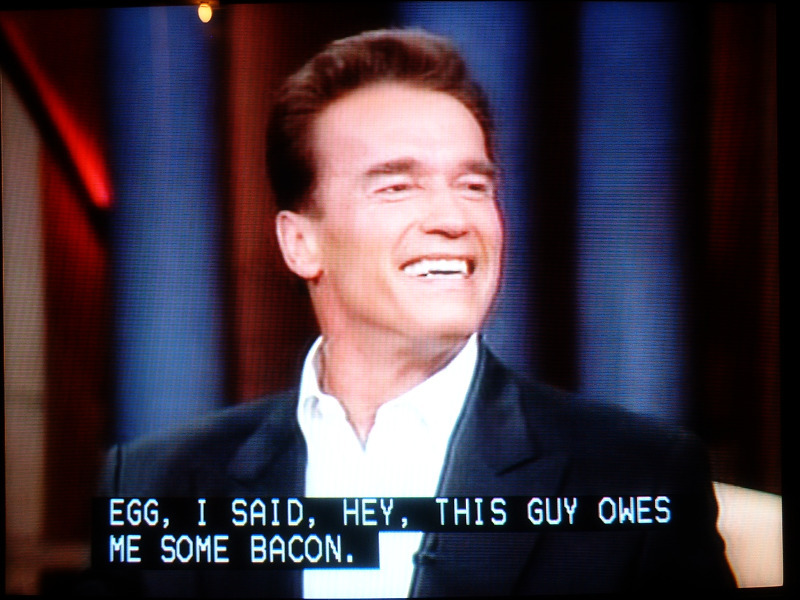
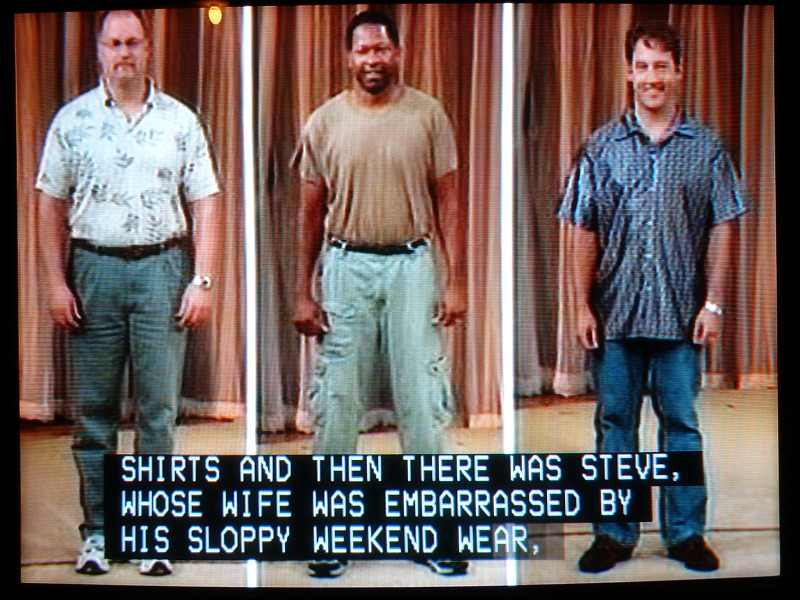
The captured TV images in this newsletter show the "Fab 5" only on Oprah Winfrey, who invited the guys to her mega-show because of their groundbreaking success. That's because the show "Queer Eye for the Straight Guy" is airing on a cable channel that I recently canceled due to a fee increase. Surely, someone will soon call us at home to offer it to us again at a special price -- but until then, we have to do without.
Angelika In the last newsletter, I covered the American school system up to the high school graduation. After that, many people go on to attend an American university or college. In Germany, I often hear the question about the difference between a university and a college. In the USA, the term "college" is commonly used as a general term for both. A "college" in the classical sense takes four years and leads to a "Bachelor's" degree. At universities, various departments are often referred to as colleges, and you typically find a medical school and research departments. Furthermore, the university offers extended programs after the student has obtained a "Bachelor's Degree", in order to pursue a higher academic degree, the so-called "Master's Degree" or, for those eager to learn more, a doctorate.
According to statistics from the U.S. Bureau of Labor, 65 percent of American students with a high school diploma attended college in 2002. This percentage might seem a bit high to you, but you must consider that America does not have a tripartite school system like Germany. While high school graduates in Germany enroll directly in a specific subject at the university, the first two years at a four-year American college typically serve as general education, including humanities, natural and social sciences, arts, languages, and mathematics. After completing the general education requirements, the student then focuses their studies on one or two subjects ("majors"). Depending on the chosen major, they are awarded a "Bachelor of Arts" (B.A.) or a "Bachelor of Science" (B.S.) after an additional two years.
The "Bachelor of Business Administration" (B.B.A. = Bachelor of Economic Sciences) is also common. The four-year college can perhaps best be described as a combination of the German Abitur and the preliminary diploma. Many college graduates initially dive into the workforce once they have their "Bachelor" in hand and return to university at a later point for two to three years to earn a "Master's Degree." In America, we also often encounter people working in a profession that has little to do with their original "Bachelor's Degree." Changing one's profession or career goal is not considered a stigma in America.
In addition to the "Bachelor's Degree," there is another lower academic degree known as the "Associate Degree," which students receive after two years at a "Junior College" or "Community College," among others. These institutions offer the general education courses of the first two years of four-year college programs and often additionally focus on specialized vocational areas such as nursing, business, or technology. If one wishes to transfer to a four-year college later, this is generally not a problem, as the qualifications obtained previously are recognized.
Many students choose community college because of the more affordable tuition fees, which are often astronomically high in America for private universities. City College of San Francisco, for example, a community college that offers countless educational programs for further education, personal development (similar to the German Volkshochschulen), and the acquisition of various degrees, charges only $18 per unit for California residents (a California resident is someone who has lived in California for more than a year).
Most courses consist of three units per semester. So that amounts to 54 dollars for one course. If a student, for example, takes five such courses, they pay 270 dollars for the respective semester. Since many community college students are working part time, they do not enroll as full-time students. Many use community college as a second educational path. Perhaps you remember that I also diligently went to City College during the first months of our stay in San Francisco to study English as a second language.
For certain professional fields, including medicine, dentistry, pharmacy, law, and theology, students must first obtain a "Bachelor's Degree" in the USA before enrolling in an advanced study program to earn a "Master's Degree" (equivalent to a Magister in Germany). Dentists spend an additional four years in school after their "Bachelor's Degree," while lawyers spend at least three years. Becoming a doctor is also a lengthy process in the USA: after the "Bachelor's," there are four years of study, followed by a one-year clinical internship, which is then followed by specialist training (residency) that can last from one to eight years, depending on the specialty. American student life often takes place on the "campus." While in Germany university buildings of various faculties are often spread throughout the city, in America everything is typically centrally located in one place: lecture halls, research facilities, student dormitories, library and student bookstore, sports and recreational facilities, student organizations, and the cafeteria.
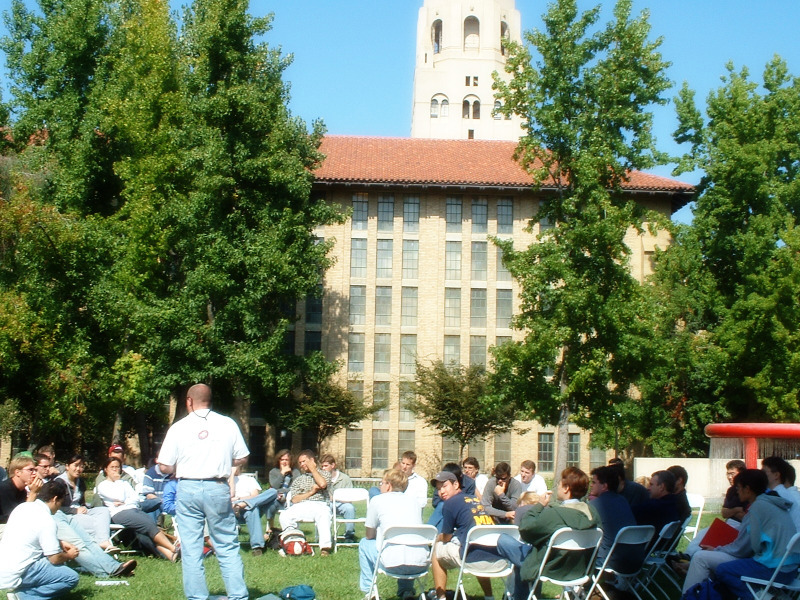
The campus of the prestigious private Stanford University in Palo Alto--about a 45-minute drive from San Francisco--feels like its own little town. Many students live on campus in dormitories ("dorms") because, due to the high tuition fees, they can hardly afford anything else.
You are probably familiar with the situation from American TV shows: a dormitory room is often shared by two or three students. How anyone is supposed to get any studying done in such a setting is beyond me. Single rooms are usually only available for students in higher semesters. It is considered normal to go into debt for one's studies. At an elite university, that can quickly add up to $100,000 or more.
Every state and some larger American cities have their own public universities. In California, this is the "University of California," with the world-famous "University of California, Berkeley" located right in our backyard across the Bay. Colleges or universities, whether public or private, charge tuition fees in the USA. Public institutions, like the University of California, are often more affordable--at least for students who are considered residents of the respective state. The funding for these institutions relies more heavily on public funds. Currently (as of 2003), the University of California, Berkeley charges $2,135 per semester in pure tuition fees for California residents (one-year rule, see above), but a hefty $9,240 for non-residents.
In comparison, the private elite university Stanford charges $9,520 per semester for programs leading to a "Bachelor's Degree." Medical students, however, pay $11,572. As mentioned, I am only talking about tuition fees here, meaning what the student pays for their courses. The total does not include costs for a room, books, health insurance, which is mandatory at many universities, or various other fees (e.g., for enrollment). Incidentally, the "University of California, Berkeley" has just increased its fees by a modest 30% (already reflected in the number given above) because public subsidies were drastically cut due to California's budget crisis.
To finance the exorbitantly expensive education after high school, American students have the following options: 1) They have extremely wealthy parents who are not hesitant to spend money with both hands. 2) The parents have iron discipline and have been saving for college since the birth of their son or daughter. 3) They are super smart, talented, or an athlete and secure a scholarship. However, there are often only partial scholarships that do not cover all costs, but at least debt does not have to be repaid. 4) They work part-time and therefore take a bit longer to complete their studies. 5) They possess an arsenal of credit cards with high credit limits. 6) They apply for a student loan.
Many of our friends and acquaintances have financed their studies through a student loan. The amount of the loan depends on the financial situation of the parents. Student loans benefit from government support, so no interest payments are required before graduation. However, the amount that must be repaid later does include interest, although the interest rate is comparatively low. Most people make their repayments in the form of monthly installments over the course of many years.
Since America does not have the Abitur or another qualification that automatically opens the doors to college, many higher education institutions set their own admission requirements. First, the grade point average (GPA) of the student's high school diploma is considered, which is expressed numerically for these purposes rather than in the usual letter grading system. The scale ranges from 0 to 4.0--the higher the number, the better the grades.
Most institutions also want to see a so-called SAT score. SAT stands for Scholastic Aptitude Test, which is a standardized test that assesses verbal and mathematical skills. The SAT test goes on for three hours, and most high school students take it. However, please do not confuse the SAT with an exam like the Abitur. Students can score between 200 and 800 points per section (verbal and mathematical) on the SAT. Incidentally, students can take the test as often as they like to potentially improve their SAT score. Naturally, the free market also offers various preparatory courses to help achieve better grades on the SAT.
For their college application, the prospective student usually has to write an essay, submit letters of recommendation, and pay a fee. Additionally, the student's previous social engagement is always well-received. Here are two Examples of essay topics: "'Why is XYZ a good college choice for you?' 'How would you describe yourself as a human being?'"
And here's another humorous example of an essay for a university application. However, securing a place at a college or university with a good reputation is not easy.
In the next newsletter, I'll publish the final part, describing the American education system. I will then reveal some curiosities to you, such as an interesting form of quota regulation ("Affirmative Action") and more.
Greetings from the state under Schwarzenegger's rule:
Angelika und Michael