![]() |
| Angelika/Mike Schilli |
Michael If someone is arrested for a crime in America, there is the possibility, as in Germany, that the examining judge will release the prisoner on bail until the actual trial. If there is no direct risk of flight, this is quite common. For minor offenses like marijuana possession, about $5,000 must be deposited with the court, but for more serious crimes, the amount can quickly reach $100,000. In the case of Michael Jackson, it was recently $3 million. The bail is returned if the defendant appears for the trial.
For those who don't have the urgently needed money or can't get it from the bank, there's a special industry in the USA: the "bondsmen," who issue "bail bonds." These small businesses typically set up around courthouses. In somewhat shady offices reminiscent of "Phil Marlowe," they issue bonds to equally shady defendants for a substantial fee (about 10% of the bail amount). To keep the risk manageable, the bondsman will first try to involve the defendant's relatives and personal assets, but to a significant extent, he must truly trust the defendant and take a calculated risk: if the defendant fails to appear in court, the bondsman must pay the full bail amount to the court.
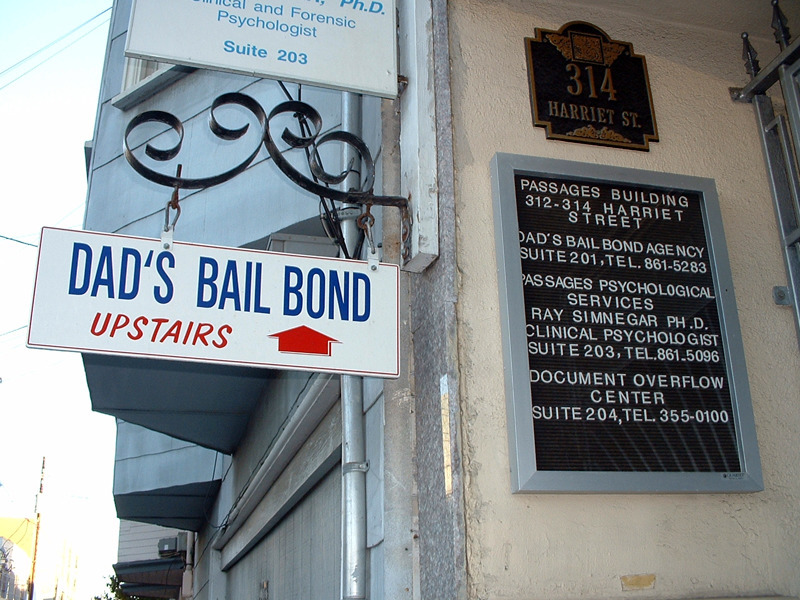
Next to the "San Francisco Criminal Court" on Bryant Street in SoMa, there are a few dozen of these small offices that often advertise their services to the bad guys with charming signs. The photos for this newsletter topic were taken by the newsletter reporter racing through SoMa on a bike with trembling hands, because the quirky characters operating there don't mess around. The company "Bad Boys Bail Bonds" is actually known nationwide and even advertises on television. And there's even "Aladdin Bail Bonds" and "Dad's Bonds"!
If the defendant actually absconds and does not appear for the court date, which happens in about 20% of all cases, the bondsman has a problem and only one option: He must bring the defendant in within the so-called "grace period" (six months in California) and deliver them to the police--otherwise, it becomes costly. For this situation, many bondsmen employ so-called "bounty hunters," daring types who, in serious cases, set out to capture the fugitive using methods that are often on the edge of legality and deliver them in exchange for a reward paid by the bondsman (usually 10% of the bail amount).
There are legendary figures like Ray Hawkins, a daring bounty hunter who claims to have captured 7,000 escapees in his 50 years of service! The professional bounty hunters do an excellent job: in 87 percent of all cases, they bring in the fugitives. And they don't even have to handle them gently: according to a Supreme Court ruling from 1873, bounty hunters are allowed to detain the bail jumper, who is considered a sort of commodity until officially arrested, even at their own home until they can safely deliver them to the police.
The bounty hunter business used to be relatively unregulated; it wasn't until January 2000 that a law was enacted in California regarding the training of bounty hunters. It mandates that future bounty hunters complete a 40-hour course on arresting techniques, a 12-hour legal course focusing on bail law, and a 3-hour security guard training. The exact number of bounty hunters in the USA is unknown, with estimates ranging from 1,200 to 7,000.
In California, bounty hunters must be at least 18 years old (for comparison: you can only buy alcohol in a supermarket from the age of 21) and have no blemishes on their criminal record. To arrest a fugitive, they must notify the police no more than 6 hours in advance. They are also not allowed to arbitrarily enter any private residences or deceive people with uniforms or badges. No later than 48 hours after a successful arrest, they must hand over the fugitive at a police station.
For success in this rough business, a bounty hunter needs a good connection to the underworld and a knack for dealing with bad guys. He must know where the underworld bars are, where the shady characters are hanging out. He's snooping around like a private detective, locating relatives and ex-girlfriends who might want to get back at the target. He spreads rumors in the underworld and gets the startled crooks to call fake phone numbers, which then, in turn, locate the calling phone.
One of the most famous bondsmen in San Francisco is not a man but a 60-year-old woman named Mackenzie Green from the bail bond agency "Mackenzie Green and Partner," known for taking on almost any bail. In case one of her clients disappears, she has a few strongmen for support, but she still goes bounty hunting herself for the "thrill."
Now, have you caught the scent of adventure? On the internet, there's a Training Seminar for Bounty Hunters and even a Certificate for Bail Enforcement Training available.
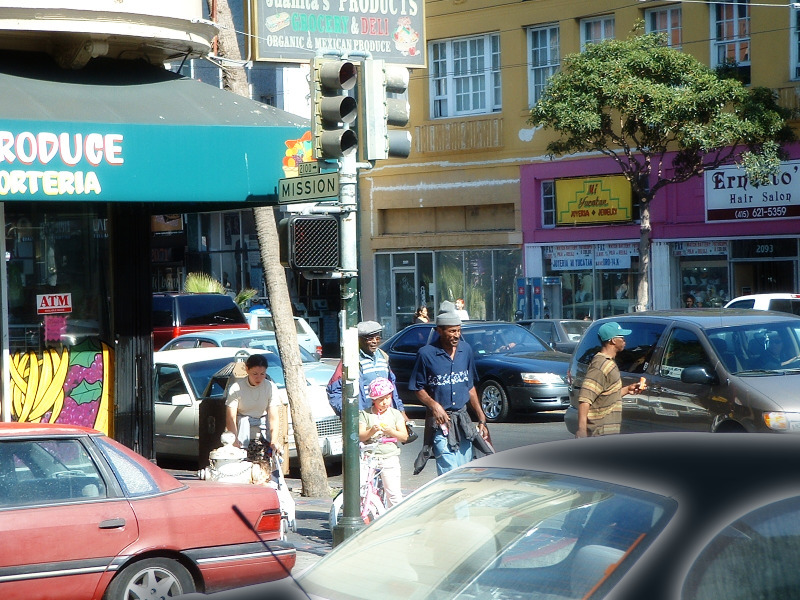
Michael One of the most beautiful achievements in San Francisco is the international atmosphere. Within half an hour, you can travel from Japan through Italy and China to South America. The latter neighborhood is just around the corner from us, and when you descend from our Noe Valley into the colorful Mexican "Mission," you can hardly believe your eyes and ears: everybody suddenly is speaking Spanish, people drive rundown cars, more trash lying in the streets, and Mexican oom-pah music blares from apartments and bars. One taqueria after another offers tacos, burritos, fajitas, and chile relleno.
In the Mission, people from Mexico and other South American countries--Nicaragua, Peru, Brazil, Chile--have chosen this neightborhood for a very long time. Interestingly, the Mission has the warmest climate in San Francisco: never foggy, and on some summer days, it's actually as scorching hot as in South America. Carlos Santana, the guitar legend, grew up here.
During the dot-com boom in the late nineties, the Mission was quite a wild neighborhood, with shootouts every night. However, it was considered extremely chic among the newly wealthy yuppies to find apartments in the Mission and furnish them in a hyper-modern style. Suddenly, between the dented cars of the old Mission residents, there were Daimlers, Porsches, and BMWs. This was not well-received, as it drove up the cost of rent and displaced some of the poorer long-time residents from their neighborhood, which they and their families had inhabited for generations.
Even today, I wouldn't park a luxury car in the Mission -- on those that are parked there, you often see unsightly meter-long scratches in the paint, which were obviously caused intentionally by angry people.
Alternative small businesses had settled in the Mission due to the lower rents: For example, 'Die Werkstatt,' a motorcycle workshop run by a German. Or The company Timbuk2, which makes messenger bags popular amongst bicycle couriers, is based here. Every hardcore cyclist in San Francisco carries one. It's more than just a bag; it's a clear political statement. You can buy them in select stores in San Francisco or order them online. But they are made in the Mission.
And also the Electronic Frontier Foundation has its office there. It's an organization that focuses on defending civil liberties in the digital world. The organization is based in the Mission. The small, shop-like office serves as the headquarters for the globally known, somewhat radical organization that stands against any form of internet censorship.
Because most people in the Mission speak Spanish and many do not speak English, the advertisements on billboards or the menus in restaurants are often in Spanish. And probably due to the proximity of our apartment to the Mission, I often receive promotional letters from the telephone company in Spanish (Figure 12).
What many Europeans don't know: In the USA, there is this a language-based two-class society. People who only speak Spanish and not English typically work in low-wage jobs, such as washing cars or as kitchen assistants. The head chef in a restaurant is required to speak Spanish fluently, since most of the kitchen staff do not speak English. And while waiters almost always speak English, in more affordable restaurants it can certainly happen that the assistant who clears the empty plates after a meal (the "bus boy") does not understand a question asked in English and has to call the waiter for help.
As is common in South America, on hot days ice cream vendors are pushing white handcarts, softly jingling, through the streets. Ancient pickup trucks with massive, amateurishly constructed structures transport towering loads in defiance of regulations -- in Germany, such an operation would be stopped by the next police patrol after at most five minutes of driving.
Many house walls display so-called "murals," typical South American wall paintings with various political or religious content, which, especially in sunny weather, give the neighborhood its distinctive southern flair with their colorful diversity.
The taqueria "La Taqueria" near the intersection of Mission Street and 26th Street serves the best tacos in the city. To order, you first go to the counter, get a number, and then sometimes have to pay close attention if the number is called out only in Spanish by mistake. The taco chef, a middle-aged man with meticulously combed jet-black hair, works through the orders at lightning speed. It's fun to watch him as he swiftly slices meat with a knife or uses spoons to scoop guacamole, salsa, or sour cream from the neatly organized side dish pots onto the small, tasty creations. Afterwards, you sit at long beer garden-like benches, mingling with other people (something unusual in America, where everyone usually has their own table) and enjoy the delicacies amidst a bustling atmosphere with toddlers running around.
Michael And here's another comment on the topic: Why Germans give up their rights as consumers and let themselves be led by the nose by the industry. The record industry is currently in quite a predicament worldwide because people prefer to download free pirated copies from the internet instead of buying CDs. What is the response of the German record distributors to this? CDs that can no longer be stored on the computer. This scam is called "copy-controlled." Folks, okay, I know you're not there yet, but try to listen to me anyway: In a few years, no one will be handling silver discs to listen to music. Do you start your cars with a crank, perhaps? Are your cell phones as big as bricks? Playing music CDs will seem just as ridiculous to you in a few years. I've been playing music exclusively through the computer on the stereo system for some time now. And, of course, only music that I have legally purchased beforehand--I have no problem with that. This way, I can choose from tens of thousands of songs at the push of a button, play them randomly, or rate them based on their romantic or intense factor and make my selection according to the situation. On a single computer, you can store more than 5,000 CDs. For your Stone Age method, you'd have to rent an extra room. I can play songs on portable devices that are as small as a matchbox (e.g., the "MP3 Player MuVo" and deliver stereo system quality. Even if you drop them on the floor -- because no rotating silver disc is necessary. Angelika has one of these devices and is very satisfied with it. Or has anyone heard of the iPod? Once you've experienced all of this, you can only laugh at the obvious idiocy of the poor CD players.
Because the music industry is too dumb to find a method that digitally replicates the previously functioning system (copies for private use and friends are okay, but no unlimited piracy), more and more so-called "copy-controlled" CDs are sneaking onto the German market. This method restricts the rights of consumers who pay a lot of money for music and cannot fully use it because the music cannot even be stored on their own computer. Back to the Stone Age, just because there are only blockheads working in the record industry? I don't think so.
People, stand up for yourselves! Don't let the record company guys fool you. Do it like the people in America: simply stop buying these CDs. Value your rights. The result of the copy-control misstep in the USA: American consumers vehemently demanded their rights, and these CDs disappeared from the shelves as quickly as they had arrived due to lack of sales. Not so in Germany: Germans apparently have no problem shelling out the same amount of money for fewer rights. Wake up! Those who buy such CDs not only disregard their own claim to reasonably usable quality but also help to restrict the rights of others. Put an end to it! You still have a lot to learn, my dear friends.
Michael About two and a half years ago, I introduced the TiVo box here (Rundbrief 05/2001), Rundbrief 05/2001 the device that has caused a second Big Bang in the history of television in the USA. I would estimate that by now almost 50% of all Americans know what a TiVo is. Do you know? If not, I would suggest that you quickly look it up in the old newsletter, otherwise you might miss the revolution.
In Germany, miracles always take a little longer, but in the meantime, I have learned that the device is now being showcased there as a new exhibition feature! Welcome to the future, dear friends!
Anyone who now believes that they can catch up with us by purchasing a TiVo is mistaken: The Americans have used the two and a half years of technological advantage to crack open the box, inject all sorts of self-written software into the computer-like (Linux!) platform under the hood, and expand their TiVos with the most outlandish functions.
The whole thing is called "TiVo Hacking," but I need to elaborate a bit. In the media, there's this term "hacker." In the common understanding of the average person, this is someone who illegally breaks into other people's computer systems and steals data or causes other damage. Professional programmers, on the other hand, use the term appreciatively for honest, talented colleagues, while they refer to the troublemakers as "crackers."
"TiVo Hacking" is somewhere in the middle: you need some tinkering and programming experience to technically upgrade a standard TiVo and customize it with unofficially developed software to suit personal needs. "Modding" is currently very trendy, not just with TiVo, but also with gaming consoles like the "PlayStation" and "Xbox". The company TiVo raises a warning finger and voids the warranty if you crack open the box--so you're always playing with the risk of turning your TiVo, along with its lifetime program service, into a $500 piece of junk. On the other hand, TiVo looks at it with a wink, because the wealth of talent that high-caliber people accumulate in TiVo internet forums to exploit the revolutionary technology is something the small company could never afford to pay for. There are even books available on the topic now (see illustration 21)!
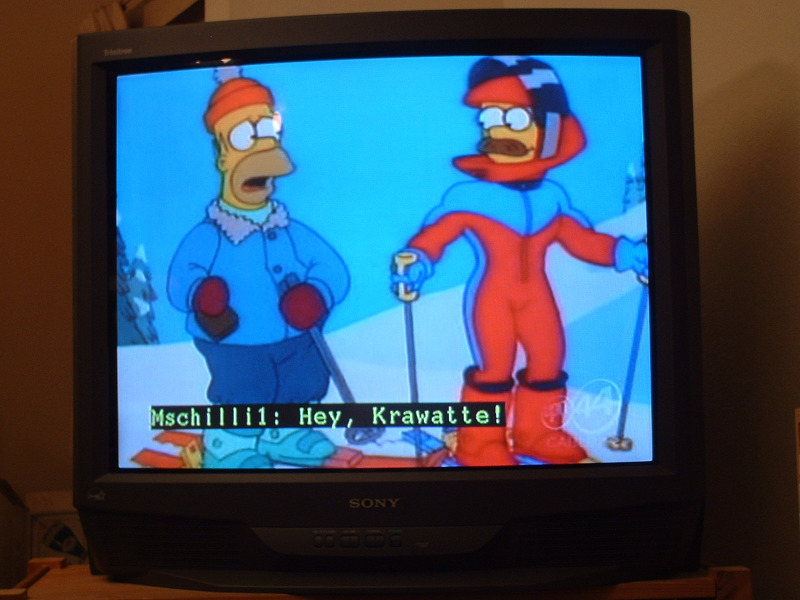
On the online auction site ebay.com, professional TiVo enhancers offer their finished products for sale. These individuals purchase new TiVos, modify them according to the latest underground insights, and then sell them to the highest bidder. Thanks to the modifications (which I, of course, carried out myself following the above instructions), our TiVo can record 140 hours of television and is connected to the internet, allowing me to program it remotely from the office or a hotel room if necessary. And illustration 20 shows how our TiVo can even display an instant message (AIM) received on my computer directly onto the ongoing TV program. This way, you don't have to go through the hassle of getting up from the couch to see who wants something again!
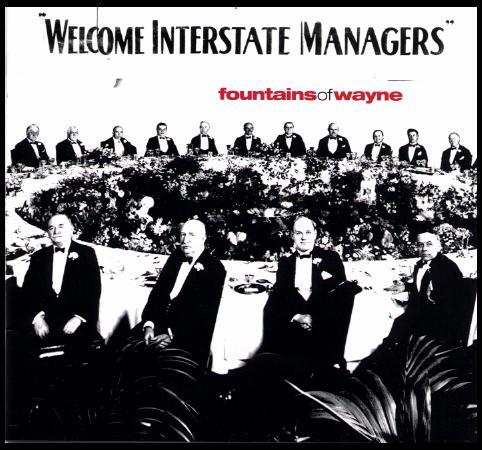
Michael The CD of the month is: "Welcome Interstate Managers" by "Fountains of Wayne". I discovered it because "Stacey's Mom" is currently being played non-stop on the radio. But, beware: for those who aren't 18 at heart like I am, this song by the four New Yorkers might seem incredibly childish. However, the album has more to offer: "Bought for a Song" or "Supercollider" are reminiscent of the fabulous British band Oasis, while others, like "Fire Island," recall the brilliant compositions of John Lennon. It's fantastic, buy it immediately!
Angelika We are known to love traveling and do not tolerate any blank spots on our map. As some of you know, we both met back in the day at a car rental company in Las Vegas and traveled with a spontaneously assembled group of 8 people through the national parks of the American West: Grand Canyon, Bryce Canyon, Canyonlands, Arches. Zion National Park was also on the itinerary back then, but time was running short and a winter storm was approaching, so we only drove through this particular park briefly. I believe we took some photos, but my memory of this park had faded significantly. That needed to change: So, at the beginning of November, we boarded a plane to Las Vegas, stayed for two nights at the MGM Grand Hotel, and then continued from there with a rental car to Zion National Park.
From our room in the MGM, we glanced over at the Motel 6 where my friend Marianne and I had stayed almost 17 years ago. Michael and his college friend Christian had chosen the youth hostel. The MGM didn't even exist back then: typical Las Vegas, the undeniably most surreal city in America, which is constantly changing at a rapid pace. Only one thing has remained constant in Las Vegas until recently: the show of the German-born magicians Siegfried and Roy. You know, the ones with the white tigers. The duo had been performing in Las Vegas for almost 30 years until recently, when a tiger attacked the dark-haired Roy on stage in October and seriously injured him. All of Las Vegas was in mourning when we visited.
But now to Zion: The landscape of the American West has fascinated me since I first saw it in 1987. This may also be because there is nothing comparable in Europe. Zion National Park can certainly be described as a mountain range, but it has nothing in common with the Alps. The gigantic, rugged rocks shimmer in red, orange, and ocher. A river squeezes through the massive canyons. To truly experience Zion Park, visitors must explore it on foot. Of course, that's what we did.
A hike with the poetic name "Angel's Landing" is considered the absolute highlight. It involves a rather strenuous ascent, initially leading to the viewpoint "Scout's Lookout" and then almost a mile over a narrow mountain ridge. I was somewhat surprised that the park brochures vehemently emphasized that the last half mile is not suitable for small children and people with a fear of heights. Arrogantly--despite being quite a coward when it comes to heights--I ignored the warning because I once again thought it was an exaggerated American precaution.
Ha, that lasted until we reached Scout's Lookout and I saw tiny dots in the distance climbing around on a hair-thin ridge: it dropped 1,500 feet on each side. The dots were "daredevil" hikers for whom the word "fear of heights" did not exist. After a feeble attempt to conquer the ridge, I declared Scout's Lookout as my summit after 100 meters. For Michael, who is known to love adventure, there was no stopping. So he conquered the summit, clinging to the chains serving as ropes, while I stayed back with the more faint-hearted souls at the viewpoint, exchanging horror stories. For example, that last year a man pushed his wife off the ridge to murder her after he had increased her life insurance payout.
After an hour, Michael came back safe and sound and showed me a short film of Angel's Landing on his digital camera.
| Video: Angel's Landing: Not for people who are afraid of heights |
Even just looking at the pictures made me dizzy. When Michael then told me that some hikers were crawling on their behinds at particularly narrow spots to get through, I thought to myself that there's really no point in experiencing everything in person.
On the return trip from Zion, we made a small detour to the little-known Valley of Fire State Park, which is about a 45-minute drive from Las Vegas. A bizarre desert landscape with sandstone formations, including prehistoric Native American drawings, awaited us. The rocks glowed in the most magnificent colors under the Nevada sun. So, dear newsletter readers, if you ever find yourselves in the area and tired of gambling, visit this park - it's an absolute insider tip.
To explore the park extensively, we stayed overnight in the nearby town of "Overton," which, aside from a Best Western motel, a supermarket, and two restaurants, didn't offer much excitement. When we travel through the vastness of America, I'm always amazed anew at the small towns (hey, I'm a city person) where people live. In Overton, it is also notable that it is located in the middle of the desert. Everything was bone-dry and covered with a grayish layer. The question plagued me as to how people can endure it here in the summer when the thermometer rises to unbearable heights.
Owning an oversized car ("truck") with a trailer apparently helps combat boredom in Overton. The trailer usually carries a Jeep-like contraption, which is used to race across the desert landscape. To each their own! Due to a lack of alternatives, we went to a Chinese restaurant one evening and to a diner called "Sugar's" the next for dinner. We immediately stood out as tourists from the big city because Michael wasn't wearing a baseball cap. When he then asked the waitress if they served local microbrews (often very good beers from small breweries), which made me want to sink into the ground with embarrassment, and she looked at him as if he came from mars, we were completely labeled as snobs in the place. It's a good thing no one knew us there.
It was also funny that our first server wasn't allowed to take Michael's beer order. She kindly explained to us that she wasn't 21 yet, but she would be happy to send her older colleague to our table. You remember: In most states in America, you can only buy alcohol at 21. We were a bit surprised that the girl wasn't even allowed to serve Michael his beer, because the state of Nevada--after all, Las Vegas is located here--is generally considered to be quite lenient when it comes to "sinful" behaviors. We only experienced comparable strictness in Utah, the state with an extremely high Mormon population, where Zion National Park is located. Buying alcohol there is similarly restricted as in Finland. For example, in the supermarket, you can find beer but not wine. Back to Overton: The next day, we bought a bottle of sparkling wine and a few other things at the supermarket. A very young person (apparently only teenagers work in Overton) was at the checkout, and as the bottle of sparkling wine almost reached the scanner, the cashier stopped, called her supervisor over the internal intercom, and said that she wasn't allowed to ring up the sparkling wine because she was under 21 ("under age" as they say here). Ahhhh!!!!
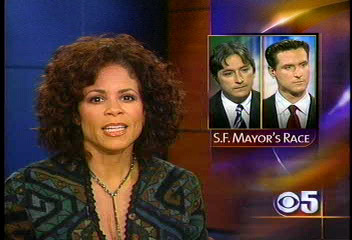
Angelika After we had just recovered from the shock that "Mr. Terminator" is now governing the state of California, another election campaign started in San Francisco. The city is looking for a new mayor, because Willie Brown, who had steered the city's affairs for eight years, has to step down, as required by reelection laws. San Francisco has always been an island in the American sea: liberal, a little quirky, firmly in Democratic hands, so to speak, a Bush-free zone.
This was also reflected in the candidates. Of the six candidates, only one belonged to the Republican--thus conservative--party and promptly received the fewest votes. Matt Gonzalez, a Green Party member who entered the mayoral race at the last minute, is considered the candidate with the most leftist ideology. Gavin Newsom, according to polls the favorite, is a Democrat, but in San Francisco, he is often described by critics as a closet Republican--an exaggerated characterization. The wealthy businessman Newsom sees himself as a centrist and primarily represents the economic interests of companies and businesses in San Francisco.
Transferred to the German party system, he seems to me more like a dynamic FDP man. However, Newsom also did not secure the required 50% of the votes on November 3 to win the election. Since Gonzalez landed in second place, albeit significantly behind Newsom (by 40,000 votes), a runoff election will take place on December 9, and as of now, the city seems to be splitting into the Gonzalez and Newsom camps.
Gonzalez, who only switched from the Democratic Party to the Greens three years ago, always reminds me of Joschka Fischer during his Sturm und Drang phase, when he still sat in the Bundestag wearing sneakers and jeans, and everyone in Germany smirked at green politicians. The Greens still have a hard time in America, with only 1% of voters supporting them. In San Francisco, it's three percent. It would be nothing short of sensational if San Francisco, a city of some significance on the West Coast, were soon to have a Green mayor.
However, I believe that for the people in San Francisco, the green party affiliation takes a backseat. What matters is the future of the city. Naturally, "green" ideas are indeed part of Gonzalez's program. For example, he promises, much to the delight of Michael and the other dedicated cyclists of San Francisco (a group not to be underestimated), to extensively expand the bike lanes throughout the city. According to Gonzalez, the MUNI, the public transportation system that includes streetcars, buses, and cable cars, should be free of charge for seniors, youth, and people with disabilities. He advocates for keeping large retail chains out of San Francisco's neighborhoods, a hot political topic in the city. Additionally, he wants to impose higher taxes on larger companies.
He became popular with blue collar workers by supporting, in his role as acting city councilor, the initiative to raise the minimum wage in San Francisco to $8.50 (for comparison: the minimum wage in California is currently $6.75), which voters approved by a large majority on the aforementioned November 3rd. His worker-friendly attitude also earns him approval among the South American immigrants living in the Mission. Additionally, he speaks Spanish, as he grew up in a bilingual household (Spanish-English) in the Texan city of McAllen, which is four miles from the Mexican border. Later, he studied law at the prestigious Stanford University and worked as a public defender in San Francisco. By chance, I recently flipped through various TV channels and was captivated by what was actually a boring city council meeting. One of the councilors stood out with his charming, intelligent, and substantive contributions to the discussion. You guessed it: I had come across Matt Gonzalez. Even his political opponents always admiringly note that Gonzalez is not for sale, a refreshing change, as Willie Brown's cronyism achieved notoriety during his time as mayor.
But once again back to Newsom: There is only one issue that stirs emotions in this city more than the unreliability of the MUNI: the homelessness problem. So far, every mayoral candidate has promised to solve this problem permanently, and each one has failed miserably (including Willie Brown). Newsom tackled this issue, already eyeing the mayor's office, in his role as a city council member with his flowery campaign "Care not Cash," which completely polarized the city. The idea behind the campaign is to drastically reduce cash payments for homeless welfare recipients and replace them with entitlements to assistance such as housing, food, and drug rehabilitation--ensuring that the cash is not converted into drugs and alcohol.
The idea may initially sound reasonable, but there are already not enough homeless shelters in San Francisco, let alone affordable housing or therapy spots, especially for the high proportion of mentally ill people living on San Francisco's streets. To make a long story short: "Care not Cash" was put before voters as the ballot initiative "Proposition N" in November 2002, received almost 60% support, and immediately ended up in the courts. There, Newsom faced criticism because the judge ruled that only the city council (and not a ballot initiative) could decide on the matter. After endless legal wrangling, the city council voted again on "Care not Cash"--and this time against it.
In America, by the way, every election campaign relies on so-called "endorsements" (support, backing). Newspapers, for example, openly and very directly state in their editorials shortly before the election who their readers should vote for. The idea that the Süddeutsche Zeitung could write "Vote for Schröder!" always amuses me greatly. But it's not just newspapers that endorse certain candidates; unions and all sorts of other interest groups do as well. Therefore, a crucial part of every campaign is who endorses whom. For example, Al Gore and Willie Brown support Newsom, which undoubtedly influences many voters. Who I endorse, once again, interests no one. What a pity! I want a green mayor!
But regardless of whether Newsom or Gonzalez succeeds on December 9, San Francisco's mayor will be a young whippersnapper: Newsom is 36 and Gonzalez is 38.
Greetings from the city that keeps you young:
Michael und Angelika