![]() |
| Angelika/Mike Schilli |
Angelika: We have been living in San Francisco for almost 8 years now and have never moved apartments. This was partly due to the unaffordable rents in San Francisco and partly because of Michael's refusal to move--he dreaded all the work involved. Way back in Munich, I managed the move to America all by myself, as Michael had left seven weeks before me, armed with only two small travel bags!
We were also very attached to our old apartment. The view was priceless, and it was our first place in San Francisco. However, the space in the two-room apartment (called a "one-bedroom" in America) became extremely tight due to the clutter accumulated over the years. Michael insists that he must own every Perl book on the planet, and I'm not far behind with my thousand and one boxes filled with my photos.
But anyone who moves naturally wants to improve their situation, so we created the following list of requirements: three rooms (called "two-bedroom"), with a balcony and a fantastic view, as well as a garage (indispensable in the parking crisis area of San Francisco). We wanted to live on the top floor of the building so that in the event of an earthquake, the neighbor wouldn't fall on our heads.
The "stomp factor" is also not to be underestimated in American buildings in this regard. Due to the lightweight wooden construction, normal walking already sounds like elephants trampling. When we stay in a two-story motel, we always make sure to stay on the upper floor. The new apartment had to face the back, not the street, and be located in our beloved neighborhood of "Noe Valley." We also needed the so-called "Rent Control." It ensures that the rent remains stable, as it did once before in our previous location (Rundbrief 08/2000).
Moving in the USA
For a long time, we had dismissed this list as completely unrealistic, and, consequently, weren't even looking for a new apartment. But in recent months, "For Rent" signs have been appearing more frequently on doors and windows in our neighborhood. This doesn't mean that rents have dramatically decreased, but the situation in San Francisco is no longer as crazy as it was during the dot-com boom. You no longer have to pay a fortune for a rat hole.
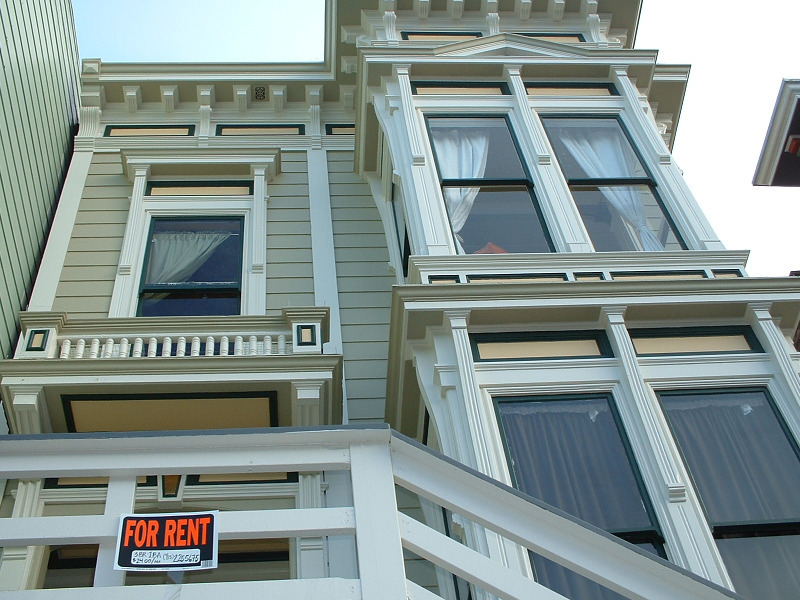
The principle of the "For Rent" sign is, by the way, a popular method here to rent out an apartment. The sign usually displays a phone number that prospective tenants can call to learn more about the apartment and arrange a viewing appointment. This works particularly well in busy areas with a lot of foot traffic. Some apartments and houses are also available for sale, and there are signs for that as well.
And then, of course, there is "Craigslist" in San Francisco, a true institution that is known by everyone who wants to sell something, is looking for a job, or wants to make connections. Every landlord and apartment seeker also knows the website address "www.craigslist.org" by heart.
Like a newspaper, the website lists, among other things, housing offers. Craigslist, by the way, started in 1994 in San Francisco when a certain Craig Newmark (hence the name) began sending listings of events in and around San Francisco via email to his friends and acquaintances. The list became very popular and kept growing, so that now 15 permanent employees work for Craig. The newspaper "San Francisco Chronicle" recently published an interesting article about it and featured Interview with the local hero. 'Craigslist' is now available in 45 cities in the USA, with branches in Canada and England. The internet company makes money by charging companies and employers $75 (in San Francisco) to list a job offer, everything else is free of charge.
One afternoon in May, we were strolling down 24th Street in our neighborhood and saw a "For Rent" sign. Since the sign advertised the apartment's spectacular view, I quickly picked up the phone and scheduled a viewing. And lo and behold: The apartment met all our requirements and even boasted an open fireplace. This convinced even Michael, who is usually reluctant to move, because he is known to love playing with fire. Additionally, the new apartment was already an old acquaintance: We had been able to see it for years from our old apartment.
Since we were seriously interested in the apartment after the viewing, we filled out the customary "Application." Typically, you provide your employer, monthly income, Social Security Number, and driver's license number on it. The landlord has the right to verify the information and check the credit report (see Rundbrief 05/2004). Some landlords also require the potential tenant to bring the credit report to the viewing appointment. By the way, the credit report almost became Michael's downfall when we set out to rent our first apartment. Freshly arrived from Germany, it was just a blank sheet of paper. Thankfully, the only competing applicant had a cat, and cat-less Michael therefore outshone him. This time, everything went smoothly, and we eventually signed the lease agreement.
In San Francisco, it is common to commit to renting an apartment for a year, after which a monthly notice period applies. A security deposit is also paid, typically amounting to one and a half to two months' rent. As in Germany, the landlord may retain the deposit if the tenant damages the apartment or falls behind on rent. Over the years, the tenant earns interest on the deposit amount. The municipal Rent Board sets the annual interest rate in the process.
When you move, you naturally also submit a forwarding request for your mail in America. The United States Postal Service is very modern in this regard, as the address change can be done online for a fee of $1. However, if you submit the request directly at the post office, there is no charge. Most mail is forwarded to the new address for free for one year. For magazines and newspapers, this is limited to 2 months. And, lo and behold, the mail forwarding even works, but that's thanks to our great mail carrier George, who has been working in our neighborhood for over 20 years (an absolute record by American standards) and continues to be responsible for us. Hooray!
Everyone knows that America does not have a registration law. However, in California, you must inform the Department of Motor Vehicles (called DMV) of your address change within 10 days. And Green Card holders like us (as well as visa holders) should not forget to send their new address to the immigration authorities -- also within 10 days.
The latter, by the way, should not be taken lightly. Although this regulation has existed for ages, the immigration authorities did not pursue charges in this regard. However, after the terrorist attacks on September 11, 2001, people were suddenly arrested for not sending the address change form to the immigration authorities, as the authorities used this violation as a pretext to detain people.
This led, in turn, to all foreigners suddenly reporting their address changes like crazy, and the immigration office was completely inundated with forms. I sent everything by registered mail with a return receipt to ensure that we could prove that we had sent the letter on time.
It's a good thing the internet exists because anyone can download the required forms from the immigration authority's server. Hats off, most American authorities are really on the ball in this regard.
Michael After almost eight years in the USA, we thought nothing could shock us anymore. You get used to a lot of things: nothing here is reliable. It's the exception when something actually works as promised. Whenever someone confirms something to me, I've made it a habit to make a note in my calendar. A week later, there's an entry reminding me to check if what was promised actually happened. In 90% of cases, it didn't work out, and then I have to do the so-called "follow-up."
When reminding someone, you must remain friendly, because no one wants to be reminded of their own sloppiness. So instead of saying, "Why wasn't this done?" you should say, "Have you had the opportunity to address XY?" "Not yet? Hmm, do you think you could get to it this week?" You need the patience of a saint for this. Those who can't handle it and lose their temper will end up frustrated and won't make any progress, as people will become stubborn.
What happened during the move, however, knocked us both out: Two weeks earlier, we called the local telephone company "SBC" to request that the land line be moved one street over while keeping the same number. "No problem, we'll take care of it!" they said, and I became suspicious. Why is it so easy? "I really won't need to do anything else for the line to be switched in fourteen days?" "No, you're all set!" I didn't quite want to believe it, but okay.
The next morning, our phone line was dead. I called the local telephone company on my cell phone. Yes, the line had been switched. "But the agreed date was the 29th -- today is the 15th." "Hmm, yes, you're right, today is not the 29th." "Can you fix it?" "Sure, no problem, where can we reach you -- at your registered phone number?" "No. That's why I'm calling." "Oh, I see." Good grief.
It continued like this. In the new apartment, neither the phone nor the DSL connection worked. I had to call two different companies for both and keep arguing for hours on end that it wasn't my phone or my DSL router that was defective, but rather that the line simply wasn't working: "We know this, it's usually the phone." "I've had this phone for seven years, and it has always worked perfectly." "It could still be broken." "I have a second, identical phone. That one doesn't work either." "Alright, we'll send someone over, but if it's your fault, we'll charge you." Madness. Dealing with the customer service of the local telephone monopoly "SBC" feels like being in East Germany.
But thanks to the thick skin developed over many years by your two protagonists, we have managed to clean up the chaos step by step. During the cleanup, unnecessary furniture was also given away or sold. Slowly, normality is returning. But I guarantee that I won't be moving again in the next twenty years.
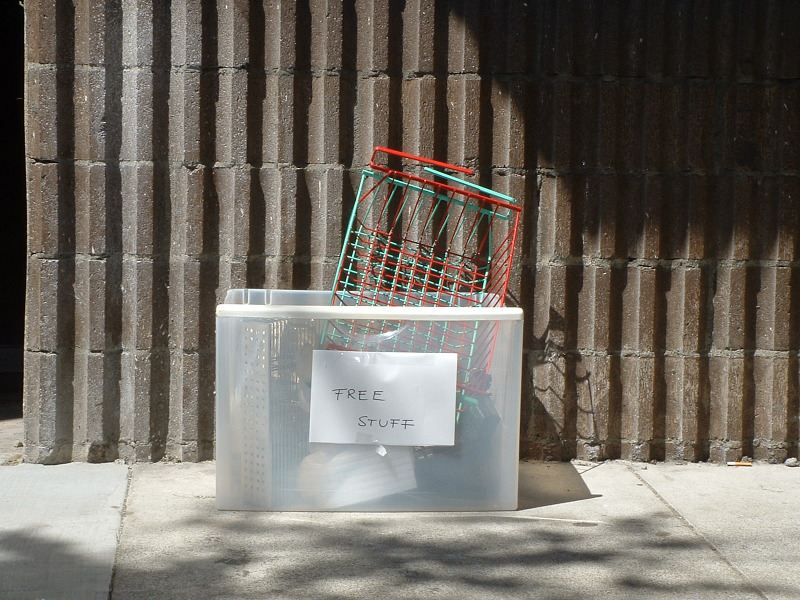
Americans are often accused of producing excessive waste. This is somewhat true when you think of the plastic bag madness in supermarkets and the practically non-existent waste separation in rural areas. However, there is a recycling process here that I was not familiar with from Germany. (Informants from Berlin have, however, told me that it works similarly there.) You put old junk out on the sidewalk, stick a note on it that says "Free Stuff", and wait an hour or two.
On August 15th at 1:54 PM, we repeated the experiment, which I had already been conducted dozens of times, for the newsletter: An old plastic box with leftover items from the move was placed on the sidewalk in front of the house with a note attached. The box contained: two wire baskets for hanging in a shelf, a dish rack, an old telephone, and 50 ballpoint pens that I had once received as promotional gifts.
Approximately two hours later, at 3:49:33 PM, I went down again, and lo and behold: everything was gone, including the box.
I once put down a box of read German books and attached a large note: "GERMAN LANGUAGE BOOKS," since the contents were only readable by a small minority and not everyone else should have to reach into the box to find this out.
Shortly afterwards, the box was gone, and Angelika happened to discover a homeless man on the other side of the street, offering the books for sale on the sidewalk and demonstratively holding a German crime novel open as if he were reading it. Unfortunately, she didn't have the courage to photograph the scene.
If you have a lot of time and enjoy sitting on the sidewalk for hours, you can also get rid of old stuff through a "garage sale." You simply start a private flea market in front of your garage (if you don't have one, just do it on the sidewalk) and sell the items to passersby and curious occupants of stopping cars. This business is particularly popular on weekends, when you often see half a dozen cars parked haphazardly in front of some people with their junk spread out on the sidewalk. It's unbelievable what can be sold; some people probably buy the stuff just to resell it at their own "garage sale."
It was a completely normal workday in June when I routinely rode my bike into the Netscape parking lot at ten o'clock in the morning. I was just about to open the door to the building when the security guard, who always makes sure everyone is wearing their "badge" (company ID), indicated to me that there was a snake in the parking lot. And indeed: just a few meters away, a patterned snake about 2 meters long and three to four centimeters thick was slithering through the bushes!
Quickly, I went into the building, informed my colleagues, grabbed the camera from my backpack, and soon everyone rushed out to marvel at the spectacle! An expert among the people responsible for building maintenance identified the reptile as a so-called "Gopher Snake," a non-venomous snake that preys on ground squirrels. A SUV was quickly brought around, a billiard cue and a trash can were fetched from the game room, and after some back and forth, the snake was placed in the bin.
My suggestion to simply drive it to Microsoft and let them loose in the parking lot was brusquely rejected "for legal reasons," unfortunately! No sense of humor, these Americans!
At the county and state level, there is a vibrant system of referendums in California. Busy individuals constantly introduce proposals for changes in the law, known as "propositions." For example, a recent proposal in the city of San Francisco debated whether to give homeless people food stamps instead of money. In such cases, interest groups hire young people to approach local eligible pedestrians on the streets and persuade them to add their address and signature to a list. If a certain number of valid signatures are collected, the proposal can be publicly voted on in the next election.
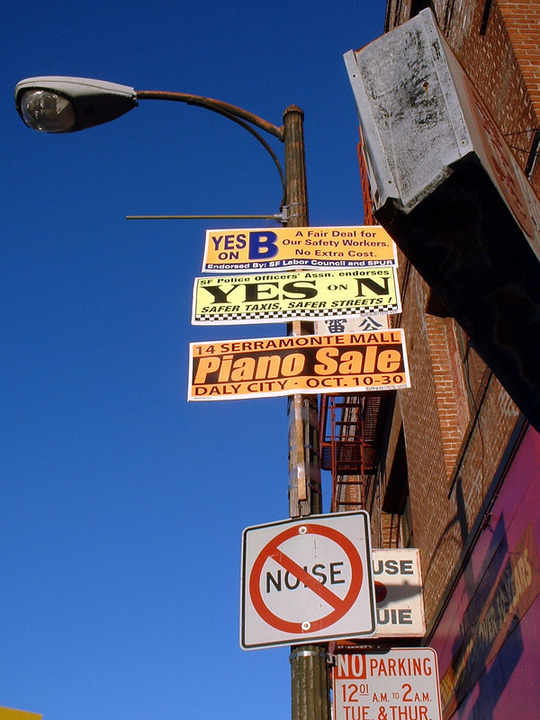
To avoid having to explain the sometimes complex proposals in every detail, those responsible assign them letters at the county level and numbers at the state level. For example, the proposal against same-sex marriage was labeled as "Proposition 22," and the homelessness debacle was referred to as "N." On mini election posters, often hung on street lamps, you might see slogans like "Yes on N, Safer Taxis, Safer Streets!" and the informed citizen needs to know what that means.
The meetings of the city's "Supervisors" are, by the way, broadcast live on local television channels. This might seem completely crazy to you, but it is highly interesting to watch these extremely smart and dedicated people during these transparent sessions. Recently, a proposal was up for debate in San Francisco that would require restaurants, like in Los Angeles, to prominently display the results of the latest health department inspection at the entrance: It would show an "A," "B," or "C," allowing customers to assess the health risk they might be exposed to when entering the establishment.
What fascinates me about it is how friendly and collegial these people interact with each other: There is indeed competition and political games, but time and again, the representatives of the restaurant industry were addressed kindly with "You Guys," sometimes there was even laughter, and discussions are generally conducted in a very factual manner. Hats off to these people, who really commit themselves to their city in meetings that often last late into the evening.
The regular readers will remember, in Rundbrief 10/1998 we already reported on the "Lost Coast," the stretch of coastline near Mendocino that is cut off from Highway 1.
Because it was so nice back then, we did it again: This time we really sped along deserted, unpaved country roads right by the ocean, and the good old "PERL MAN" even had to cross a small creek. He did creak a bit when the underbody slid over a small rock, but he made it through without any damage to the oil pan. As a reward, he got a hand car wash at home.
The beaches of the "Lost Coast" are truly unique and generally deserted. You only come across quite large (20 cm in diameter), plump, colorful starfish that you can toss back into the water with a stick if you're in a good mood. By the way, starfish are called "starfish" in English and not "sea star," as Angelika once amusingly said in kindergarten.
However, you can forget about going there: Last week, the place "Shelter Cove" on the Lost Coast was on TV. The series "Bay Area Backroads" reported on it in detail and, here's the kicker, even showed our motel room called "Captain's Lodge"! Goodbye Lost Coast, it's gonna be busy now, sorry!
Angelika: Even after almost eight years in the USA, I am still fascinated by how much the country's language reflects its culture. I am surprised when the children in the Tenderloin shout a hearty "I love you" at me, even though I know that these three words are used quite liberally in American English. Americans, it seems, love everything and everyone. In German, however, the declaration of love "Ich liebe dich!" carries significant weight. It is used sparingly, as one can fall back on the famous "Ich hab' dich lieb!" as a milder expression.
American politicians, on the other hand, find the phrase "God bless America" great. No speech or interview ends without God's blessing, and this has been the case long before Bush became president. However, I had to smile when Germany's new Federal President, Horst Köhler, recently drew on his American experience and invoked God's blessing over Germany in his inaugural speech.
Angelika: Although the convention of the American Republican Party, during which Bush's official nomination as the presidential candidate will take place, is still pending, everyone already knows: Kerry is running against Bush.
The United States are known to have a rather sophisticated electoral system, which appears extremely convoluted to Europeans (Rundbrief 12/2000). This process begins with the so-called primaries (internal party elections). Between January and June of the election year, the official candidate of each party is determined through primaries in almost all American states.
This is done either through "open primaries" or "closed primaries." The open variant allows any eligible voter to cast their vote for their favored Republican or Democratic candidate, while in closed primaries, the voter must be a registered member of the respective party to participate in the party's internal primary election.
Then, in some states, such as Iowa, there is the alternative of "caucuses." You should think of a "caucus" as events at a lower political level where delegates are elected to support a specific preferred candidate at various regional and national party conventions.
Until the 1960s, there were only primary elections in 10 to 12 states, which were considered mere indicators of public opinion before the national party conventions. The delegates had the final say on the nomination of the presidential candidate. Nowadays, everything is decided on "Super Tuesday" in March, when populous states like California and New York hold their primaries. As a result, the nomination at the national party conventions in the summer is increasingly becoming a formality. For those aligned with the Republican Party, there was no worry this year anyway, as Bush had no opponent within his own party. Among the Democrats, Kerry eventually won, although Howard Dean was initially considered the favorite.
We have been seeing an election campaign conducted at tabloid level for months now. It's enough to make you cry. Initially, there was no more important question than who had the better head of hair: Kerry or Bush. Then, some eager journalists, close to the tabloid press, began to speculate whether Kerry was using Botox to smooth out his wrinkles.
The wives of the two candidates are also preferred targets. Teresa Heinz Kerry is considered too outspoken and generally suspicious by the conservative press, as she is the millionaire heiress of the Heinz ketchup empire. In contrast, Laura Bush deliberately plays the role of the homemaker.
In the meantime, the smear campaign shifted to more political topics. Since Bush boasts of being a war President who protected America from terrorists with a firm hand, Kerry cannot lag behind. He needs to prove that he can fulfill the role of Commander-in-Chief of the armed forces as President. What better suits him than his Vietnam experience? After all, Kerry returned from the war zone in the seventies as a decorated soldier and had even volunteered. In contrast, Bush served in the National Guard on American soil.
A plus for Kerry in gathering votes from Vietnam veterans. Americans have a thing with Vietnam anyway. The trauma still runs deep in their bones. However, some cheeky former Vietnam comrades of Kerry, who have given themselves the name "Swift Boat Veterans for Truth," claim in a TV commercial that Kerry's heroic deeds are just hot air. The New York Times then reported that the TV commercial was co-financed by people close to the Bush family. So the country is occupied with the truthfulness of old hero stories instead of discussing current issues. Sigh!
But who will win the election? Michael always drives me crazy with his gloomy predictions that Bush will emerge as the clear winner. I believe the country is completely divided, and there will be a neck-and-neck race in November with an extremely close election outcome. Kerry is stumbling over the same obstacles as Gore. He wants to please everyone, which makes him seem completely wishy-washy--a trait that Americans do not like at all.
For many Democrats in San Francisco, however, Kerry is not left-wing enough, although most here would vote for anyone as long as their name isn't Bush. Everything depends on voter turnout, which in the USA is typically only 50%. The Democrats are primarily trying to get young voters to the polls, as the turnout in the 18 to 24-year-old age group is abysmal. In the last election in 2000, it was a mere 36%.
In our neighborhood, young people from the "Democratic National Committee" have been collecting money for weeks to go door-to-door in the so-called "swing states" (states that sometimes vote Republican, sometimes Democratic) to encourage their peers to vote.
The crucial question remains: Why do so many Americans still support Bush? Even if one overlooks the foreign policy disaster in Iraq, there is plenty to criticize domestically. The average American is significantly worse off under Bush: they often have to deal with a lower-paying job while facing astronomically rising healthcare costs and a high personal debt burden. Nevertheless, many follow Bush like the Pied Piper of Hamelin. Oh, sometimes this country just drives me to despair.
Michael: Back in the Rundbrief 12/2003 issue I was boasting that American consumers would never put up with copy-protected CDs, and bam! Reality slapped me with a wet towel: The new CD from the "Guns 'n Roses" offshoot "Velvet Revolver" can't be listened to as an MP3 on the computer, and consumers apparently don't mind. What sheep! For "Velvet Revolver," this means they're banned--at least from my record shelf. For life!Divine Love Whispers
Election Campaign in America: Bush versus Kerry
Copy-Protected CDs
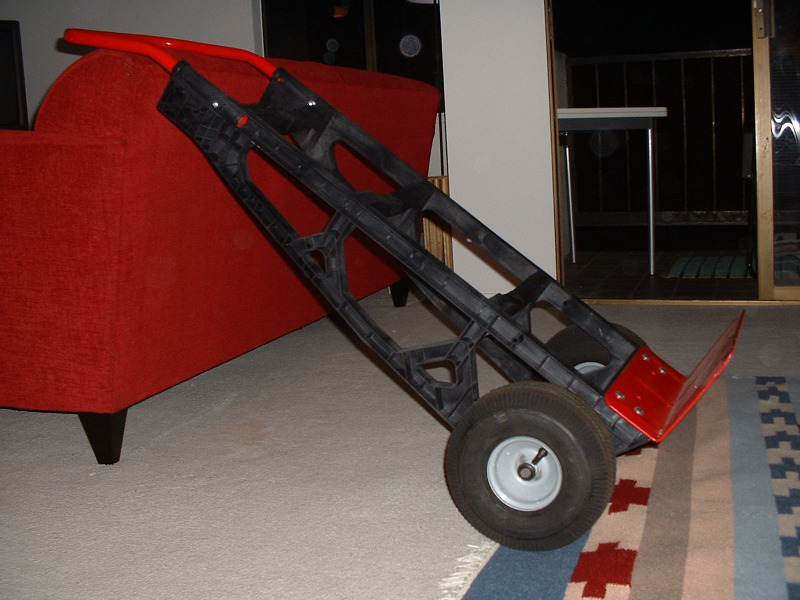
Moving boxes around is no fun and can be hard on your back--unless, like us, you've bought a handcart at the "Home Depot" hardware store. In American English, these rolling helpers are also called "dollies," but when I asked the store clerk, "Where might I find a dolly?" he responded with, "A what??" Maybe it was my pronunciation, but I had to briefly describe that I wanted one of those things you can use to cart stuff around. Ah, he understood and informed me that "hand trucks" could be found in the last aisle on the shelf next to the trash cans. I chose the top model for $39.99, which can handle up to 600 pounds. That's quality! It even withstood the heavy moving goods and now stands on the balcony. Unfortunately, it won't fold!
By the way, I always notice in the hardware store how limited my English skills still are, even after eight years in America. Quick test before you laugh: Regular screwdriver? Cross-head screwdriver? See, you don't know either.
Regular screwdrivers are 'Flat heads', 'Phillips' is the name for the cross-head screwdriver, which sounds quite strange to European ears, is actually derived from the name of its inventor Henry F. Phillips, who patented it in the year 1936.
Recently, I was standing in the hardware store around the corner and wanted to buy a dustpan with a broom, but when I tried to find the word, all that came out was a slow "uhhhh...". Angelika, on the other hand, impressed with the correct term "dustpan," which she had learned in kindergarten, while such things are less common at AOL.
Greetings from the new place:
Angelika und Michael