![]() |
| Angelika/Mike Schilli |
|
|
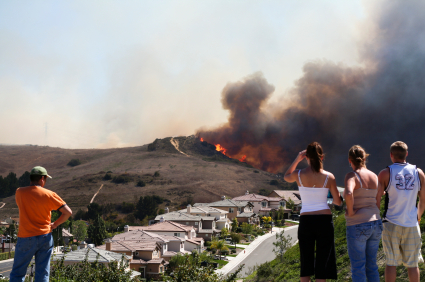
Michael You probably heard it in the news: There was a forest fire in California. However, it wasn't up here in San Francisco, but down in Southern California, more than 400 miles away. Sometimes people forget that California is larger than Germany.
We heard about the fire on the news, and at Yahoo, some employees from Southern California took pictures of burning forests from their bedroom windows. Some Yahoos had to flee their homes and were evacuated. In the meantime, everything has settled down again, the fires have been extinguished, and things are returning to normal.
TODO
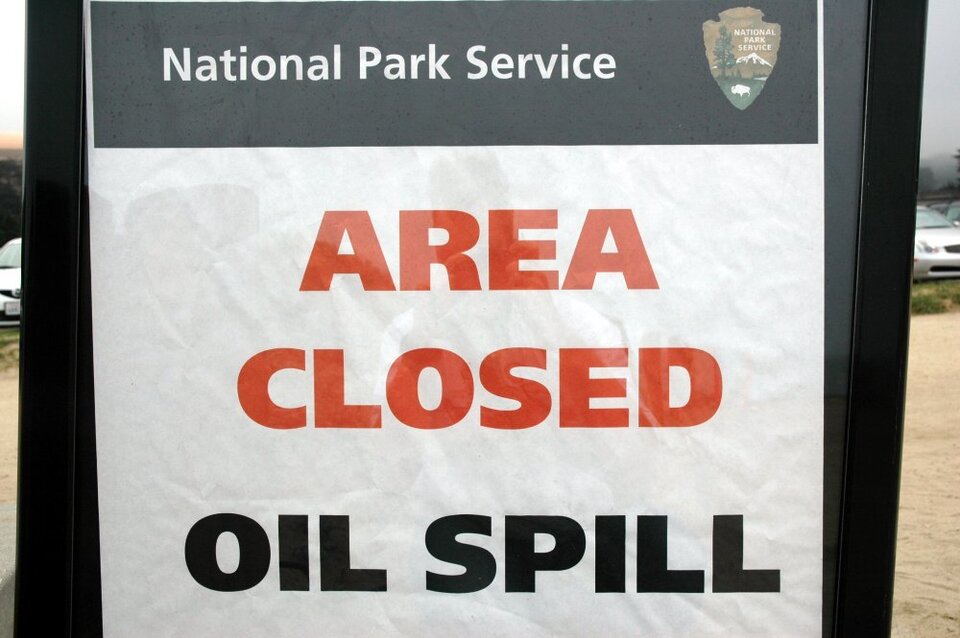
Angelika After the fires in Southern California and an earthquake with a magnitude of 5.6 with an epicenter near San Jose (about an hour's drive south of San Francisco), another incident tested our nerves: Two weeks ago, a container ship rammed a pillar of the Bay Bridge in dense fog. Surprisingly, the bridge withstood the impact because there is something like a giant cushion around the bridge pillar, a kind of shock absorber for collisions of this type. However, the container ship "Cosco Busan" (not to be confused with Michael's favorite store "Costco") lost 58,000 gallons (about 220,000 liters) of oil, which flowed into the San Francisco Bay. It's madness! Unfortunately, the Coast Guard initially underestimated the extent of the disaster, assuming it was 140 gallons instead of 58,000. Quite a significant difference!
The mayor, Gavin Newsom, who had just been re-elected the day before, was quite furious about this misjudgment. Valuable time was lost before the cleanup efforts with the appropriate equipment began. Governor Schwarzenegger declared a state of emergency and immediately banned fishing in the affected regions. The authorities closed off numerous beaches, including many of our favorite beaches like Rodeo Beach in the Marin Headlands and the coastal strip around Crissy Field. Rundbrief 02/2007 .
Volunteers not only collected oil-polluted seabirds, but also scraped the grease off stones and scooped oil clumps out of the sand. In the meantime, most beaches are accessible again, and the first cleaned birds have been released back into the wild, but the consequences of the environmental disaster are still not foreseeable.
At the same time, the search for those responsible and the mutual blame game began. I wouldn't want to be in the shoes of the captain of the "Cosco Busan" and the pilot on board, who has more than 25 years of experience. The fog can't really be blamed either, as dense fog is more the rule than the exception in San Francisco. That's why pilots board the ships to safely navigate them through the challenging waters around the Golden Gate and Bay Bridge.
Moreover, the ship was equipped with two radar systems. However, the pilot now claims that these did not function properly. But even our mayor faced criticism because he flew off to Hawaii with his new girlfriend a day after the accident happened. The chief officer of the coast guard was replaced without a fuss. Environmentalists and politicians also have harsh words for the private specialist firm "O'Brian's Group" from Louisiana, which was hired by the shipping company of the container ship to manage the cleanup operations. I was initially surprised that such firms even exist, but apparently, collecting oil in all kinds of waters is a lucrative business. A commission is now supposed to investigate the circumstances that led to the accident.
Michael Only recently, we visited a national park that had been on our list for a long time, but was so far off the beaten path that we just couldn't bring ourselves to go: Yellowstone. It is half the size of the German state of Rhineland-Palatinate and extends into three American states: Montana, Idaho, and Wyoming.
The name "Yellowstone" comes from the Native American inhabitants who lived in this area more than 11,000 years ago and likely referred to the yellowish stones of the "Yellowstone Grand Canyon" (not to be confused with the Grand Canyon National Park in Arizona).
Angelika Yellowstone is not only one of the most popular national parks in the USA, but also the first national park in the world. The American Congress designated Yellowstone as a national park as early as 1872, and it was not until 18 years later that Sequoia, Kings Canyon, and Yosemite followed. The politicians of that time demonstrated remarkable foresight. They relied on the reports of the first explorers and painters who visited Yellowstone and decided that this special piece of land should be protected from exploitation and destruction.
However, in the first decades, things continued to be chaotic because there was no proper state supervision. Poachers and vandals were causing trouble. In 1886, Congress even called in the military for help, and soldiers (for the only time in the history of American national parks) moved into Yellowstone to protect the park. In 1916, Congress finally established a new agency to protect and manage the national parks according to the founding idea, the National Park Service. Even today, all 58 American national parks are under the authority of this agency. My goal is to visit all the American national parks. I have already seen 23.
Many Americans feel a deep connection to certain national parks, as generations have spent numerous summers camping, fishing, and hiking in Yellowstone or Yosemite. Unfortunately, some national parks are literally being loved to death by the masses. Parks where attractions are easily accessible by car and require little walking suffer from high visitor numbers with an amusement park mentality. In Yellowstone, we often shook our heads when hordes would drive up to the parking lot, quickly take a photo, and jump right back into their cars. However, we often only needed to escape onto a nearby hiking trail to be by ourselves again.
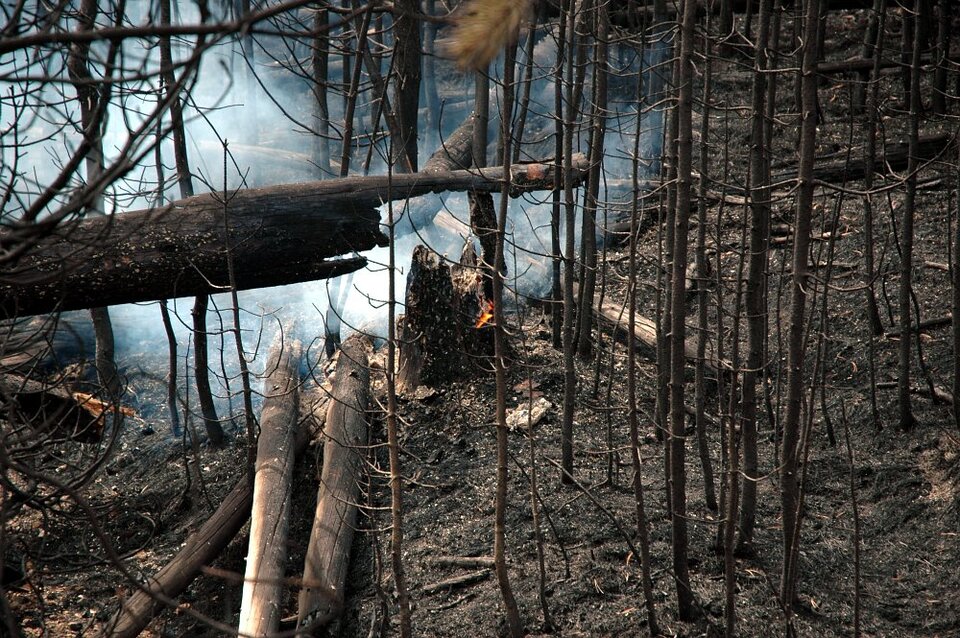
Michael Not only careless campers or malicious arsonists cause forest fires. They often have completely natural causes, such as lightning strikes or intense sunlight. The fire then renews the forest. The old trees go up in flames, the pine cones fall to the ground, and the heat of the fire releases the tree seeds contained within them, which then slip into the soil and, after some time, allow new trees to sprout.
Until 1988, the park rangers in Yellowstone followed the "Let it burn!" policy regarding fires and only intervened with firefighting vehicles when human lives or historical structures were at risk. However, in 1988, a third of the national park burned because, by the time the park service finally decided to intervene, the fire was no longer controllable. The 15 separate fires spread at times with rapid speed, up to 1.5 km per hour. One of the fires, under extremely dry weather conditions and aided by wind, actually covered 15 kilometers in a day!
Firefighters from all parts of the country who were called to the emergency area cut firebreaks in the forest, with a total length exceeding 1,300 kilometers. However, there was no stopping it; the fire broke through these barriers with few exceptions. It even leaped over the Yellowstone River to the forest on the other bank to continue its path. Firefighting experts call this effect "spotting." The wind carries ping-pong ball-sized embers from a blazing fire hundreds of meters away, and at the point of impact, they immediately ignite small fires on the bone-dry ground.
At the northern end of the park, the fire approached the private property of the sect "Church Universal and Triumphant," and the community threatened to sue the park if their sacred sites were damaged. Firefighters intervened massively with water helicopters, and sect members positioned themselves near the fire front to ward off the flames with chants. The action was successful, and both groups considered their contribution crucial to this small partial success.
But elsewhere, the fire continued to blaze uncontrollably. After three months, it was finally possible to contain the fire due to the onset of snow and rain. Nowadays, the motto "Let it Burn" is no longer applied without restriction; only fires that meet certain criteria are allowed to burn out by the park rangers, while all others are extinguished rigorously.
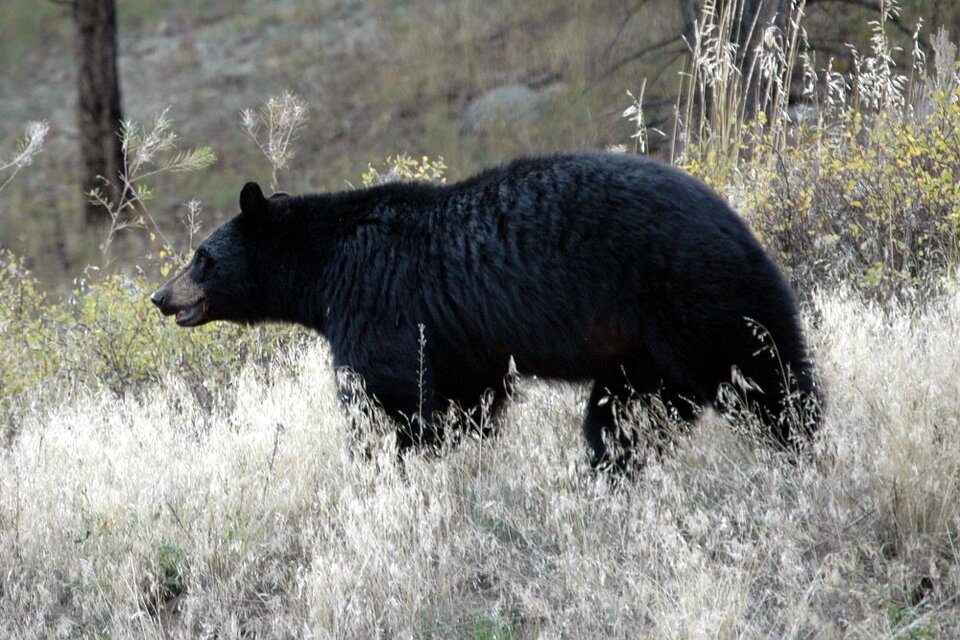
Michael In Alaska we have ( Rundbrief 05/2006 ..on a boat tour, we once saw bears from a distance. In Yellowstone Park, we drove through the northern areas by car and suddenly came across a larger crowd of people being kept in check by a ranger. In such cases, there's usually some kind of animal to see, and we looked around curiously. And indeed: On a rather steep slope to the left of the road, a bear was crawling around! I immediately grabbed my camera from the back seat and took a few photos through the windshield, but the ranger was wildly waving her arms, indicating that I should move on and not hold up traffic. We parked a few hundred meters further along the roadside, walked back, and joined the crowd to watch the bear. And there were actually two, a bear cub traveling with its mother, an impressive black bear sow.
Bears are unpredictable animals with incredible strength, capable of killing a person without much effort. And if, for example, you happen to get between a bear cub and its mother, the mother bear will go berserk, and that's no picnic. The ranger then gestured wildly and instructed the people to stay in a group, as bears do not attack groups, only individuals at most.
The bears lingered for a while on the slope before suddenly approaching the road. The ranger seemed to have anticipated this, as she had cleared a path about 20 meters wide, free of people and cars, for the bears to cross the road. We stood about 10 meters away, and I was already considering what to do in case we needed to intervene, as we had bear pepper spray with us. But the single mother bear and her cub purposefully trotted across the road and continued down the slope on the other side. To speed things up, the ranger made herself appear larger, clapped her hands, and shouted loudly, "Go bear!" which didn't have any significant effect, as a bear doesn't take orders from anyone. Then the ranger threw a small stone in the direction of the bears, causing the bear cub to jump aside in fright, but the mother didn't budge. Eventually, the two of them wandered off, the crowd dispersed, and we continued on our way. You experience things here!
Angelika Crazy as it may seem, for a long time, one of the main attractions of Yellowstone was feeding the bears to see them up close. In souvenir shops around Yellowstone Park, we frequently came across old postcards that proved this. Even garbage dumps behind the hotels in the park became tourist attractions because the bears would come there to rummage through the trash. However, bears are extremely dangerous when they become accustomed to humans. As we were already told in Alaska, bears think about eating 24 hours a day because they need to build up a thick layer of fat for hibernation. Additionally, bears are creatures of habit. For example, they return to the same river every summer to fish for salmon. If they learn that humans have food, they no longer shy away when they catch a human scent but instead approach campsites and break into tents or cars parked nearby. We often heard the saying from park rangers: "A fed bear is a dead bear!" because the bear no longer behaves naturally.
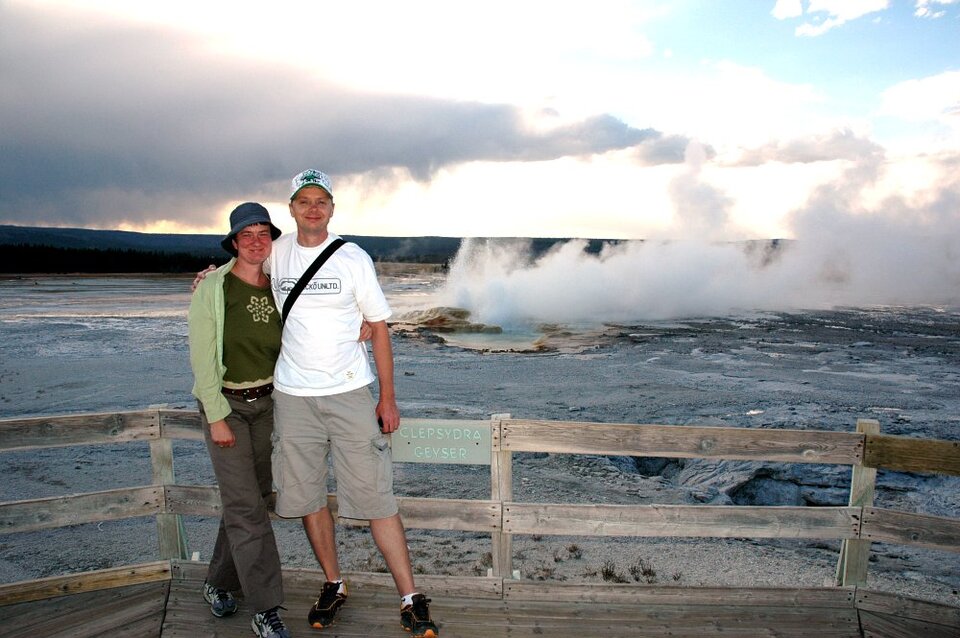
Angelika Yellowstone is of volcanic origin and offers a unique worldwide concentration of 300 geysers, as well as bubbling mud pots and hot springs. We often felt like we were in a witch's cauldron, as it bubbled, steamed, and puffed everywhere quite intensely.
Geysers form when three components come together: water, heat, and a natural system of underground pipes and cavities connected to the Earth's surface by a narrow channel. Rain or snow water seeps deep into the Earth into underground cavities, where it is heated by volcanic magma. Because the water column above the reservoir exerts pressure on the water, the water at the bottom heats up well above the boiling point of 100 degrees Celsius before turning into steam. Steam bubbles rise through the channel, displacing the water in the water column, causing the pressure in the channel to drop, and the highly superheated and pressurized steam in the cavity shoots up through the channel. A fountain of steam, condensed water, and sometimes minerals or rock particles then erupts from the geyser hole.
Now geysers erupt in the most diverse patterns. Some simmer for years without anything happening, while others shoot water out twice daily with beautiful regularity. In Yellowstone, we encountered many geyser enthusiasts who patiently waited for hours for a particular geyser to erupt. They knew how to interpret every bubble or gurgle.
As we all know, Michael can't sit still in one place for very long, so we had to be content with the eruptions of the "Old Faithful" and "Riverside" geysers. "Old Faithful" erupts in a tourist-friendly manner every 60 minutes, and the whole thing resembles a Disneyland set more than a national park. Benches are set up in front of Old Faithful, where crowds of people settle shortly before the eruption and then scatter back to the parking lot like startled chickens shortly afterward.
Even more than the geysers, I was fascinated by the hot springs, which often shimmered in the most beautiful shades of blue in the sunlight. At the edges, microorganisms create shades of green, yellow, red, and orange. The water is boiling hot, and multilingual warning signs caution visitors not to leave the wooden walkways or even think about putting their hands in the water.
However, it is alarming how foolish some tourists can be. We witnessed with our own eyes how an unsuspecting tourist left the wooden walkway to get a better position for a photo. Thankfully, her husband immediately called her back. In the somewhat eerie but very fascinating book "Death in Yellowstone" by Lee H. Whittlesey, I read that most accidents in Yellowstone occur because people behave carelessly and fall into the boiling springs.
In 1981, for example, a 24-year-old Californian jumped headfirst into a hot spring with a temperature of about 95 degrees Celsius to save his friend's dog. Since dogs cannot assess the temperature of water, they are not allowed on the hiking trails and boardwalks around the thermal fields. However, the dog in question had escaped from a car parked nearby. Neither the dog nor the man survived the incident.
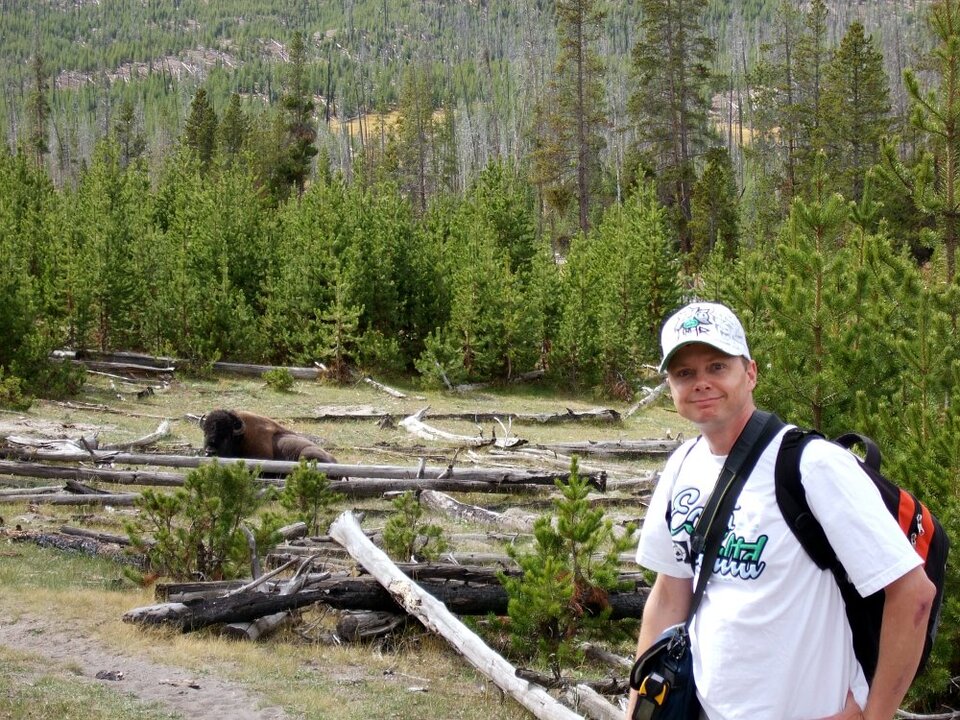
Michael Bisons, also known as "buffalos," number about 5,000 in the park. They are quite peace-loving if you don't get too close to them. However, if you breach the recommended safety distance of 20 meters, they quickly turn into aggressive furies that have already gored tourists and caused serious injuries. On a hiking trail, we didn't even notice a bison lying in the sand behind a stand of trees until it suddenly stood up when we got too close. We cautiously stepped back, and since there was no way to continue on our path without upsetting the buffalo, we reluctantly turned around.
Even on the road, you sometimes encounter these buffalo, which leisurely trot from one grazing spot to another and are not afraid of anything or anyone. It's quite exciting when you're sitting in a rental car and one of these buffalo approaches!
Michael On the way to Yellowstone, we stopped in Salt Lake City for a day to browse around in our favorite library, the Family History Library of the Mormons. Rundbrief 11/2006 The translation to English is: "We have already reported on this fascinating collection of books and microfilms.
I read an essay this time by a Robert Thomas from the year 1938 titled "Family Names and Family History, Publications of the Bavarian State Association for Family Culture e.V., Issue 6". It states in old German script that people in the past only had first names and no last names.
Around the year 1200, there were, for example, about 12 men named "Heinrich" in Augsburg. With increasing population density, it became necessary to distinguish individuals by additional names. Thus, a Heinrich who worked as a weaver might become "Heinrich the Weaver." An unusually tall one might be called "Heinrich the Tall," and one who had traveled from Bobingen might be "Heinrich the Bobinger." Over centuries, these additions developed into the surnames as we know them today. For a long time, however, the first name remained the primary name. For instance, if you look at the signature on Albrecht Dürer's paintings, you notice a large "A" and a much smaller "D" disappearing into the "A.
Other surnames refer to hair color, such as "Schwarzkopf" (black head), "WeiÃhaupt" (white head), and "Fuchs" (for redheads). If a place name is found in a surname, it refers to immigrants. In the Swabian region, there was no one with the name "Schwab" unless they had moved away and then returned to Swabia.
The translation to English is: "As job titles, 'Meier' is known as a word for vassal, tenant, or also owner of an estate. Schultheiß The derived form "Schulze" was a court official who "demanded debts," meaning he collected dues. The "Krüger" was the innkeeper, as he handled jugs. And the fact that there was virtually no division of labor in the Middle Ages meant that each craftsman made a product from start to finish, but had to limit themselves to a small range of products. As a result, even "Löffler" (spoon maker) and "Gabler" (fork maker) existed, leading to corresponding surnames!
Some names are meant to be mocking, such as "Krebs" (crab), which refers to a rope maker who walks backwards, or "Breitkopf" (broad head) or "Gnugesser" (glutton) for someone with a large belly. Noble-sounding names like "König" (king), "Graf" (count), or "Fürst" (prince) do not necessarily originate from actual nobility, but also from people who presented themselves as such, as well as from shooting and beggar kings. Additionally, those who worked for a count or prince often received this name suffix.
If you want to study the little booklet and happen to be in Salt Lake City, you can simply go to the Family History Library, take the elevator to floor B1 to the international section, and look on the shelf under "Europe 943.3 B4." Just walk right in, no registration required. A top-notch place!
Angelika On October 31st in San Francisco, not only do children go from house to house to collect sweets, but the traditionally more adult-oriented Halloween party also takes place in the Castro, the gay district. Rundbrief 11/2001 We have already reported on this tradition, which has been maintained for 30 years. Admittedly, the party always gets quite lively, especially as the night progresses. Last year, the city moved the curfew forward to 11 PM for safety reasons.
At the Castro party, crowds of people typically gather in the craziest costumes (many barely dressed) and dance in the street along the not-so-wide Castro Street. Originally, the event was purely a neighborhood affair, essentially a crazy carnival street festival, also meant to celebrate and creatively express one's own homosexuality in a colorful way. Over the decades, the Castro Halloween party has grown increasingly popular, and in recent years, estimates suggest that between 200,000 and 300,000 people have come to the Castro district. This has pushed the capacity to its limits.
Unfortunately, among the participants last year, there were also a few complete idiots who thought it was appropriate to shoot firearms. A few young punks got into an argument and thought it could be resolved with gun violence. Why someone would bring a weapon to a Halloween party is, of course, a good question.
Nine people suffered gunshot wounds last year. The city fathers, who had long been annoyed by the extravagant party (there was a stabbing in 2002), quickly put an end to it this year by simply canceling the event. No one in San Francisco had expected them to get away with it. Many feared that the ban would lead to acts of defiance and civil disobedience.
But the city council pulled out all the stops. They persuaded many bar and restaurant owners to close their doors early, so partygoers had no opportunity to get drunk in the immediate vicinity of the Castro District. By the way, at the first Halloween party we attended after moving to San Francisco, alcohol was still available for purchase publicly on the street!
Then our mayor, Gavin Newsom, and his men decided to simply close off the Muni and BART stations (public transportation system in San Francisco) around the Castro early in the evening and simultaneously severely restrict parking in the neighborhood, making it difficult to reach the non-existent party. Of course, this didn't deter us at all, as we live practically next door, just one hill to the east.
On Castro Street, however, we were met with a sad sight, as only a handful of the fearless showed up. The place was swarming with police officers who were competing to look intimidating and were quick to reprimand anyone for the slightest rule violation. For example, I crossed a street intersection and stepped slightly over the white line that, as is customary in America, indicated the pedestrian crossing. A police officer immediately whistled me back. The police also had strict orders to arrest anyone who misbehaved in public while intoxicated.
The sledgehammer approach led to the desired success; most people stayed away from the Halloween party in the Castro, and the roadblocks prepared just in case were left unused by the roadside. I was really disappointed with our otherwise progressive San Francisco. Not only does the city council allow itself to be silenced by aggressive young troublemakers and simply cancel an otherwise predominantly peaceful festivity, but also the gay movement in San Francisco has apparently aged a bit and now prefers to spend Halloween on the couch at home in a quiet neighborhood. According to rumors, it is primarily the residents of the Castro district who want the party to take place elsewhere in the future.
Everyone gets old, except us!
The translation of "Angelika und Michael" to English is "Angelika and Michael.