02/03/2008   English German

Previous
edition
  Edition # 73  
San Francisco, 02-03-2008
Next
edition


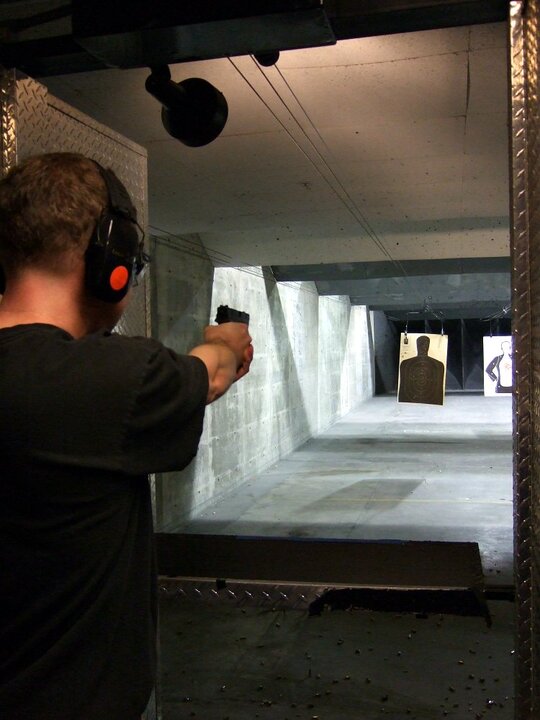
Figure [1]: The intrepid newsletter reporter is shooting with a 9-millimeter handgun.

Michael When a colleague asked me one day if I wanted to go shooting with him over the weekend, I naturally agreed. We have previously reported (Rundbrief 01/2001) that in America, it is quite normal for private individuals to have handguns in their homes.

Shooting ranges, such as for example, "Jackson Arms" in South San Francisco, not far from the supermarket "Costco", offer opportunities for practice.

Now, my aforementioned colleague owns a handgun of the type Springfield XD-9 and we properly packed it into a box secured with a padlock, loaded the box into the trunk of our car and sped 10 minutes down the highway heading south to the shooting range. In California, a firearm must, as previously mentioned (Rundbrief 08/2003), be unloaded, transported separately from the ammunition, and in a locked container. It must not be kept in the glove compartment to prevent the idea of blowing away other road users in a fit of rage.

Figure [2]: Did I really hit it?

At the shooting range, we had to hand over our California driver's licenses and sign a form to accept the club's rules. My colleague had been there before and was therefore classified as a "Coach" (trainer). The instructor led us to the end of hallway with the gun and a practice round, and we went through the loading and unloading process. I had spent some time in the military many years ago, so I was already familiar with everything, and it went quickly.

Figure [3]: At the shooting range "Jackson Arms"

In two sections, separated from the entrance area by double doors, there were eight shooting chutes each. These areas, open at the front and back, were about 10 square feet in size and had a small table on which you could place the gun and load the magazine with bullets. We were given targets that either showed rings with numbers or human silhouettes. These were attached with clips to a cart that ran on wire cables and could be moved 30 to 100 feet onto the shooting range at the push of a button.

Our instructor explained that you are not allowed to wave a loaded gun around or go back to the cashier area from the shooting range. Additionally, randomly shooting at the side walls of the shooting lane will result in a "strike." For the first "strike," you receive a warning, and for the second, you must leave the shooting range and can only return the next day. Naturally, all of us were well behaved. We recorded everything and put it on Youtube.

We had a hell of a time, each firing around 60 shots, and found out that it's not so easy to hit a person at a distance of 10 meters with a 9mm gun. The thing has quite a recoil, and you really have to aim carefully and hold steady to hit the target.

Primaries - Who will be the next president?

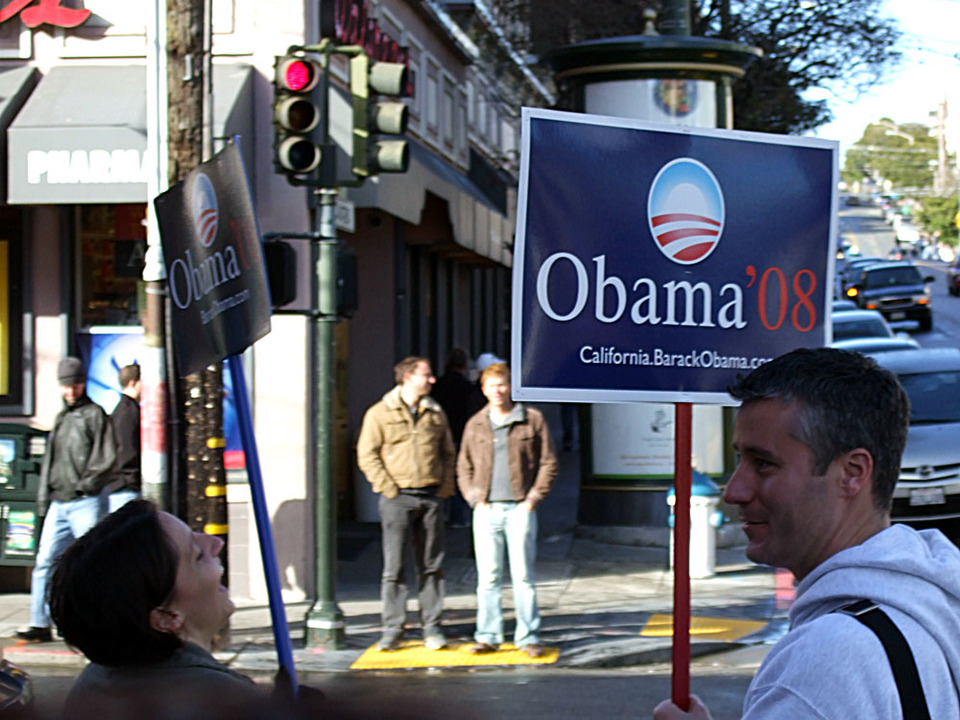
Figure [4]: Obama supporters in the Castro District in San Francisco

Angelika The American election campaign machine is in full swing, and for months the media have been bombarding us with forecasts, debates, and commercials of the candidates for the American presidency. At the end of the primaries, two candidates emerge, one for the Republican Party and one for the Democratic Party -- and one of them will become the President of the USA in the actual elections in November. Usually, interest in these primaries is relatively low, and voter turnout is extremely low, but this year everything looks different.

TODO

This is partly because there is currently no clear favorite among either the Republicans or the Democrats. Among the Democrats, Hillary Clinton and Barack Obama are engaged in an exciting race. Although their political concepts do not differ significantly, many Democratic voters are wondering whom they should vote for. Should it be the young, charismatic Barack Obama, the Senator from the state of Illinois, who promises to unite the country across all political divides? Or perhaps Hillary Clinton, who repeatedly emphasizes her thorough knowledge of the White House and the Washington establishment, but also carries the baggage of her husband Bill Clinton?

Many voters are apprehensive about replacing the Bush dynasty with a Clinton dynasty, especially since no one really knows what strings Bill Clinton is pulling behind the scenes. The historical dimension is also important to many voters: for the first time in U.S. history, either a woman or a Black person has a chance at the highest office in the country. And many already see Barack Obama as the reincarnation of John F. Kennedy, as he excites the masses regardless of skin color, age, and income, at least as it seems in San Francisco.

Figure [5]: A staunch supporter of Hillary Clinton

Among the Republicans, the former Vietnam veteran and long-time Senator from Arizona, John McCain, and the millionaire businessman and former Governor of Massachusetts, Mitt Romney, are leading. For weeks, the country debated whether the Mormon Romney is even electable due to his religious affiliation. Romney's Mormon status is particularly problematic for the religious right, which predominantly votes Republican. The former Baptist pastor and former Governor of Arkansas, Mike Huckabee, is also holding his ground, as he is particularly appreciated by the conservative-religious base. So far, primaries have been held in 7 states, but everyone is now eagerly awaiting February 5th, the so-called "Super Tuesday," when primaries will take place in 22 more states.

The hellishly complicated system of primaries I have briefly... Rundbrief 08/2004 The text translates to:

"described, but today I will try to explain it more precisely. In principle, in American primaries, the citizen does not directly cast their vote for their favored candidate; instead, they elect delegates who then determine the presidential candidate at the respective party conventions.

Some ballots therefore do not list the candidates, but only the delegates. The number of delegates a state is allowed to send to the party conventions is determined by the population density of the respective state. There are different methods for converting the number of votes cast into delegates.

The Democratic Party strictly follows the proportional method, meaning that if the Democratic Party from state X is allowed to send, for example, 100 delegates to the convention and Candidate A secures 70 percent of the votes, Candidate A receives 70 delegates. The Republican Party leaves it up to the individual states to decide whether to use the proportional method or the "winner-takes-all" approach (where the candidate with the most votes receives all the delegates). alle The translation to English is: "Delegates) are being proceeded with.

In these primaries, the Republicans end up with a total of 2,380 delegates and the Democrats with 4,049. At least according to the current situation, as Florida's and Michigan's votes are not being counted for the Democrats at the moment, because the Democratic Party stripped both states of their delegates due to their unauthorized early elections. Hillary Clinton would like to reverse this punitive action, as she won in Florida and Michigan. To be nominated at the convention, the Republican candidate needs the votes of 1,191 (out of 2,380) delegates, and the Democratic candidate needs 2,025 (out of 4,049).

Figure [6]: A supporter of Hillary Clinton in San
Francisco>

Interesting are the delegates who are not bound by the primary election results but instead cast their votes at the party conventions according to their own discretion. These are usually party officials and elected representatives. The Democrats amusingly call these delegates "superdelegates," while the Republicans simply refer to them as "unpledged delegates." The Democrats are sending 796 of these superdelegates to their convention in Denver in August, while the Republicans have 463 at their convention in Minneapolis/St. Paul. Generally, the superdelegates do not have much impact, but this year they could become the deciding factor for the Democrats if the race between Obama and Clinton remains neck and neck.

Figure [7]: The entire San Francisco is hot for Obama.

It is also interesting whether the individual states hold "primaries" or "caucuses." You can think of primaries as regular elections. Voters go to their polling station and cast their vote on a specific day. There are closed and open primaries. In closed primaries, only registered party members are allowed to vote. However, the registration process is often quite straightforward. Democrats vote for the Democratic candidates, and Republicans for the Republican ones. In open primaries, party affiliation does not matter.

However, the American system also includes a mixed form, namely partially open primaries, where independent voters may be allowed to participate under certain circumstances. In California, for example, the Democratic Party allows independent voters to participate, while the Republican Party prohibits it. This might surprise you, but the Republican Party fears that the less conservative candidate of their party might win in California, as the state has a high proportion of independent voters who are considered more moderate. An American acquaintance even told me that her friends, who lean more towards the Democratic side, register as Republicans in California to influence the selection of the Republican candidate.

In English, the text translates to:

"Under 'Caucus,' you should imagine a party meeting at the local level. People meet, for example, in schools and debate which candidate is best suited, and later, usually in a public vote, determine the favorite. The corresponding delegates are then sent to the higher-level meetings at the county and state levels, to ultimately determine the electors for the national party convention. However, the method of the 'Caucus' is increasingly falling behind. Only about one-third of the American states still conduct 'Caucuses.'

Figure [8]: The translation to English is: "Grandma Meume
is also for Obama.>

Something peculiar about the primary election system is that the primaries do not all take place on the same day, but are staggered between January and July. New Hampshire and Iowa traditionally vote first because New Hampshire's laws stipulate that their primary must be held a week before any other primary. This results in smaller states with relatively small and homogeneous populations (in Iowa, for example, white farmers dominate the demographics) having significant influence on the initial selection of presidential candidates. This irritates more populous states like Florida and California, leading to a trend of increasingly earlier primaries.

You may remember that initially 9 Democrats and 11 Republicans entered the race. Currently, among the Democrats, only Hillary Clinton, Barack Obama, and Mike Gravel, who no longer appears in debates or in the press, are left to choose from. Among the Republicans, John McCain, Mitt Romney, Mike Huckabee, and Ron Paul are still in the race, and as mentioned, California will not vote until Tuesday. The field of candidates thins out relatively quickly after the first primaries because campaigning in the USA is extremely expensive, and candidates who receive few votes have difficulty raising funds to continue their campaigns.

No one throws their money out the window and continues to support a candidate who no longer has a realistic chance. However, people like John Edwards (Democrat) or Dennis Kucinich (Democrat) or even Rudy Giuliani (Republican) could have certainly received votes in California. I know many who wanted to vote for John Edwards or Kucinich (the most left-leaning candidate) on Tuesday and now can't do so. It even goes so far that some Californians who have already voted by mail and, for example, gave their vote to Edwards, are now left in the lurch because their vote no longer counts since Edwards is no longer in the race.

Figure [9]: In this beautiful Victorian house, there also
lives an Obama supporter.>

By the way, anyone who thinks that a Democrat is guaranteed to move into the White House as President is mistaken. Especially if McCain secures the nomination for the Republicans, he could very well win the election later on. John McCain embodies what Americans like, particularly those in the middle of the country. He is a former Vietnam veteran who survived captivity and torture in Vietnam, and for this reason, he is a strong opponent of torture. And although he voted for the Iraq War and supported Bush in this regard, many see his experiences in Vietnam and his long military career as an advantage in resolving the mess in Iraq.

He is also considered pragmatic, speaks plainly, and is known for acting in a non-partisan manner, all qualities that are particularly appreciated by the more moderate conservatives as well as independent voters. For instance, he advocates for a humane solution to the problem of illegal immigrants in the country and attempted, together with the staunch Democrat Ted Kennedy, to push a bill on this issue through Congress and the Senate, which ultimately failed.

Figure [10]: A postcard with Barack Obama's
campaign.>

On the other hand, he is quite conservative. He is against abortion and wants to make the tax cuts introduced by Bush permanent. Those hoping for a Democratic president should keep their fingers crossed that Mitt Romney wins the nomination for the Republicans, because according to polls, the chances for the Democratic candidate increase if the opponent is Romney and not McCain. It's just a shame that we can't vote, because my vote would go to Obama.

Autokauf

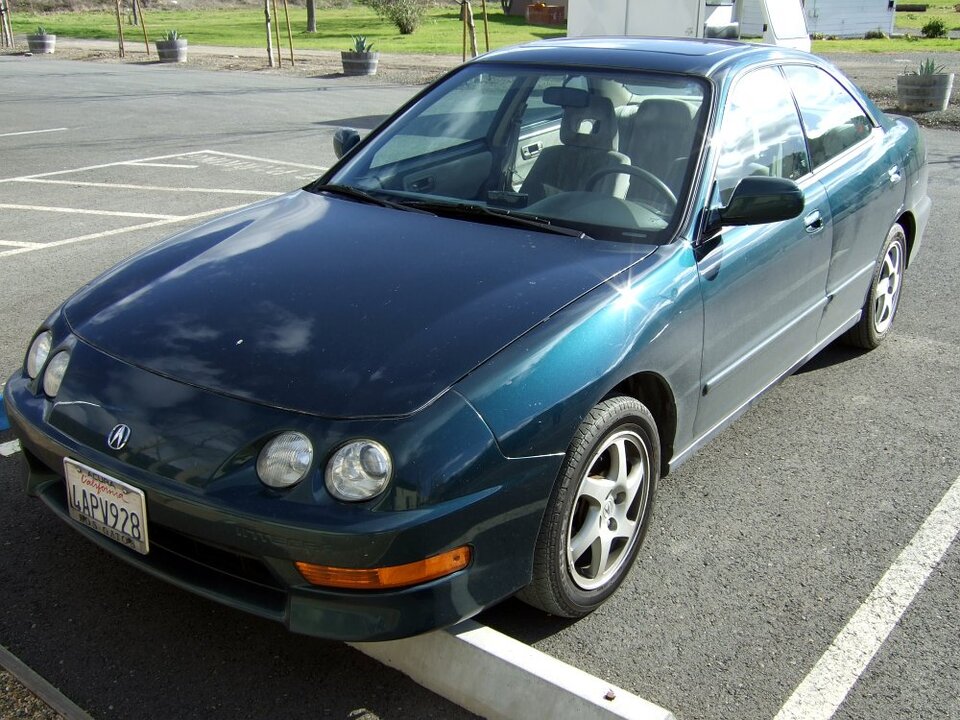
Figure [11]: The Perlman successor "Rocket

Michael How do you buy a used car from a private seller in the USA? A few months ago, we bought a PERLMAN successor and can share our experiences with you today.

What kind of car should it be? I recommend Japanese cars from the brands Honda and Toyota. In America, Honda sells the more expensive models under the name "Acura," and Toyota presents them as "Lexus." Both are excellent brands that I highly recommend if you need durable, well-equipped, and absolutely reliable luxury vehicles.

Certainly! Here's the translation to English:

"Yes, I'm not a fan of German cars. They are overpriced, rated as unreliable by 'Consumer Reports' (the American equivalent of 'Stiftung Warentest'), and recently have shown serious manufacturing defects. One of my colleagues bought an S-Class Mercedes, and after a few years, the trunk was rusted through. In California, without snow, can you imagine that! Another colleague had to take a new Porsche Boxster to the workshop with a broken engine after four weeks. I have no understanding for such sloppy work. After our '91 Acura Integra got old, we recently bought a '98 Acura Integra. Almost 10 years old, 100,000 miles on the clock, but it runs like hell with its 170 horsepower. And we also bought the PERLMAN when it was 7 and drove it for 10 years without any significant problems!

First of all, you need to negotiate a price with the seller. The standard value for a used car is listed in the "Kelly Blue Book," which is available for free online at kbb.com. You enter the make, model, and year, and also add extras like a sunroof or air conditioning. In America, 90% of people drive automatic cars, as manual transmission is less in demand. However, anyone who can really drive, which is only about 10% of Americans, drives cars with manual transmission.

The condition of the vehicle is either "Excellent," "Good," "Fair," or "Poor," depending on how dented the car is and what flaws it has. Furthermore, a distinction is made between "Trade-in Value" (what the dealer offers when you trade in your old car), "Private Party Value" (the price you can ask as a private seller), and "Suggested Retail Value" (the price used car dealers can charge).

Figure [12]: Das "Certificate of Title" eines
Kraftfahrzeugs wird im Englischen als "vehicle title" oder "car title" bezeichnet. Es ist ein offizielles Dokument, das den rechtmäßigen Eigentümer eines Fahrzeugs ausweist.>

To find out if the car has been involved in accidents, failed emissions tests, was stolen at some point, frequently bought/sold, or has had any other issues, the company "Carfax" offers an information service on the internet. You pay $29.95 and can then check as many vehicles as you want using their VIN ("Vehicle Identification Number") for a month. Not bad, but not flawless either, as Carfax, for example, did not know that our PERLMAN had already been in an accident. Rundbrief 09/2001 .

After concluding the price negotiations, a decision is made. Bill of Sale"translates to English as "Bill of Sale." It is a legal document thatrecords the transfer of ownership of an item from a seller to abuyer. Translate to English: a form that can be downloaded as a PDF from the California Department of Motor Vehicles (DMV). It is only half a page long and you only need to fill in the names and addresses of the seller and buyer, the purchase price, and the VIN. The seller signs it. To exclude liability, you should draft a document that includes the phrase "Sold 'As-Is' without Warranty.

The buyer then pays. But how? You don't just carry a few thousand dollars around in your pocket, and besides, everyone is afraid of counterfeit money because dollar bills have very few security features. Additionally, cash leaves no traceable records in the banking industry, and proving how much money actually changed hands is almost impossible afterwards if disputes arise.

American checks for larger amounts are not accepted by anyone who is reasonably sane. They are often not covered and "bounce," which means that the recipient simply does not receive the money. Even if everything goes well, it often takes up to a week for a check to "clear," meaning the money from the transaction arrives in the recipient's account. Usually, the money arrives earlier, but it cannot be withdrawn because the transaction has not yet been confirmed. It's hair-raising.

Figure [13]: A cashier's check.

For car purchases, people use so-called "Cashier's Checks." The buyer goes to the bank (which is open on Saturdays here in the USA), requests a Cashier's Check from the teller for the negotiated car price, and has it made out to the name of the recipient. The amount on the check is immediately deducted from the buyer's account. This ensures that the check does not bounce. The check is signed by the teller, not the buyer. During the purchase, the buyer hands the Cashier's Check to the seller, who then deposits it at their bank. One should not lose the check, as it cannot be easily canceled. There have been fraud cases with counterfeit Cashier's Checks, so sometimes the seller asks the buyer to accompany them to the bank to deposit the check. This way, any potential fraud would be immediately detected.

In order for a car to legally change ownership, the seller must sign the vehicle title, known as the "Certificate of Title" (illustration 12), twice. Once to release the car ("the signature below releases interest in the vehicle") and once to confirm the stated mileage. Additionally, the buyer also signs to prove that both parties are aware of how far the vehicle has traveled. The "Certificate of Title" used to be pink and was called the "Pink Slip." This should not be confused with the termination notice for workers, also called a "Pink Slip," which was also printed on pink paper. "To get the pink slip" means "to be fired" in America. But I digress.

Later, for a while, a colorful mixture of colors could be seen on the vehicle registration document, and it was called the "Rainbow Title." Nowadays, it is pink again with a blue border, and people usually just call it the "Title." At the very bottom, there is a signature field for a "Lienholder," but this is only relevant if the car doesn't actually belong to the seller but to the bank, for example, because it was financed. Otherwise, this field simply remains empty.

The "Title" is transferred to the buyer's possession after the seller has removed the top part with the red boxes. The seller fills out this form and sends it by mail to the Department of Motor Vehicles (DMV) so that they are informed of the transaction. This is important because the responsibility for the vehicle (accidents, tickets) is thereby transferred from the seller to the buyer.

Figure [14]: The back of the "Rainbow Title," which the
buyer fills out to register the car.>

When a private individual sells a car, they must ensure that a certificate for an emissions test ("Smog Test") passed no more than three months ago is available. The DMV has this data electronically, making it impossible to cheat. The buyer has the right to the corresponding certificate but must explicitly request it from the seller.

On the back of the vehicle registration certificate 14, the buyer enters their information and takes it to the DMV office. There, they pay a re-registration fee (about $30) and a "Use Tax" on the purchase price. This tax is as high as the sales tax in California (8.5% in San Francisco). When buying a car from a dealer, the sales tax is typically added by the dealer, but since the insatiable state of California also wants to see money from private vehicle sales, the DMV collects this tax. It adds up: For a sale price of $5,000, you pay $425 to the DMV, which hurts the wallet! The DMV employees ask the buyer for the sale price, and if the buyer lies and the price is completely unreasonable, the value set in the "Kelly's Blue Book" is used.

The seller should insist that the buyer registers the car as soon as possible. Any tickets will still go to the seller until then. Although the seller is not liable, they must explain to the DMV each time that the car has already been sold, and the aforementioned form sent by the seller is solid proof. The buyer is required to register the car within 10 days, or else they will face penalties. It also happens that the seller asks the buyer to go to the DMV with them, so the seller can see with their own eyes that the car is re-registered and the transaction is completed.

The DMV retains the title, by the way, and sends a new one to the new owner within two weeks. On this new title, the signature fields are blank again, and the new owner can later sell the car again using the same procedure.

It is also common to have the car inspected by a mechanic for a price of about $50. The potential buyer bears the cost. Of course, you can never be completely sure that you won't be ripped off, which is why I recommend conducting such transactions preferably with colleagues.

The threshold for committing fraud is relatively high, after all, everyone knows where the other works and can cause quite a stir if problems arise unexpectedly. I bought a colleague's car through Yahoo, and everything went smoothly. It was her husband's favorite car, but since she couldn't drive a manual transmission, he had to sell it!

San Francisco Views: Hunters Point

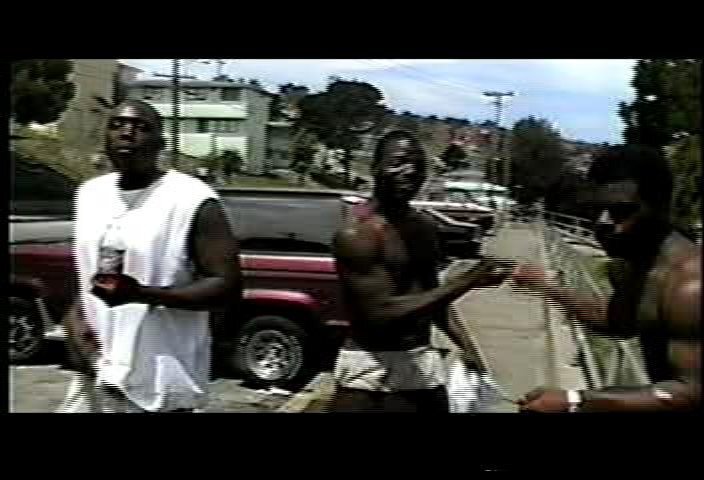
Figure [15]: Scene from the film "Straight Out of
Hunters Point>

Michael In our series "San Francisco Views," today we visit the notorious twin neighborhood "Bayview"/"Hunters Point." It is located so far south that no tourist ever wanders there, and that's a good thing. Long-time residents of San Francisco cringe at just hearing the name of the neighborhood, would never drive there under any circumstances, and strongly advise any newcomer against even approaching the area.

Figure [16]: Hunters Point is
located on the southeastern outskirts of San Francisco.>

The book on Bayview/Hunters Point (illustration 17) from the well-known neighborhood series, which dedicates a volume to each district of San Francisco, only features old black-and-white photos and reminisces about past times when Hunters Point was still a relatively normal working-class area with a shipyard.

Figure [17]: The book "San Francisco's Bayview
Hunters Point>

Figure [18]: The substation in Hunters Point.

After World War II, however, the shipyard was immediately closed down. The predominantly black shipyard workers were dismissed and housed in barrack-like social housing buildings in the neighborhood. Over the years, the conditions deteriorated dramatically, and by the 1970s, a veritable slum had developed, where rival street gangs were causing trouble.

Figure [19]: The film "Straight Out of Hunters Point

Figure [20]: The corridors in the evening news

The documentation Straight out ofHunters Point It provides quite a good insight into the catastrophic conditions there. Although there is a handful of dedicated people trying to turn the neighborhood around, it is not easy for the residents to escape the vortex of violence and drugs. And since in America the schools of a neighborhood are mainly funded by the residents through property taxes, the schools in Hunters Point look like a mess. The children learn nothing, and the parents don't care -- the next generation of gangsters is pre-programmed. The translation of"Musik-Video 'Straight out of Hunters Point'" to English is "Musicvideo 'Straight out of Hunters Point'. Some gangsta rappers from the run-down neighborhood boast about their misdeeds.

Although news reports about shootings in Hunters Point no longer appear daily, it's practically impossible for an ordinary citizen to drive around there. The newsletter reporter, known as a thrill-seeker, ventured in anyway with a car, camera, and GPS--on a Sunday morning, when the worst criminals are known to still be asleep. Some were still around and looked somewhat puzzled. A car with two menacing-looking figures even turned around and followed the reporter's car, but he had already taken his photos and sped away at full throttle.

Figure [21]: The "Project" in Potrero Hill

The phenomenon of completely run-down neighborhoods in the USA is often associated with the so-called "projects." In this type of public housing, barrack-like buildings were simply placed in solid residential areas and populated with marginalized social groups. Much to the dismay of the local residents, of course, who saw the value of their homes plummet to dizzying depths. Urban planners hoped that the newcomers would integrate, but they found that after a few years, the buildings became totally dilapidated and the crime rate in the neighborhood skyrocketed.

Figure [22]: Green and orange houses in the "Project" in
Potrero Hill>

In the "Potrero Hill" neighborhood in San Francisco, there is also such a "project," and it's still quite lively there today. Anyone who takes the 48 bus, which I have dubbed the "adventure bus," from the Caltrain station on 22nd Street to Noe Valley will experience one or two adventures, especially in the evenings.

Nowadays, "projects" are usually smaller houses that are built with more architectural sophistication. There's one on Cesar Chavez Street around the corner from us that seems to be doing reasonably well--at least better than ten years ago when we moved to San Francisco and the area was called the "death zone." The smaller construction style also has the advantage that residents tend to identify more with their homes and don't let everything deteriorate with an "I don't care" attitude.

Figure [23]: A small church in Hunters Point.

Figure [24]: It actually looks quite idyllic in Hunters
Point, but only on Sunday mornings.>

And Hunters Point even has some nice areas where residents get involved and take a stand against the bleak everyday life of the projects. The video "Hunters PointHeroes It introduces people who carry out small projects (e.g., creating a small garden), achieve minor improvements, and are immediately celebrated as everyday heroes. America and its optimism!

Indian tribes and their casinos

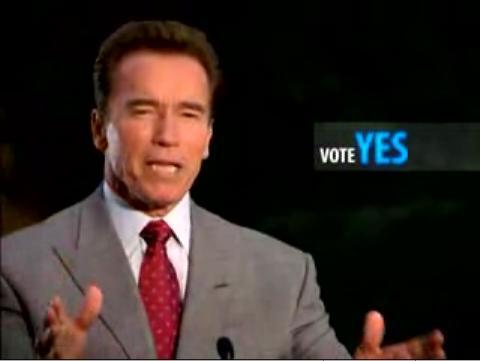
Arnie is campaigning to vote 'yes'.

Michael Currently, commercials are haunting television, in which even our beloved...

Indians? Casinos? What?" you might be asking now, and I think I need to elaborate a bit. Not so long ago, the indigenous people, the Indians, lived on the American continent. Then the Spaniards came first... Rundbrief 05/2000 ..and later all sorts of other people settled on the land of the Native Americans. They resisted vehemently in some cases, but ultimately succumbed to the Europeans, who plied the Native Americans with firewater and took their land from them in not always fair ways.

Nowadays, Native Americans either live integrated into society or isolated in so-called reservations. Rundbrief 10/2006 That goes so-so, their huts are quite poor, and people hang around on the street, just a 'No Motivation/No Future' kind of society. Since they don't make a lot of money from the few pearl necklaces and straw baskets they produce, they lack the funds to build schools and provide their children with a better future.

In 1988, the American Congress came up with a procedure to help these tribes generate income more quickly: they allowed them to operate independent casinos on reservations under the "Indian Gaming Regulatory Act" (IGRA). The profits were not subject to taxes and could be invested in the development of the reservations. A casino is practically a license to print money, and the cash flowed abundantly because Americans gamble like crazy.

This, however, brought other interest groups into play, who did not see why ordinary people should pay a heap of taxes while the Native Americans brought in money tax-free by the shovelful. Nowadays, there are 400 Native American casinos spread across America, generating a total of 18 billion dollars annually!

A years-long back-and-forth ensued, resulting in the tax burden on the Native Americans being gradually increased. California recently even brokered a deal whereby the Native Americans will pay three times as much in taxes as before.

But for some, that is still not enough, and that's why especially regular casinos and teachers' associations (which benefit from more money in the state treasury) are mobilizing against the rigged contract. Both groups apparently have tons of cash, as they are constantly broadcasting...

As always, there are two sides to the story of the Indian Gaming"refers to the gambling operations conducted by Native American tribesin the United States. These operations are typically regulated underthe Indian Gaming Regulatory Act and can include casinos, bingohalls, and other gaming activities on tribal lands. What amuses me about the whole back and forth, however, are the completely transparently manipulative commercials, which were technically sophisticated in filming and editing, but the content shows that amateur demagogues were at work here. We can't vote anyway, but we still watch the commercials with interest.

Chicago

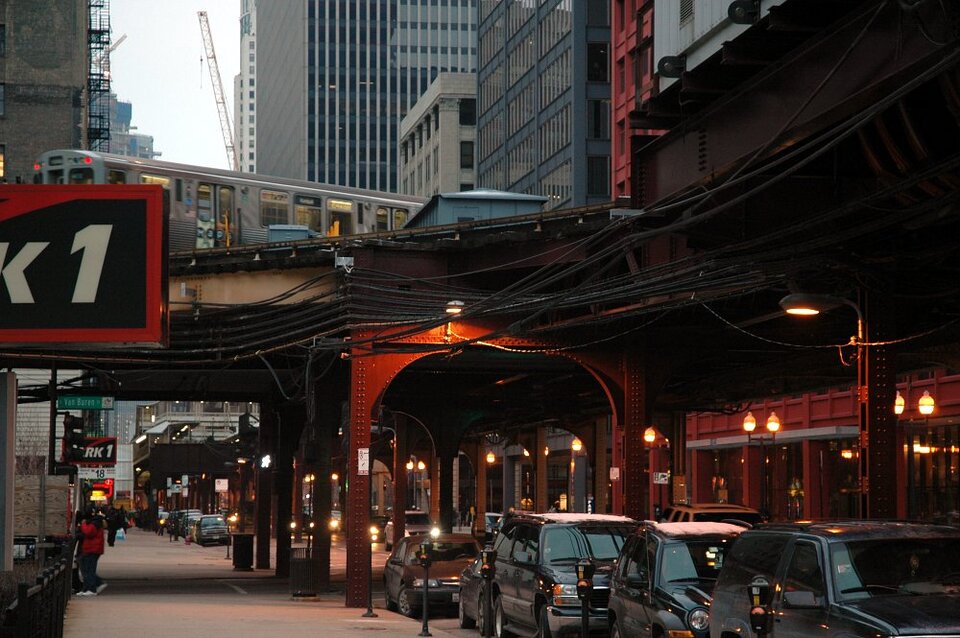
Figure [25]: The elevated railway in Chicago

Angelika There aren't many American cities that really blow you away, as many get lost in the monotony of suburbs and skyscrapers (San Francisco and New York are, of course, not included here). Since many people have repeatedly told us how amazing Chicago is and I had never set foot in this city, we thought, why not just fly there for New Year's Eve?

Michael had actually been there once before, 20 years ago, but he could only vaguely remember that he and his friend Christian had wanted to visit the zoo in Chicago. However, upon exiting the subway, they walked in the wrong direction and ended up in a rough neighborhood that shocked them so much that they never made it to the zoo.

Figure [26]: A brownstone house in Chicago

Now you must know that Chicago is colloquially known as the "windy city," which didn't initially impress me much as a true North German. However, in winter, the temperatures there are similar to those in Germany, and there's snow as well. So, we reconsidered and stocked up on winter jackets and boots. A wise decision, because on New Year's Eve it promptly snowed, and it was cold in Chicago.

Figure [27]: Angelika, snugly wrapped in her puffer
anorak at a subway station in Chicago.>

Nonetheless, we really liked the city. Not only is there a great subway system (not a given in America), but it even has the romantic variant where the trains partially run as elevated trains through downtown and other neighborhoods. And that in the truest sense of the word, because the system is quite old in some parts. The mix of the most modern architecture alongside old, still ornate skyscrapers and historic brownstone buildings gives the city a special touch. You can also find charming little neighborhoods like in San Francisco, without chain stores but with interesting, independent shops and good restaurants in Chicago. The Wicker Park neighborhood, for example, reminded us of Valencia Street in San Francisco. Rundbrief 08/2007 By the way, Chicago has a lake ("Lake Michigan") right in the middle of the city (hence the wind), which is surely wonderful in the summer, but not suitable for delicate Californian plants in the winter. We spent hours in the heated "Art Institute," an impressive, enormous museum that offers everything from European and American paintings to photography and contemporary modern art, delighting the heart of any art lover. So if you're planning your next trip to America, don't hesitate to put Chicago on your list.

Figure [28]: Angelika curled up on the windowsill of
the hotel room.>

Good evening, everyone!

The translation of "Angelika & Michael" to English is "Angelika & Michael," as these are proper names and typically do not change when translated between languages.

RSS Feed
Mailing Liste
Impressum
Mike Schilli Monologues


Get announcements for new editions

New editions of this publication appear in somewhat random intervals. To receive a brief note when they're available in your mailbox (about once every two months on average), you can register your email on the 'usarundbrief' Google Groups list.

Your email address


All Editions:


Send us a comment
We'd like to hear from you, please send us feedback if you want to comment on the content or have suggestions for future topics.

Simply write your your message into the text box below. If you'd like a response from us, please also leave your email. If you want to stay anonymous, simply put 'anonymous' into the email field. This way we'll get the message, but we have no way to respond to you.

Your email address


Message

 
Contact the authors
Latest update: 03-May-2026