
Japanese Class
Michael Since we want to go to Japan either this year or next year, we are currently learning the language in a course that takes place every Saturday in Japantown in San Francisco. There, a Japanese woman teaches us Japanese in both spoken and written form. It's absolutely crazy, of course--Japanese has absolutely nothing in common with European languages, and it is also written completely differently. There are no individual letters, but thousands of symbols that either represent things or determine pronunciation or grammar.
That's why one learns in two stages: Practical phrases are learned acoustically and written down in a "romanized" script, meaning with Western letters that roughly represent the pronunciation. For example, "Hajimemashite. AOL no Schilli desu. Dozo yoroshiku onegai itashi masu." translates to "Hello, how are you? My name is Schilli and I work for AOL. Very pleased to meet you." It is spoken as "Hascheeme-mush-te. AOL no Schilli dess. Douso yorosch-ko onega-e-eetashymass."
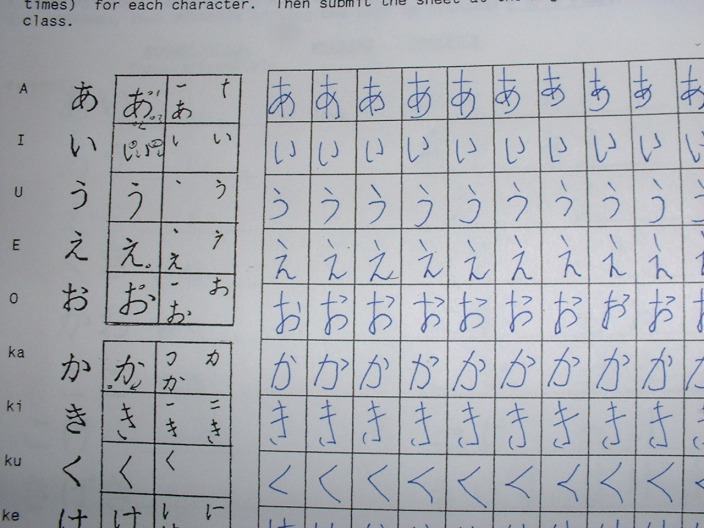
The writing system is divided into three parts: Kanji, the Chinese (!) characters that represent things or concepts. Then there are Katakana characters, which the Japanese use to phonetically spell out foreign words. Naturally, there is no Kanji character for "computer" because it didn't exist a few thousand years ago when Kanji was developed. So, the Japanese say something that sounds similar ("Co-n-pyu-ta") and piece together a few Katakana characters for it. The third script is Hiragana, a type of phonetic script used to attach grammatical endings to words or to phonetically spell out words. For example, there is a Hiragana character for "Ka" or "Gu." Some Japanese children's books are written entirely in Hiragana. Train stations in Japan are, by the way, labeled in both Kanji and (below) in Hiragana.
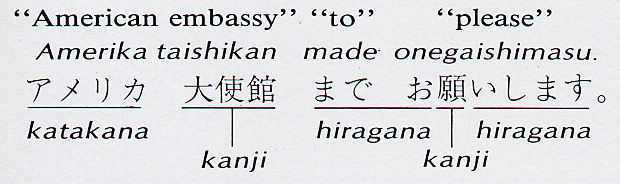
The three scripts are mixed together colorfully. For example, the sentence "Please take me to the American embassy" is written using all three: For "embassy," there are three Kanji characters that are placed together to mean "embassy." "American" is, of course, not a Japanese word, so it is phonetically spelled out in Katakana ("A-me-ri-ka"). The rest is grammar ("ma-de" for "to" and "onegai shimasu" for "please") and consists of Kanji and Hiragana.
We are learning Hiragana so that we can just read like children. But believe us, that's already hard enough (Figure 1).