
Japanese Bath
Angelika The use of a Japanese bath poses the risk for Western tourists of stepping from one faux pas to another. It is important to follow some key rules. Japanese people bathe to relax, not to clean themselves. The most popular time for bathing is before dinner. In Japanese accommodations, travelers will find either communal baths (usually separated by gender) or private baths, both in the Japanese style. To accommodate multiple people in the communal bath, the dimensions of the tub-like structure that guests enter are somewhat larger. The bathwater is freshly drawn once a day and reused. Therefore, the first faux pas would be to pull the plug when leaving the "bathtub." Since many people enter the same bathwater, which contains no additives (neither chlorine nor bath foam), one washes before bathing.
In a ryokan in Kyoto, we enjoyed the luxury of a private Japanese bath, which consisted of a wonderfully deep wooden bathtub that smelled delightfully of fresh wood. In our private bath, we practiced the etiquette to perfect it before using the communal bath at our temple accommodation in Koya-san. In Japan, it is customary for families to bathe together, even if a private Japanese bath is available, which one could certainly use alone. During our shared baths, Michael was always worried about the wooden walls of the bathtub. He feared they might break if we leaned too hard against them. (The chair-leaning issue was still on his mind.)
How does the cleansing process before bathing take place? Typically, the communal bath has an anteroom. Here, you completely undress. Baskets are available for your clothes. A bit away from the bathtub, there are water taps, bowls, small stools, shampoo, soap, and shower gel. Sitting on the stool, you wash yourself with soap. It is important to thoroughly rinse off the soap residue to ensure that no remnants get into the bathwater. Often, there are also handheld showers (much to Michael's delight), which make washing much easier. In our temple accommodation, I was among the lucky ones, as there was no one in the women's bath when I used it. Michael had the company of some monks. By the way, Japanese people usually carry a small towel with them. No one washes or dries themselves with it. It is solely used to discreetly cover oneself in the appropriate areas during the washing process. This towel must not be dipped into the bathwater. However, many Japanese place it on their heads when sitting in the "bathtub." The bathwater is extremely hot -- that's how the Japanese like it, as the muscles are supposed to relax after a strenuous day.
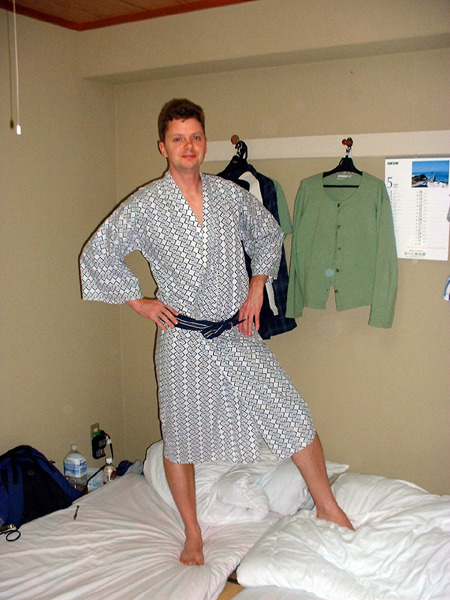
After bathing and drying off, everyone slips into a kind of bathrobe ("Yukata"). Yukatas are available in every Japanese accommodation. No one minds if you walk around the house in it, have dinner in it, or use the bathrobe as pajamas. The left side of the bathrobe is wrapped over the right. I always focused on doing this correctly because right over left means that you are no longer among the living. The only question that remained unanswered: What should we wear under the Yukata? Underwear? T-shirt? Socks? No travel guide answered this crucial question. To prevent getting cold, there is also a kind of overcoat that you can wear over the "Yukata," called "Tanzen".