
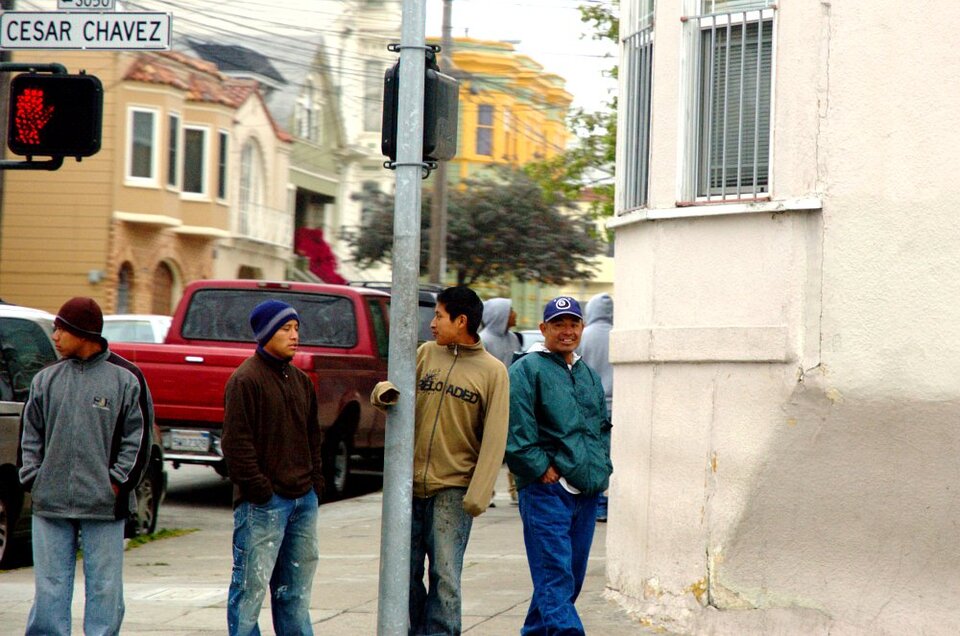
Michael Not all immigrants in the USA have a valid residence permit. It is estimated that there are about 12 million illegal immigrants in the country, of which about 5-6 million are Mexicans (as of 2007). Often, they have left a village in a Latin American country, paid a smuggler (called "Coyote," pronounced "Ka-y-ote" in American English) about $1,500, and then marched through the desert for up to 40 hours to find work somewhere in the USA and try out the American dream. Often, they work in restaurants, moving up from dishwasher to busboy, to salad preparer, and maybe to grill cook.
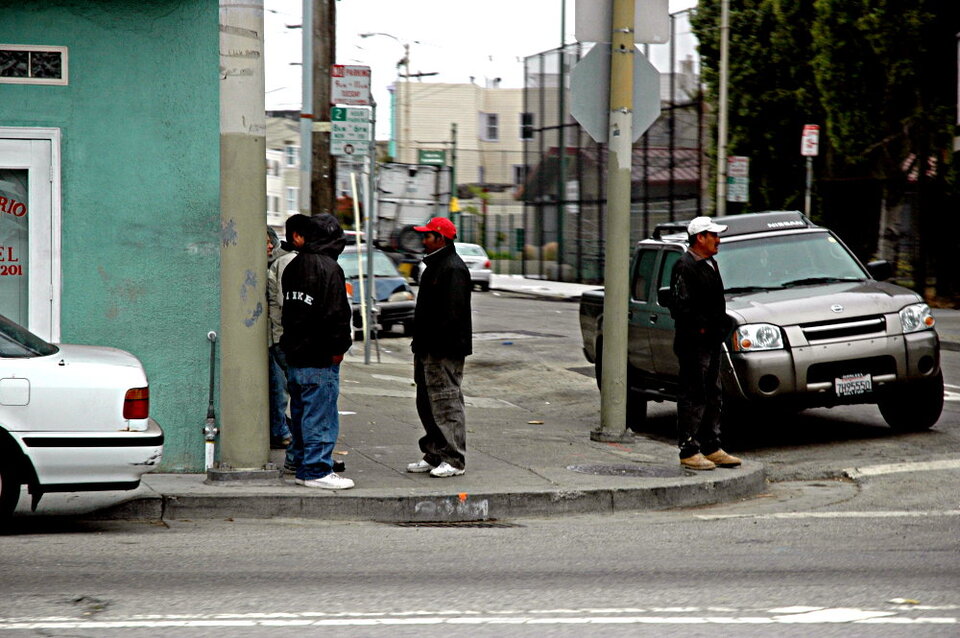
On Cesar Chavez Street, just around the corner from us, hundreds of young Latin Americans gather in small groups early in the morning, waving at passing pickups in the hope that one will take them to a construction site where they can perform hard labor for a few hours at a negotiable wage. They are called "Esquineros," from the Spanish word for street corner, "Esquina." Other pickup spots with masses of willing workers can be found in the parking lots of large hardware stores like Home Depot or Lowe's. There, you can also see the specialization of the workers: those wearing white clothing perform painting work, while the rest are responsible for other laboring construction tasks. Although there is competition among the workers, who immediately run over and wave frantically when a hardware store customer shows interest in hiring help, everything generally proceeds remarkably peacefully. Many undocumented immigrants want to avoid any conflict with the law or even drawing unwanted attention, as they risk deportation otherwise.
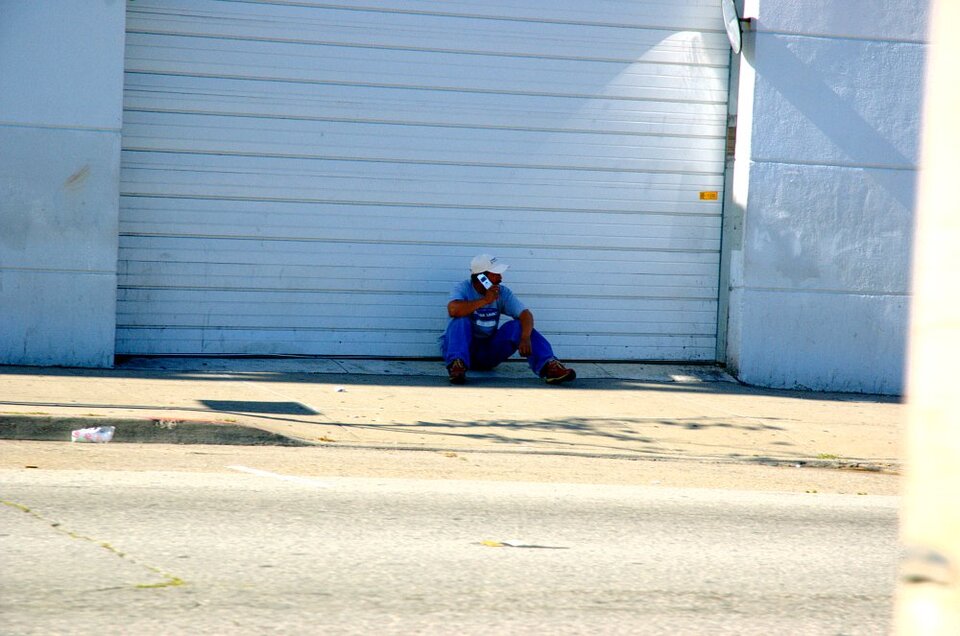
Additional pickup points are located in front of the garages of moving truck rental companies like U-Haul. When I ride my bike through Alameda Street at 7:30 in the morning, there are always a few dozen workers standing in front of the U-Haul center, approaching anyone who seems to be renting a moving truck with broken English, saying "Do you need any help?" or "Want someone to do the work for you?"
The hourly rate is around 5-10 dollars, so on a good day, an "Esquinero" can earn up to $100, but on a bad day, they go home empty-handed. By the way, not all casual workers are illegal immigrants, but according to studies, about three-quarters are. Although the practice is not legal, it is not pursued by the police because they are not responsible for immigration issues. Moreover, everyone knows that on every construction site and in every restaurant kitchen, some illegal immigrants work -- it's part of everyday life in America. And it's not as if "undocumented immigrants" operate in a completely lawless space. It does happen that the official federal labor agency, the "Department of Labor," advocates for illegals who have been cheated or had to work under unacceptable conditions. This is, of course, a balancing act because the illegals fear being deported and remain silent in case of doubt.
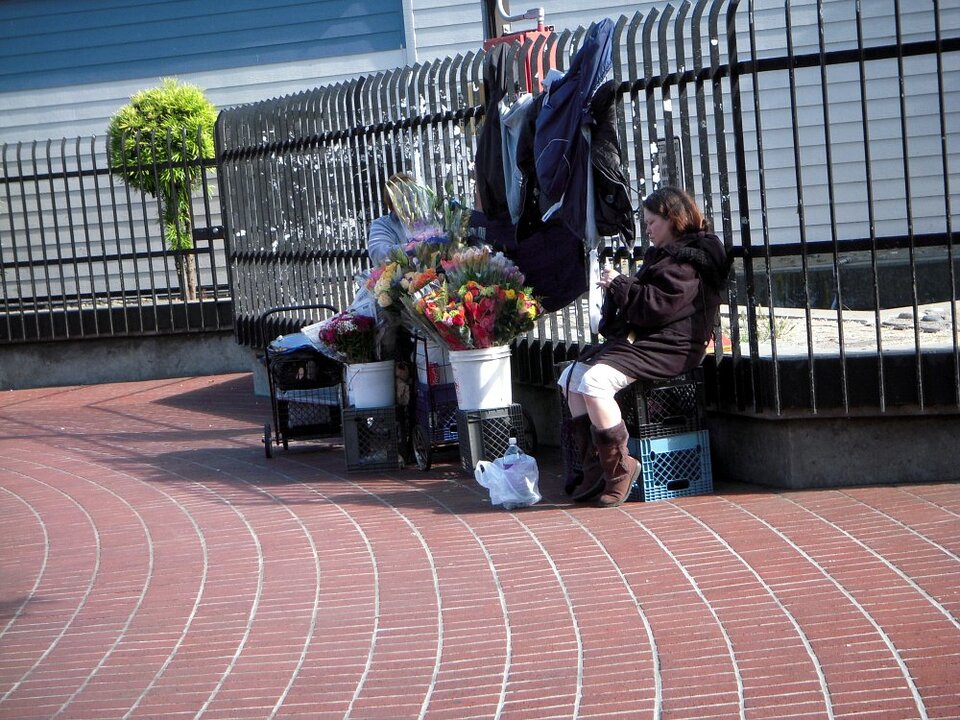
You don't see women on Cesar Chavez Street, as usually only the men come across the border, earn enough money in a few years for a decent house in Mexico, and then return to their wives and children who were left behind. Additionally, the division of roles among South Americans is rather "traditional." However, at subway stations, you often see women selling flowers or the Mexican dish "tamales" (laboriously cooked meat in corn husks).
In San Francisco, we tend to view illegal immigrants with a wink, but there are certainly people who don't find it amusing and who start initiatives to put an end to it through political means. For example, in 1994, there was Proposition 187 in California, a referendum that denied illegal immigrants access to the public school system and hospitals, and it achieved a clear majority of 59% among the population. However, the Federal Appeals Court, a federal court, quickly put an end to this.
The politicians are not exactly tearing themselves apart to address the problem: they know all too well that the American economy urgently needs illegal workers. Thus, in 1994, Rudolph Giuliani, as the mayor of New York, issued an order that no city agency was allowed to leak any information about illegal immigrants to the immigration authorities. His successor, Bloomberg, also issued an order in 2003 that significantly restricted city employees' ability to ask probing questions about immigration status--at a time when many were calling for a police state after September 11, 2001. In San Francisco, the rule "Don't ask, don't tell" has always applied, which surely doesn't surprise you. No questions are asked, and no one has to give awkward answers.
In Mexico, this leads to abandoned villages where eventually there are not enough children to justify operating a school. Although parents do not want their children to migrate north to the USA, they usually receive monthly payments (remittances) from there, which put them in a good financial position in their home village, so they often turn a blind eye.
By the way, Mexicans do not only immigrate to the southern United States, but they are also particularly present in New York City. Why are illegal immigrants drawn to the far north, to a city that, with its harsh winters, is certainly climatically unfamiliar to many? Firstly, in New York, due to the good public transportation connections, no one needs to drive a car, which would be an incalculable risk for illegal immigrants without a driver's license or insurance. And, of course, they feel well accommodated there, where there is already a high presence of immigrants from Mexico, where the population accepts illegal immigrants, and where one can easily make connections and find work quickly and reliably through social networks.
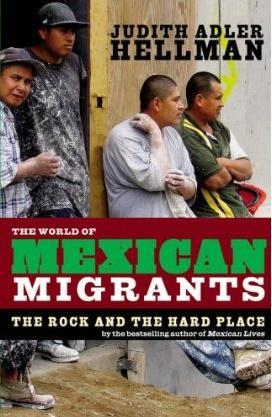
Are you interested in the topic? The beautifully written book "The World of Mexican Migrants" by Judith Hellman describes all the small details of everyday life and the life stories of the Mexicans who left their villages to seek the chance for some prosperity on "al otro lado" (the other side), as the USA is called in Mexico.