
Angelika While President Obama was battling with healthcare reform and its critics in recent weeks, something else groundbreaking happened. In early August, the Senate confirmed the appointment of a new Supreme Court Justice to the U.S. Supreme Court, the highest court in the United States: Sonia Sotomayor is not only the third woman to hold this position, but also the first person of Latin American descent in the 220-year history of the court.
She fills the position of Justice David Souter, who retired at the age of 69. Appointments to the court carry significant weight during a president's term because they are lifetime appointments. If you look at the list of currently active Supreme Court justices and which presidents appointed them, you'll know what I mean: Samuel Alito (appointed in 2006 by George W. Bush), Stephen Breyer (appointed in 1994 by Clinton), Ruth Bader Ginsburg (appointed in 1993 by Clinton), Anthony Kennedy (appointed in 1988 by Reagan), John Roberts (appointed in 2005 by George W. Bush), Antonin Scalia (appointed in 1986 by Reagan), Sonia Sotomayor (appointed in 2009 by Obama), John Paul Stevens (appointed in 1975 by Ford), Clarence Thomas (appointed in 1991 by George H. W. Bush).
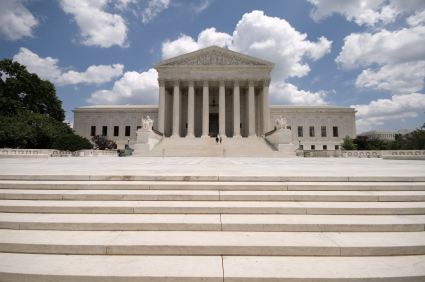
If you've been keeping count, you know that the Supreme Court consists of a total of nine justices. The 54-year-old John G. Roberts serves as the Chief Justice. By the way, the Constitution does not specify how many justices should make up the Supreme Court, but since 1869, there have been nine. An odd number of justices is advisable, however, to avoid possible deadlock situations.
There are actually only three ways to lose a seat on the Supreme Court: impeachment, death, and voluntary resignation. However, there has only been one attempt to remove a justice. This occurred in 1805 when the House of Representatives impeached Justice Samuel Chase, but the necessary votes for conviction in the Senate were not obtained, so the justice remained in office--a strong endorsement of the separation of powers between the legislative branch and politics.
At 55 years old, Sotomayor is among the younger justices of the Supreme Court and likely has many years ahead of her in which she can shape the court and, more broadly, American society through her decisions. Her vote is just one of nine, but especially when the court is balanced between conservative and liberal justices, this one vote can potentially tip the scales.
It is the responsibility of the judges to ensure, as a last resort, that the American Constitution is applied lawfully. It is not about writing new laws, but about applying existing law. That sounds good, but the American Constitution is often written so vaguely that it does indeed matter how the judges interpret the legal text. Generally, the Supreme Court deals with appellate cases, i.e., cases that have already been decided in lower courts.
Presidents certainly try to influence the court by selecting candidates who align with their views. The big questions that arise repeatedly are: What is the newly appointed judge's stance on abortion, gun ownership, affirmative action, or civil rights? While the president may propose their ideal candidate, that person only gets a seat on the Supreme Court if the Senate confirms them through a two-step process. First, the Senate Judiciary Committee questions the Supreme Court candidate and gives a green or red light on whether the candidate should be voted on by the full Senate. If the committee agrees, a simple majority in the Senate is sufficient to confirm the nomination.
During Sotomayor's hearing, the senators primarily focused on the following comment she made in a 2001 speech in California: "I would hope that a wise Latina woman, with the richness of her experiences, would more often than not reach a better conclusion than a white male who hasn't lived that life." Many Republican senators interpreted this statement as reverse discrimination.
She also had to answer for her notorious decision regarding the firefighters of the city of New Haven. The city of New Haven required its firefighters who wanted to be promoted to take a test, but then did not consider the results because no black individuals would have been promoted to a higher position due to low test scores. The city suddenly got cold feet and feared that someone would sue because no minorities appeared with higher ranks. Consequently, predominantly white firefighters who had performed well on the test sued, arguing that they missed out on promotions due to the disregarded test results. Sotomayor sided with the city of New Haven, but her current Supreme Court colleagues later overturned her decision.

During the hearings, candidates nowadays carefully avoid directly answering sensitive questions (such as those on the topic of abortion). They often beat around the bush. The Senate ultimately confirmed Sotomayor's nomination with a vote of 68 to 31. Incidentally, it is not guaranteed that the President's preferred candidate will actually act in accordance with the President's wishes on the court, because due to the separation of powers, the Supreme Court is independent of both the President and Congress.
Republican presidents have historically nominated seemingly conservative judges to the Supreme Court, who then turned out to be extremely liberal over the course of their careers. Earl Warren, nominated by Eisenhower, is one such example. Some of the most famous and influential decisions of the Supreme Court include "Brown v. Board of Education" (1954) and "Roe v. Wade" (1973). In the former case, the justices abolished racial segregation in schools; in the latter, women were granted the fundamental right to have abortions. Behind Roe was a Texan woman named Norma McCorvey, who challenged her state's abortion ban. To protect her anonymity, she was given the name Jane Roe. Henry Wade was the district attorney of Dallas at the time. We are eager to see what Sotomayor will have a say in.