
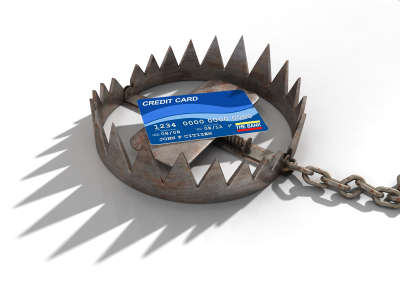
Michael Recently, Obama took the credit card industry to task. The monstrous card contracts, written in almost unreadably small print and understandable only to partially trained lawyers, which almost every American accepts without reading, must now be formulated in clear English by the card companies. Additionally, the companies committed to ceasing some of the more brazen methods they use to extract money from people through hard-to-understand clauses.
New card offers typically advertise, for example, that you can transfer debt from competitors' cards to the newly offered card for free. With this so-called "balance transfer," the transferred amount is then subject to extremely favorable conditions for a set period of time. While interest rates of 15% - 20% are usually common, transfer offers often advertise rates of 7% or even offer interest-free loans for a limited period.
Consumer associations advise against using the new card for shopping. Why? If the customer settles their purchases at the end of the month, the card company does not apply the repaid amount to the outstanding balance, but rather to the favorably transferred card debt. The ongoing balance remains open and accumulates exorbitant interest, typically around 20%. So, for example, if $10,000 is transferred and the customer makes a $100 purchase in the first month, they will pay 20% interest on the $100 until doomsday, or until they have paid off the $10,000. This is now coming to an end.
The trick of setting the payment date on a holiday is also very popular. In America, the card company sends the customer a bill by mail, which the customer then pays with a check, also by mail. If the customer sends the payment so that it arrives on the due date, the postal service naturally does not deliver it because of the holiday, and it would not be processed by the credit card company until the next business day. Bam, a hefty late fee is added to the bill! Bills not paid on time incur absurdly high penalty fees and often prompt card companies to raise the customer's interest rate due to increased lending risk. Obama's new regulations not only prohibit this trick but also require card companies to send the bill to customers in a more timely manner, giving them enough time to initiate the payment.
This predatory behavior of the credit card industry is a relatively new phenomenon. Originally, the states regulated interest rates and fees with an iron hand. The so-called "Usury Laws" of the states set different maximum interest rates, averaging around 18%. However, in the 1970s, the somewhat remote and economically underdeveloped state of South Dakota came up with the idea of giving credit card companies that registered their headquarters there free rein in setting interest rates and late fees. As a result, practically all major credit card companies moved to South Dakota, to the town with the amusing name "Sioux Falls," from where they also served customers in all other states. Even today, most credit card bills bear this postmark.

American Congress may now regulate trade between the states, but in 1978, the Supreme Court decided in the case "Marquette v. First Omaha Service Corp." that banks operating nationwide do not have to adhere to the rules of the state in which they serve their customers. Instead, they are allowed to choose the most favorable regulation from any state where they have a branch and apply it in all states. Through this loophole, all "Usury Laws" for banks operating nationwide were nullified at once. Even today, for example, Citibank has its headquarters in New York but a branch in South Dakota, from where it sends out bills with hefty interest rates of up to 30% across the entire USA. A later federal court ruling also placed local banks on the same level, so that usury laws no longer apply to them either.
People like us, who pay off their credit card bills at the end of the month with clockwork precision and never leave even a cent unpaid, are, of course, a thorn in the side of credit card companies. Although merchants who accept credit cards pay the card companies between 2% and 5% in fees for each transaction, these profits seem laughable compared to the interest paid by people who use their credit cards as a financing vehicle, with average interest rates of 15% to 20%, and who only pay back the required minimum of 2% of the debt each time. This way, the debt practically remains forever, and the cardholder is still paying interest on a one-time impulse purchase even 10 years later. Some figures from 2004: 145 million Americans owned credit cards, 55 million paid off their debt every month, and 90 million left some balance. Of those, 35 million, or one-third, only paid back the required minimum of an average of 2%!
In recent years, annual fees for most cards for regular consumers have disappeared, which previously amounted to about $50 per year. Some cards now even give customers between 1% and 3% cashback on amounts spent, so you actually save money by using the card. The cashback is often paid out in dubious points that you have to redeem for certain goods or services like flights. However, savvy customers choose cards that refund the cashback in cash. For example, our American Express card gives 3% on restaurant bills and 2% on travel expenses, and the amount accumulated over the course of a year is then paid out to us by the giant supermarket Costco. Since in America you're already considered crazy if you have $100 in cash in your pocket, you can imagine how incredulous the cashiers looked when I showed up there with my giant rebate check. They actually had to send a runner to the bank safe to pay out my refund.
But that's not all; more perks await the cardholder: If you rent a car with certain cards, a comprehensive insurance is included. If a newly purchased vase breaks or a thief snatches the new camera, the card company will reimburse the loss.

Anyone who pays with a credit card not only benefits from a cashless transaction but also holds significant leverage over the merchant. If the merchant tries to scam you, it would be extremely stressful and time-consuming to formulate and possibly enforce legal claims through a lawyer. However, if you paid with a credit card, you simply call their hotline, explain the situation, and quickly the money is taken back from the merchant and refunded to the customer, even if the merchant is furious. The merchant can then take legal action against the customer, but the burden of proof is now on them, and they will think carefully before taking legal steps, possibly in the "Small Claims Court." By the way, I recently read that the purchase amount must be at least $50 and the business must not be more than 150 miles from the cardholder's residence, otherwise the credit card company might not assist.
Credit cards are not suitable as a financing vehicle for tough times. If you lose your job or suffer financial losses, the card company immediately reduces the available credit limit and raises the interest rates to astronomical levels. Through the credit report, the American equivalent of the Schufa, they are always informed about the customer's financial situation. In the case of a "universal default," meaning a precarious financial situation of the cardholder, this can happen, even if the customer pays the card bills on time.
With Obama's proposed new rules for the card industry, which have now been approved by Congress, there are rumors that the breathtaking profits will decline and the favorable conditions for us so-called "revolvers" (as the card industry calls us due to the constant repayment of a revolving debt) will worsen. Perhaps annual fees will return as well, who knows? In any case, I can recommend an educational TV program on the topic: The Secret History of the Credit Card. on PBS. Additionally, there is a detailed article on Wikipedia about the Credit CARD Act of 2009 and the White House Fact Sheet on Credit Card Reform. summarize the facts nicely.