03/01/2004   English German

Previous
edition
  Edition # 49  
San Francisco, 03-01-2004
Next
edition


Figure [1]: The rainbow flag as a symbol of the gay/lesbian movement in the Castro.

Angelika President Bush prefers to ignore the liberal stronghold of San Francisco. On his American map, we do not exist. However, this week he mentioned the city by the Bay publicly several times. This is because our newly inaugurated mayor, Gavin Newsom, has shaken Bush to his conservative core.

Newsom issued the order to allow marriages between same-sex partners in mid-February. It began with the rewording of marriage certificates. It no longer says "husband and wife" but "spouses for life." Just in time for Valentine's Day, the first weddings took place at City Hall. In the first few days, hundreds of same-sex couples, accompanied by the San Francisco Gay Men's Chorus and cheers from onlookers, patiently lined up to receive the coveted marriage certificate. In response, City Hall even opened its doors on the weekend to handle the rush. City employees gave up their well-deserved time off and worked without pay on the typically sacred weekend for government offices to marry as many couples as possible.

The former hippie city of the "Summer of Love" was in a state of euphoric love frenzy and a thrill of civil disobedience for days. But as soon as the first same-sex couple exchanged their vows, conservatives crawled out of their holes and attempted to stop the city's actions with a judicial injunction. However, the judge ruled that there was no immediate danger. So the wedding bells continue ringing. In the meantime, San Francisco has issued around 3,400 marriage licenses to same-sex couples.

Even our very own Terminator and Governor Arnold Schwarzenegger criticized San Francisco, as the California Family Code defines marriage as being between a man and a woman. Schwarzenegger also cited the ballot initiative "Proposition 22," which over 60 percent of California voters supported in the year 2000, as it states that California only recognizes marriage between a man and a woman (Rundbrief 03/2000).

This may seem like one and the same issue to you now. But there are subtle differences. "Proposition 22" anticipates that other states might legalize same-sex marriage, which California would have to recognize without the mentioned amendment. Schwarzenegger is now harping on the fact that Newsom's actions violate California laws. He claims that it's this particular fact that concerns him as governor. Naturally, he doesn't want to offend either his Republican party friends, nor his homosexual friends in Hollywood.

Newsom, on the other hand, argues that the ban on issuing marriage certificates to same-sex couples violates the equality principle of the California Constitution, and can therefore be interpreted as discrimination. And the constitution takes precedence over any referendum and the family code. Incidentally, Bush's State of the Union address earlier this year prompted Newsom's decision. In his speech, our president predicted the downfall of civilization, should marriage between same-sex partners be legalized, which led Newsom to rebel. A decision by the Massachusetts Supreme Court then encouraged Newsom to rise up cheerfully and boldly. The judges of this small state on the East Coast approved same-sex marriages on the grounds that the equality principle of their constitution allows nothing else.

Starting in mid-May, Massachusetts will have same-sex marriage with all the rights and obligations that heterosexual couples enjoy throughout America. Only an amendment to the state constitution of Massachusetts, which some politicians there are pursuing, could stop the process. In California, too, everyone is preparing for a lengthy legal battle. San Francisco initially filed a lawsuit against the state of California for discrimination against same-sex couples. Meanwhile, the state of California, represented by Attorney General Bill Lockyer, is trying to get the California Supreme Court to prevent San Francisco from issuing the coveted marriage certificates and to declare those already issued invalid because they violate existing law in California. One thing is certain: the case will eventually end up before the California Supreme Court. The only question is when, as the court usually only deals with cases after they have gone through the lower courts. We will know more by March 5, when a second hearing has taken place before the California Supreme Court.

Bush, on the other hand, seems to be haunted by the fear that Massachusetts and San Francisco will prevail, and last week he advocated for adding an amendment to the American Constitution, stating that a marriage is only valid between a man and a woman. On the other hand, Americans generally react allergically when someone wants to tinker with their Constitution.

The Constitution is considered untouchable by many. Even staunch opponents of "same-sex marriages" therefore criticize Bush's proposal. Additionally, Americans, especially conservatives, highly value the independence of the states. Too much interference from Washington is not welcomed. A constitutional amendment at the federal level would be seen as binding for the individual states, meaning they could no longer maintain their own regulations regarding marriage between same-sex partners. To pass an amendment to the Constitution, a two-thirds majority in the American Congress and ratification by three-quarters of the states would be required.

The fairly well-known American actress and show host Rosie O'Donnell was so angered by Bush's actions that she flew with her long-time partner from New York to San Francisco to marry her at San Francisco City Hall. O'Donnell had nothing good to say about Bush. Many also believe that Bush is only thinking about his re-election campaign and wants to appease the religious right, which donates a lot of campaign funds to him, with his highly moralistic stance. Who would have thought that our dapper-looking mayor, who narrowly won the runoff election against Matt Gonzalez and was compared unfavorably to Bush and Schwarzenegger during the campaign, would establish himself as a pioneer of a new civil rights movement (as many political activists see it, Rundbrief 12/2003)? Hats off! Ah, who would want to live in another city? Overall, Newsom shows backbone. As one of his first official acts, he appointed a woman (the first in America) as the chief of the city fire department. Meanwhile, some other mayors have followed Newsom's example: In Sandoval County, New Mexico, a few same-sex couples were married on short notice. However, the county was quickly stopped from issuing marriage licenses. In the small town of New Paltz, New York, marriages are still taking place because the attorney general saw no legal reason to stop them. The city council in Oakland (the city on the other side of the San Francisco Bay) is also considering allowing weddings between same-sex couples.

Incidentally, in California and other states, there has long been the option of a registered partnership. This roughly corresponds to the current German model. By registering, same-sex couples enjoy some of the rights of married heterosexuals, such as hospital visitation rights or making medical decisions on behalf of the partner if they are no longer able to do so. However, other important rights are still denied to same sex couples, as these are mostly based on federal laws, and some rights of registered partnerships do not go far enough: the right to file a joint tax return, receive pension benefits after the death of a partner, exemption from inheritance tax when inheriting real estate that belonged to the partner, and the possibility for a foreigner to acquire a green card because the registered partner is American, which is quite significant in the immigration state of California. We will keep you updated on how things progress.

Costco Nation

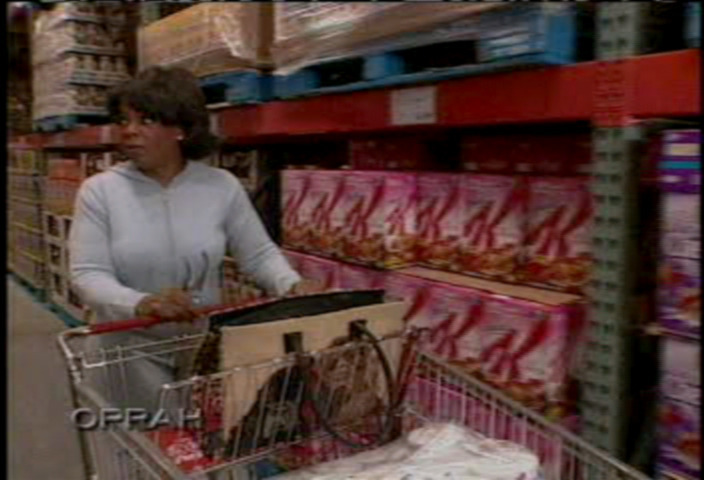
Figure [2]: Oprah Winfrey shops at Costco on her show.

Michael Who really enjoys shopping at the supermarket! However, when I get to go to the super-supermarket "Costco" once a month, the child in me comes alive. Because Costco, which you can only enter with a membership card (which costs $45 a year), doesn't just have groceries. I can spend hours strolling through the aisles and looking at the craziest things: A laser parking system for the car! A fire extinguisher! An illuminated neon sign that says "Open"! A new anti-saver showerhead that could easily shower elephants in the circus! The number of items is, similar to the German Aldi (which, by the way, has already made its way to the East Coast of the USA), quite limited. There is usually only one brand of something, but almost always the market leader.

With a shopping list for a cooking recipe, however, you would be out of place at Costco. Half of the products are not available (e.g., no horseradish or yogurt) and other items only come in huge quantities. Who needs a kilo of mustard, 52 pens, or a pack of 36 batteries?

The secret to Costco's success is that it offers top quality products not cheaply, but at reasonable prices. "Costco doesn't sell crap" - that's the favorite saying of the Costco CEO, who was recently interviewed in Money Magazine.

Take my flashlight: In the USA, the power grid is notoriously in the hands of clowns -- and having the lights go out for a while in the evening is already routine for us. When it happens again, we calmly go to our closet, which we call the "kabuff," and get the flashlight. Which flashlight brand? Of course, "MagLite." It's the most expensive flashlight in the world. But anyone who has ever held a "MagLite" in their hand, possibly in an unclear situation where the neighbors were running through the hallway with flickering cheap flashlights, will appreciate the cold, blackened steel casing of a "MagLite" with its bright white beam. In an emergency, you could use this flashlight to break a window, drive a nail into the wall, or defend your home against intruders. Once you've experienced the quality of this flashlight, you'll never settle for less. Of course, it's not exactly cheap: you have to shell out about 20 dollars. Where to buy it? At Costco, of course, in a set with a mini-Maglite torch for the car and a set of batteries, for, guess what? Exactly: 20 dollars.

Figure [3]: The best flashlight in the world: The Maglite

Costco has spread out across the entire country. They have even expanded to Japan. And although I am actually against the fact that every city now has the same department store, coffee shop, and fast-food chains, I immediately get a sense of home when I discover a Costco somewhere in the middle of nowhere. The slight local differences are also fantastic: for example, at the Costco on Oahu, Hawaii, I once bought car seat covers with Polynesian-inspired patterns -- super cool!

Costco speculates that people will buy gigantic quantities when there is top quality at low prices. The shopping carts there are oversized. Homeless people, who like to push around their belongings, value a Costco cart like a Mercedes Benz. Also, at Costco, there is no "Express Checkout Lane" at the register, as is common in other American supermarkets, where you are only allowed to line up if you have, for example, up to five or ten items and pay quickly, either in cash or with an ATM card.

I am a Costco fan and I'm not afraid to admit it publicly. If Costco ever starts an advertising campaign with famous people and wants me on a poster, I would immediately agree. I even put up with the completely un-American store closing times of this chain, although I find it totally unacceptable: They actually close at 5:00 PM on Sundays!

Pfanni, Panni and the Madness of Measurements and Weights

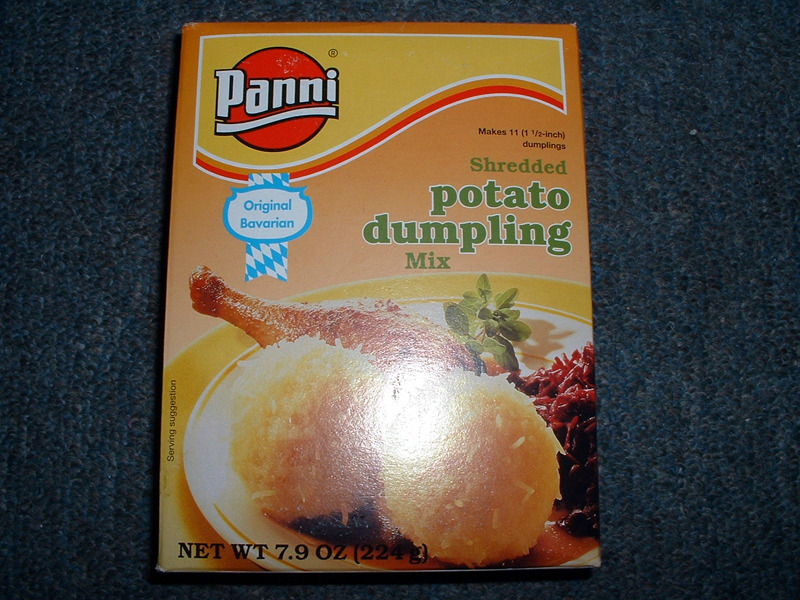
Figure [4]: The Panni Dumplings in America

Michael In our corner supermarket, I was surprised to discover some time ago that you can even buy Pfanni potato dumpling mixes. However, they are not called "Pfanni" but "Panni," probably because Americans can't pronounce "Pf" correctly and would say "Fanni," which means "funny." And the preparation posed unexpected difficulties: you had to dissolve the dumpling mix provided in the package in "2 1/8 cups" of water. With the help of the internet, you can quickly get to the bottom of such things, for example, check out convertalot.com. There you'll find, for example, that 1 cup is exactly 8 fluid ounces. One ounce is just under 30 milliliters, one cup is 237ml, which is approximately a quarter of a liter.

The fluid ounces should not be confused with weight ounces, which correspond to 28.35 grams. At the butcher, it is impossible to order 200g of sausage. I usually order "half a pound," with the American pound weighing 453g, which is slightly less than the German pound.

I have also experience ordering beer in restaurants, to which the waiter once asked, "12 or 16 ounces?" Since only child-sized portions are served in America anyway, you can safely always order the larger amount. By the way, 12 fluid ounces is a small drink can, 16 ounces is equivalent to a "pint," which is slightly less than half a liter (0.473 liters). Two pints make a "quart," and 4 quarts equal a gallon, which is 3.78 liters.

Once, I wanted to buy a new rubber stopper for our bathtub at a hardware store. I briefly used our inch tape measure and found that the drain was about two and a half inches wide. One inch is approximately 2.54 cm, but that's just a side note. When I arrived at the store, I discovered that there were stoppers in two sizes: two and a half inches and 2 3/8 inches. The difference between 2.5 and 2 3/8 is only 1/8 inch, which is 3 mm, so I drove back home cursing, to take a more precise measurement.

And in everyday interactions, you have to adjust: If you explain directions to someone and say "left after 400 meters," no one understands. However, "after a quarter mile" is understood by most. For shorter distances, "feet" are used, which are units 30.49 cm long. In the sentence "could you maybe move your gas-guzzling truck back a meter so I can pull out," you need to use "3 feet" for the length to avoid confusion. And here are all the length measurements in relation: 12 "inches" make a "foot" (30.49 cm), 3 "feet" are a yard (91.4 cm), and a mile is 1760 yards or 5280 feet (1.609 kilometers).

And now the newsletter quiz question: How much does a car consume if it is advertised with "25 miles per gallon"? Americans do not calculate how many liters of gasoline a car consumes per 100 kilometers, but rather how many miles it can drive with one gallon of gasoline. A high miles per gallon value therefore indicates low fuel consumption. Who knows the answer? Peek here

Lifetime backpack warranty

Michael As often mentioned in our newsletter, unlike German customers, American buyers do not let retailers make a fool of them. Stores are open when the customer has time to shop, not when it suits the noble sales staff to start working. If you don't like a product, you exchange it--no silly questions are asked, no drama with vouchers is performed; instead, you get your money back, and that's that.

But that's not all. Recently, after a full five years of heavy use, my backpack broke. Every weekday, I stuffed it full with a laptop and books and dragged it back and forth between Mountain View and San Francisco by bike and train. It was with me on all my travels, from Hawaii to Japan, from Washington to San Diego. And eventually, the zipper burst open. But I remembered that the manufacturer of the backpack, Briggs & Riley, at that time had offered a life long warranty on the backpack.

Now, this backpack was no longer available in their program, but I simply called the toll-free 1-800 number listed on the saved warranty card. And, lo and behold, customer service was happily willing to repair the item for free--I just had to send the backpack by mail to the repair service in Half Moon Bay. Shipping it cost about 4 dollars, and a few days later, the backpack came back perfectly repaired and with a new zipper at no cost. A really good store, this Briggs & Riley!

Glass Recycling

Michael In America, just like in Germany, you pay a deposit on glass and even some plastic bottles at the store. However, no one would think of bringing the empties back to the store to get the money back. Instead, people throw the bottles into a blue bin, put it out on the street on a specific day of the week for the municipal glass collector, and forgo the money.

This is a phenomenon in America: It's considered uncool to worry about cents or small dollar amounts. Although there is the saying "A penny saved is a penny earned," almost everyone throws their coins into the next beggar's cup. Only old grandmas with small pensions rummage through their wallets at the checkout to use the annoying small change to pay odd amounts. Young people pull bills out of their pockets and immediately deposit any coins in the "tip jar," a container often placed at the register in coffee shops and small stores--even though such places don't actually provide services that require tipping.

The copper cents are absolutely disliked by everyone -- even beggars. For this reason, there is sometimes a so-called "Give a Penny, Take a Penny" box at store checkouts. When you receive pennies as change, you toss them in there, and if you owe an amount like "Ten dollars and 3 cents," you simply give the cashier a ten-dollar bill, and they take the 3 cents from the penny box. Exceptions are the large supermarket and fast-food chains: At McDonald's or Safeway, everything is accounted for precisely, and no one accepts tips. The uniforms of McDonald's employees have no pockets for a reason.

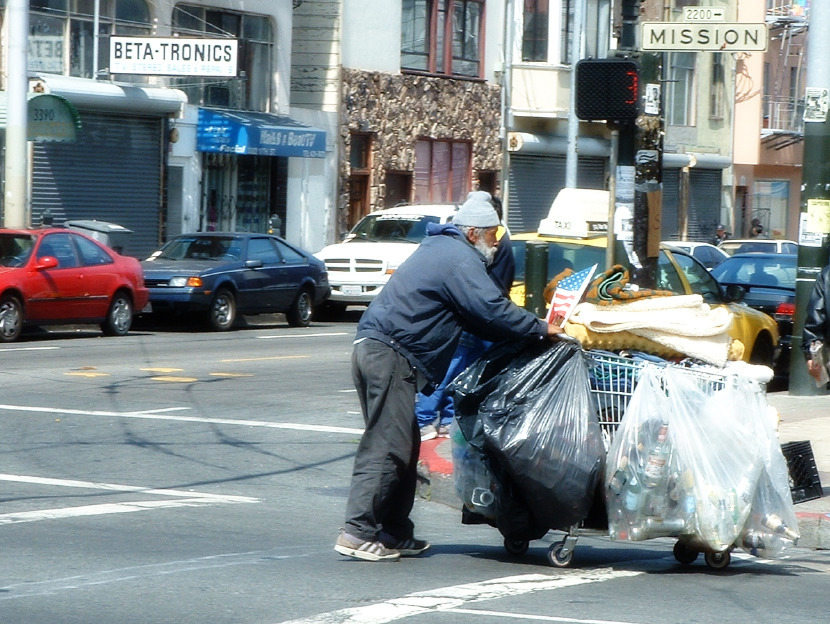
Figure [5]: Homeless person with a shopping cart and bottles

But back to glass recycling: Bottles and cans placed in the blue crates on the sidewalk are often picked up by resourceful homeless people, who roll through the streets with supermarket shopping carts packed to the brim and loaded with empties (Figure 5). They wheel the loot to the return machines located at some supermarkets and receive a few cents for each can or bottle. By the way, the amount of the refund depends on the state. In Michigan, oddly enough, you get a bit more than elsewhere. In an episode of the comedy show "Seinfeld," two of the characters try to drive a whole van full of recyclables from New York to Michigan because of this.

Figure [6]: Deposit information on a beer bottle.

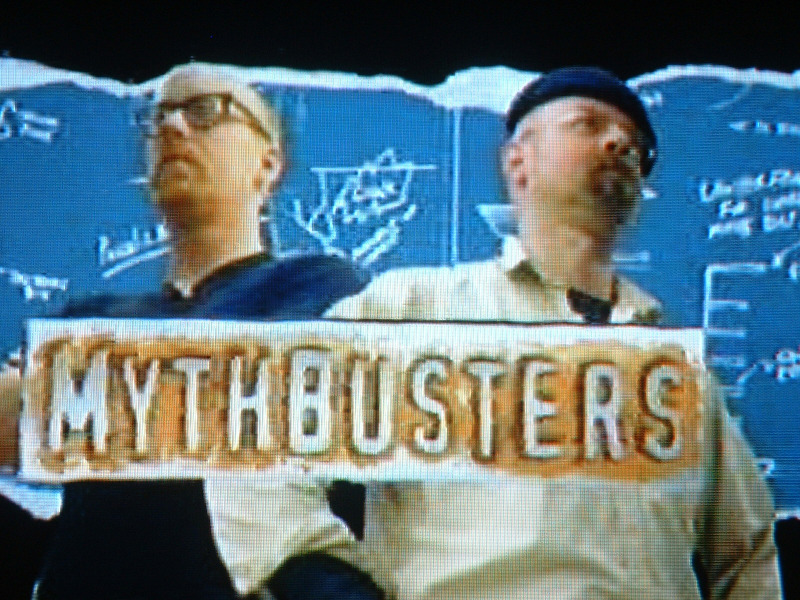
Michael Our TV box assistant Tivo (Rundbrief 05/2001) once again secretly scouted through obscure TV channels and discovered a show that I like: "Mythbusters" on the Discovery Channel.

You know, there are these urban legends: sensational rumors, mostly completely made up, that stubbornly stick in people's minds and that everyone eventually believes blindly. For example, that a penny (1-cent coin), when dropped from the Empire State Building can seriously injure someone standing on the street below. Or that a cell phone ringing while refueling your car can cause a gas station explosion. Or that a microwave oven will explode if you put something metallic inside. Or that a piece of meat soaked in Coca Cola overnight will dissolve. Or that a drug test will come out positive if you have eaten poppy seed cake.

Figure [8]: Jamie Hyneman fires a penny at 100 kilometers per hour at a plastic skull.

The declared goal of the two "Mythbusters" hosts, Adam Savage and Jamie Hyneman, is to get to the bottom of such rumors through hard-hitting laboratory experiments, while blowing up as many items as possible in a media-effective way. The format of the show is always the same: the two hosts track down an "urban legend" and then retreat to their workshop, equipped with all sorts of machines, to simulate the problem. In the case of the penny supposedly flying off the Empire State Building, they simply determined the terminal velocity of a falling penny experimentally and then crafted a special cannon from an industrial stapler machine that shoots pennies at the same speed onto a gel-encased skull. The result: all bogus. At most, you might get a slight scratch.

Figure [9]: Adam Savage breaks a CD in his hand.

Or a spoon in the microwave: It will at most get hot. However, aluminum foil crumpled into a ball will be emitting nasty sparks.

Or the case with the gas station: Even if a cell phone rings in a glass box filled with gasoline vapor, nothing explodes. Even when adding a robotic arm in there, which generates static electricity with a synthetic material, nothing dangerous will happen. Only an artificially generated electrical spark, created using high voltage, was able to initiate the desired explosion and blow up the experimental setup, to the delight of the two hosts.

And since the show is made in San Francisco, one thing cannot be missing: the escape from the prison island of Alcatraz in the middle of the Bay to the mainland. In a Mythbusters episode, the two researchers glued together a triangular raft made of rubber raincoats with prison glue--just like the three infamous convicts who escaped in 1962 but were never found, around whom countless legends have since arisen. I would never have believed it, given how stormy and cold the Bay water is: But the two hosts and a volunteer actually managed to maneuver their raft in the middle of the night with oars nailed together from planks to the northern end of the Golden Gate Bridge and reach the shore. Myth busted!

Figure [10]: The Mythbusters escape at night on a raft made of raincoats from Alcatraz to the mainland.

I would, however, like to have another myth clarified: On long, exposed country roads where the police couldn't possibly park a radar vehicle without it being visible from five kilometers away, you sometimes find signs warning of "Radar Patrol by Aircraft." Airplanes measuring the speed of cars? That's just an old wives' tale! How is that supposed to work? Besides, it would be far too expensive. Hopefully, the Mythbusters will debunk this nonsense soon!

Peculiarities of the American School System

Angelika Ha, no one noticed that I still owe you the last part of my trilogy "The American School System." I'm always fascinated by the half-knowledge one acquires about American schools through years of watching American TV shows. For example, everyone knows from the teen series "90210" that dates in high school are always arranged in front of the obligatory lockers.

"Lockers" are steel cabinets in which students lock away their books and other belongings, which is actually quite practical because this way, students don't have to carry their heavy books back and forth every day. The social calendar of high school also seems familiar to us, and yet somehow not, because we have never had the opportunity to experience certain activities live.

Two major events are on the high school calendar every year: the "Prom" and "Homecoming." "Prom" is a lavish school dance where the boys and girls dress up in formal attire and hit the dance floor. In the show "90210," all sorts of dramas unfolded at the prom. The dances (not parties) sometimes didn't even take place in the school building but in hotels or similar venues.

"Homecoming," on the other hand, can be found at both American high schools and colleges/universities. The football team comes "home" for the first home game. In addition to the football game, there is often a parade and a party. A female student and a male student are elected as "Homecoming Queen" and "Homecoming King" (similar to a beauty queen and king).

Figure [12]: School buses

I also like the American school buses. They always remind me of a children's book that I owned at a young age. The school bus in the book experienced a thousand adventures and looked just like the American ones. Whenever I see one of those yellow school buses here, I always think it's about to talk to me, because the front of the bus has almost human-like facial features. But I digress.

Children who attend public schools in America usually take the school bus. Hardly anyone walks or even rides a bicycle to school. Although I must admit that in safe areas of San Francisco, it does happen that children walk to school. Riding a bicycle is less common in this hilly city. And in sparsely populated areas, school buses are also necessary because the distance to school is often very far.

The social experiment known as "bussing" emerged in the 1970s and is rarely used today. The idea behind "bussing" was to transport students to different schools using school buses in order to create more diverse school populations. The aim was to prevent schools from being composed mainly of either black or white students.

Figure [13]: Honor-Student

In the meantime, the concept of "Affirmative Action" is highly regarded. It involves a special type of quota system in favor of disadvantaged minorities. The idea is that minorities in America often find themselves in worse financial and social situations, which reduces their educational opportunities. Therefore, universities are allowed to consider a student's ethnic background as a factor in admissions and give them preference. This is intended to create more equal opportunities. Naturally, there is strong criticism of this practice. For example, the passing of Proposition 209 in California in 1996 significantly restricted the previously common practice of "Affirmative Action."

I am always fascinated by the fact that good students in America are not immediately categorized as "nerds." How else could one explain the practice of the "Honor Roll" at American schools? Students can earn a spot on the list through outstanding achievements. We often see stickers on cars here, with which parents boast that their child is an honor student ("My child is an honor student"). I would have been mortified if my parents had put such a sticker on our car. Wearing school uniforms wouldn't have been my thing either. However, in America, not every student is made to wear one. Private schools often require school uniforms. At many public schools, this is not the case.

And finally, a little tidbit from everyday American school life. In one of my numerous photography courses, I learned about the institution of military courses at American high schools. At first, I thought it was a joke, but then we not only saw photos of students in uniforms but also a military formation exercise. The so-called JROTC courses (JROTC stands for Junior Reserve Officer Training Corps) can be found in many high schools in America. The Department of Defense sponsors them and provides the textbooks, uniforms, and the instructor, usually a retired military member. In these voluntary courses, students are supposed to learn discipline, responsibility, and leadership qualities in a military style. Critics claim that this is merely a recruitment program for the American army, which is not unfounded, as 40 percent of students who go through a JROTC program later enlist in the military. There are things that are hard to believe.

Poor Economic Situation and Closures.

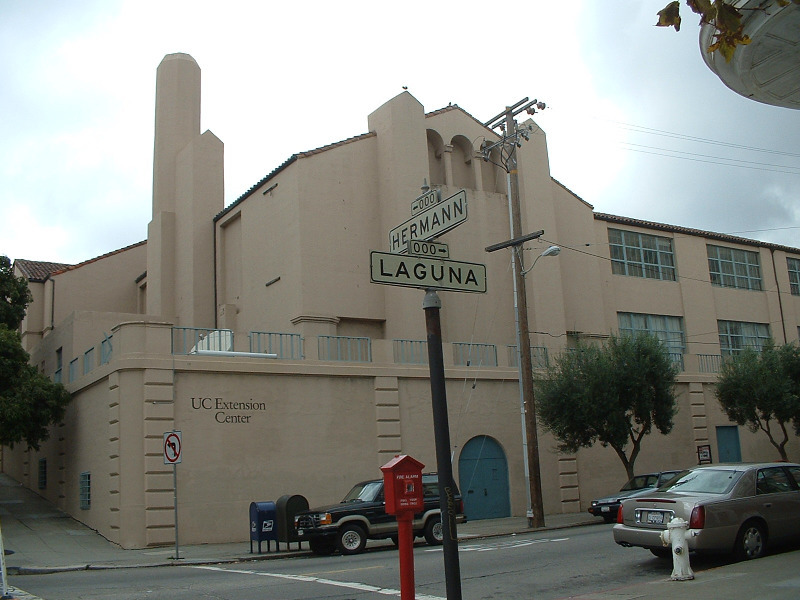
Figure [14]: The UC Berkeley Extension

Angelika Despite the persistent propaganda from the Bush administration that America is experiencing an economic upturn, layoffs are still occurring, and there are hardly any new hirings in San Francisco and Silicon Valley. The latest trend is that companies are not only outsourcing their production to low-cost countries but also their development departments, as firms in India pay programmers a fraction of the salary that would have to be paid here. Also, many companies, including large and financially strong ones, are cutting back on their health insurance programs.

But even the medium-sized businesses are suffering. As we walk up 24th Street, the main shopping street in our neighborhood, we encounter signs at every turn in the shop windows announcing clearance sales and business closures. Although we have been living here for over seven years now, I cannot understand why there is no revolution in America. There are people who have two or three jobs just to make ends meet and still cannot afford health insurance. At the same time, Bush is cutting taxes for the super-rich. The national debt is growing daily, and then last week, the top financial guru Greenspan announced that in the long term, cuts to pensions ("social security benefits") are to be expected to fill the budget gap, which of course hits low-income earners the hardest. The American dream of "rags to riches" simply does not die in people's minds. The optimism (including Michael's) remains unbroken. At the end of last year, I personally felt the impact of the economic downturn. The "University of California Berkeley Extension" decided to close its building complex on Laguna Street due to financial difficulties. Renovations were needed to make the large but aging building complex earthquake-proof and accessible for the disabled. The money was not in the budget because UC Berkeley Extension had expanded diligently during the boom years and miscalculated.

Furthermore, course enrollments declined because many could no longer afford the expensive course fees. The extension program, which can roughly be defined as adult education, is indeed affiliated with the renowned University of Berkeley, but it must independently generate a profit.

Attentive newsletter reader know that the building on Laguna Street was like my second home, because not only did I attend countless photography courses there, but it also housed "my" darkroom. Eliminated! Although courses are still offered in another building in our city and in Berkeley, the photography program and art offerings in general have shrunk at an alarminging rate, and there is no replacement for the darkroom. "Unprofitable arts," the dean declared. We protested, collected signatures, wrote letters, and discussed with the dean. It was all to no avail. Now the building stands sad and abandoned, waiting for demolition. Rumor has it that investors want to build new apartments on the highly coveted lot.

In February, I set out to find a new darkroom location. The "Harvey Milk Photo Center" came to the rescue. It is a large group darkroom operated by the city of San Francisco. You pay a small fee to use it. I was already familiar with the center because members of the photography collective I'm a member of regularly meets in their other facilities. Now I just hope that the Harvey Milk Center remains open, as San Francisco's budget is also lacking in many areas.

It's Shaking Again

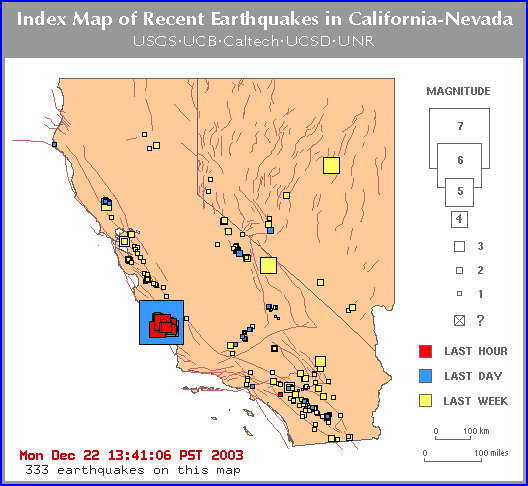
Figure [15]: An earthquake with a magnitude of 6.5 on the Richter scale.

Michael On Monday, December 22nd, at eleven o'clock in the morning, I was working in the office when suddenly the AOL/Netscape building began to sway back and forth in a wave-like, quite harmonious motion, about half a meter each way. We had just moved into new premises on the third floor, and at first, I thought someone was pushing a heavy cabinet down the hallway. When it continued and even the colleague who was standing at the entrance to my cubicle talking to me started looking puzzled, I quickly checked the internet, and lo and behold: a 6.5 on the Richter scale.

Figure [16]: An IM conversation during the quake.

While one gets used to minor tremors over the years in a seismically active area, a 6.5 on the nonlinear scale is a serious magnitude--poorly constructed buildings can collapse, and being buried under one is no fun. In fact, in the town of Paso Robles, which was near the epicenter, three people lost their lives when a building collapsed. I immediately called Angelika's cell phone, but unfortunately, no one answered. At home, I left a message on the answering machine. After a while, I became worried and looked up the number for the photo darkroom in the basement (!) of the UC Berkeley Extension, where she was once again spending time--fortunately, no one there had noticed the quake and would have thought to make contact. Phew!

The Governator

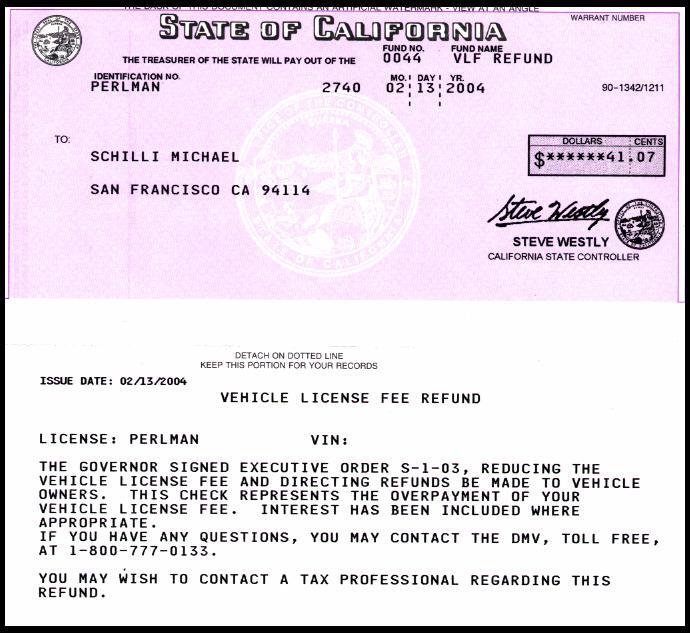
Figure [17]: Arnie lowers the motor vehicle tax again and refunds the difference.

Michael As we all know, we are currently dealing with the new "Governator," as Arnie Schwarzenegger is called in the newspapers. This neologism is a combination of "Governor" and "Terminator" (the movie). One of his first actions in office was to roll back the vehicle registration fee increase implemented by his predecessor, Gray Davis. In America, this fee is hardly worth mentioning, and for our 13-year-old "PERL MAN," we paid about $80 a year after the increase, whereas it was $40 before. Recently, we received a refund check from the Department of Motor Vehicles to reimburse us for the $41.07 we overpaid.

The downside, of course, is that these funds are now missing for quite reasonable projects, such as schools. But for Arnie's Republican sponsors, who drive gas-guzzling "Hummer" SUVs and shout "Environment? Nonsense!", this action was probably important. It doesn't get any dumber than this.

Netscape End of Life?

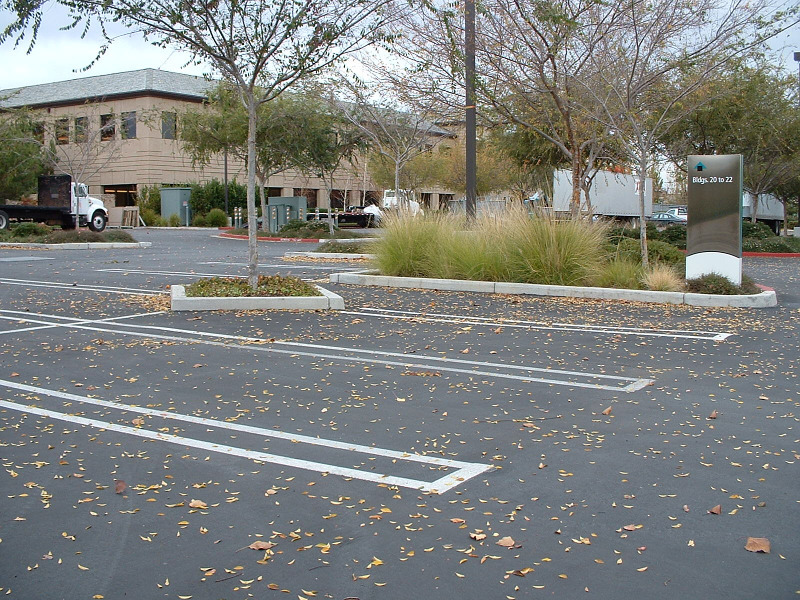
Figure [18]: Deserted: The Netscape Campus

Michael Shortly before Christmas last year, AOL cleared out the last buildings on the former Netscape campus. Out of 800 people, about 500 were immediately laid off, and around 100 were offered the opportunity to move to the East Coast, to Dulles, to AOL's headquarters. "Immediately laid off" meant being informed at ten o'clock and having to leave the building by 12:00 noon. A hectic scene ensued, with personal belongings being cleared from cubicles, farewell scenes everywhere--a sad day. The company was generous and paid everyone a four-month "severance package," which included salary plus health insurance.

Fortunately, I wasn't affected, but unfortunately, 90% of my colleagues are now gone. Interestingly, immediately after the layoffs were announced, some competing companies like Yahoo or eBay held so-called "Open Houses," specifically for those laid off from AOL, probably to snap up the best talent. I'm still in contact with my ex-colleagues through mailing lists, and some have already found new jobs, but the job market situation is not very promising.

But things are looking up. And unlike in Germany, where I have the impression that everything is really going downhill and everyone is just complaining, Americans remain positive: Things will get better. And believe me: It helps.

Greetings from the valley floor

Angelika und Michael

RSS Feed
Mailing Liste
Impressum
Mike Schilli Monologues


Get announcements for new editions

New editions of this publication appear in somewhat random intervals. To receive a brief note when they're available in your mailbox (about once every two months on average), you can register your email on the 'usarundbrief' Google Groups list.

Your email address


All Editions:


Send us a comment
We'd like to hear from you, please send us feedback if you want to comment on the content or have suggestions for future topics.

Simply write your your message into the text box below. If you'd like a response from us, please also leave your email. If you want to stay anonymous, simply put 'anonymous' into the email field. This way we'll get the message, but we have no way to respond to you.

Your email address


Message

 
Contact the authors
Latest update: 22-Nov-2025