
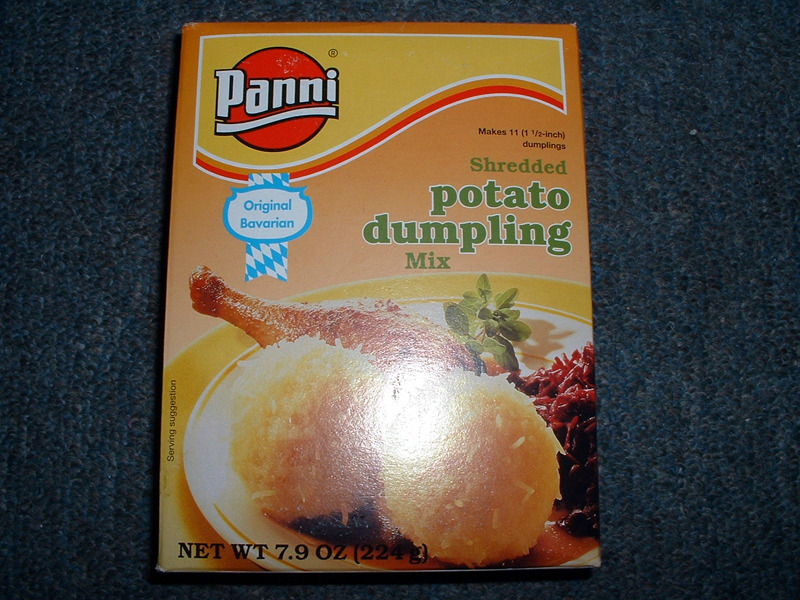
Michael In our corner supermarket, I was surprised to discover some time ago that you can even buy Pfanni potato dumpling mixes. However, they are not called "Pfanni" but "Panni," probably because Americans can't pronounce "Pf" correctly and would say "Fanni," which means "funny." And the preparation posed unexpected difficulties: you had to dissolve the dumpling mix provided in the package in "2 1/8 cups" of water. With the help of the internet, you can quickly get to the bottom of such things, for example, check out convertalot.com. There you'll find, for example, that 1 cup is exactly 8 fluid ounces. One ounce is just under 30 milliliters, one cup is 237ml, which is approximately a quarter of a liter.
The fluid ounces should not be confused with weight ounces, which correspond to 28.35 grams. At the butcher, it is impossible to order 200g of sausage. I usually order "half a pound," with the American pound weighing 453g, which is slightly less than the German pound.
I have also experience ordering beer in restaurants, to which the waiter once asked, "12 or 16 ounces?" Since only child-sized portions are served in America anyway, you can safely always order the larger amount. By the way, 12 fluid ounces is a small drink can, 16 ounces is equivalent to a "pint," which is slightly less than half a liter (0.473 liters). Two pints make a "quart," and 4 quarts equal a gallon, which is 3.78 liters.
Once, I wanted to buy a new rubber stopper for our bathtub at a hardware store. I briefly used our inch tape measure and found that the drain was about two and a half inches wide. One inch is approximately 2.54 cm, but that's just a side note. When I arrived at the store, I discovered that there were stoppers in two sizes: two and a half inches and 2 3/8 inches. The difference between 2.5 and 2 3/8 is only 1/8 inch, which is 3 mm, so I drove back home cursing, to take a more precise measurement.
And in everyday interactions, you have to adjust: If you explain directions to someone and say "left after 400 meters," no one understands. However, "after a quarter mile" is understood by most. For shorter distances, "feet" are used, which are units 30.49 cm long. In the sentence "could you maybe move your gas-guzzling truck back a meter so I can pull out," you need to use "3 feet" for the length to avoid confusion. And here are all the length measurements in relation: 12 "inches" make a "foot" (30.49 cm), 3 "feet" are a yard (91.4 cm), and a mile is 1760 yards or 5280 feet (1.609 kilometers).
And now the newsletter quiz question: How much does a car consume if it is advertised with "25 miles per gallon"? Americans do not calculate how many liters of gasoline a car consumes per 100 kilometers, but rather how many miles it can drive with one gallon of gasoline. A high miles per gallon value therefore indicates low fuel consumption. Who knows the answer? Peek here