
Angelika Ha, no one noticed that I still owe you the last part of my trilogy "The American School System." I'm always fascinated by the half-knowledge one acquires about American schools through years of watching American TV shows. For example, everyone knows from the teen series "90210" that dates in high school are always arranged in front of the obligatory lockers.
"Lockers" are steel cabinets in which students lock away their books and other belongings, which is actually quite practical because this way, students don't have to carry their heavy books back and forth every day. The social calendar of high school also seems familiar to us, and yet somehow not, because we have never had the opportunity to experience certain activities live.
Two major events are on the high school calendar every year: the "Prom" and "Homecoming." "Prom" is a lavish school dance where the boys and girls dress up in formal attire and hit the dance floor. In the show "90210," all sorts of dramas unfolded at the prom. The dances (not parties) sometimes didn't even take place in the school building but in hotels or similar venues.
"Homecoming," on the other hand, can be found at both American high schools and colleges/universities. The football team comes "home" for the first home game. In addition to the football game, there is often a parade and a party. A female student and a male student are elected as "Homecoming Queen" and "Homecoming King" (similar to a beauty queen and king).
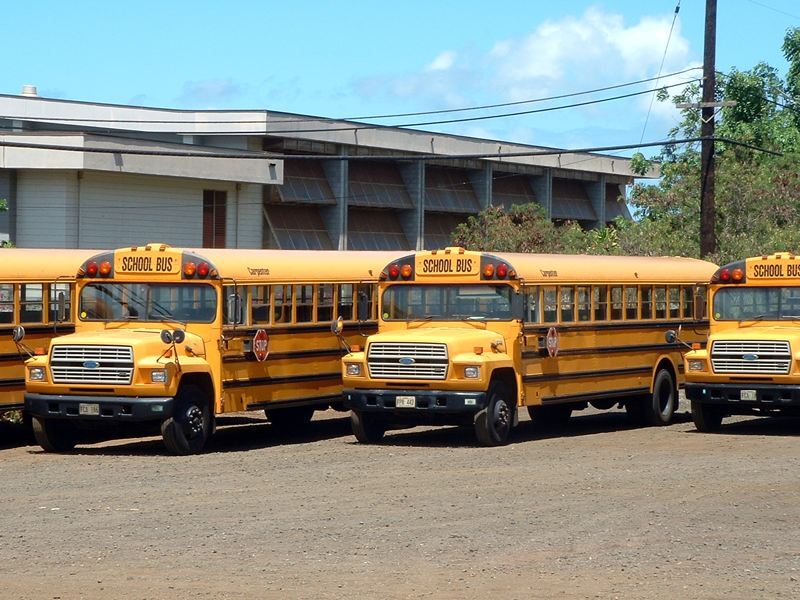
I also like the American school buses. They always remind me of a children's book that I owned at a young age. The school bus in the book experienced a thousand adventures and looked just like the American ones. Whenever I see one of those yellow school buses here, I always think it's about to talk to me, because the front of the bus has almost human-like facial features. But I digress.
Children who attend public schools in America usually take the school bus. Hardly anyone walks or even rides a bicycle to school. Although I must admit that in safe areas of San Francisco, it does happen that children walk to school. Riding a bicycle is less common in this hilly city. And in sparsely populated areas, school buses are also necessary because the distance to school is often very far.
The social experiment known as "bussing" emerged in the 1970s and is rarely used today. The idea behind "bussing" was to transport students to different schools using school buses in order to create more diverse school populations. The aim was to prevent schools from being composed mainly of either black or white students.
In the meantime, the concept of "Affirmative Action" is highly regarded. It involves a special type of quota system in favor of disadvantaged minorities. The idea is that minorities in America often find themselves in worse financial and social situations, which reduces their educational opportunities. Therefore, universities are allowed to consider a student's ethnic background as a factor in admissions and give them preference. This is intended to create more equal opportunities. Naturally, there is strong criticism of this practice. For example, the passing of Proposition 209 in California in 1996 significantly restricted the previously common practice of "Affirmative Action."
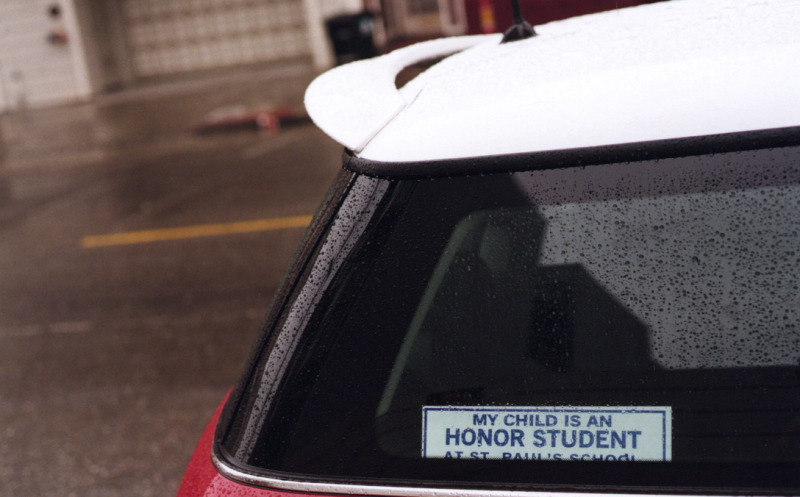
I am always fascinated by the fact that good students in America are not immediately categorized as "nerds." How else could one explain the practice of the "Honor Roll" at American schools? Students can earn a spot on the list through outstanding achievements. We often see stickers on cars here, with which parents boast that their child is an honor student ("My child is an honor student"). I would have been mortified if my parents had put such a sticker on our car. Wearing school uniforms wouldn't have been my thing either. However, in America, not every student is made to wear one. Private schools often require school uniforms. At many public schools, this is not the case.
And finally, a little tidbit from everyday American school life. In one of my numerous photography courses, I learned about the institution of military courses at American high schools. At first, I thought it was a joke, but then we not only saw photos of students in uniforms but also a military formation exercise. The so-called JROTC courses (JROTC stands for Junior Reserve Officer Training Corps) can be found in many high schools in America. The Department of Defense sponsors them and provides the textbooks, uniforms, and the instructor, usually a retired military member. In these voluntary courses, students are supposed to learn discipline, responsibility, and leadership qualities in a military style. Critics claim that this is merely a recruitment program for the American army, which is not unfounded, as 40 percent of students who go through a JROTC program later enlist in the military. There are things that are hard to believe.