
Michael Tourists often hesitate to visit somewhat run-down restaurants here, but if a place is packed, you can safely go in. The city's health department always keeps a watchful eye and an iron hand over restaurants. Every few months, a strict inspector comes by, scrutinizes the place, and writes a report.
On our 24th Street, for example, there is a small Chinese restaurant called "Tung Sing," from which we often order and pick up wonton soup to go. The place is always packed with Chinese people, the staff hardly speaks any English, and the soup is really good. Next to the entrance, the health department's report, meticulously filled out by hand, is prominently displayed as required. It states that the place only scored 92 out of 100 points. With 100 points, there's a "Certificate of Excellence," but "Tung Sing" probably needs to improve a bit for that.
On the website of the Department of Public Health, you can study the regulations, which are periodically verified by the authorities. For example, it is mandatory for every refrigerator to have a thermometer that is accurate to within 2 degrees Fahrenheit. When preparing meat, a thermometer must also be available to measure the internal temperature of the meat. Of course, no chef in the world actually does this (or maybe only when the inspector is watching), but rules are rules.
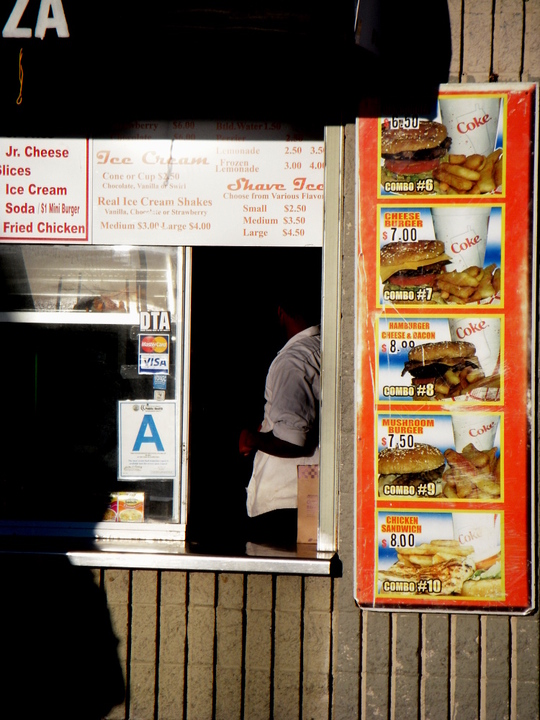
In Los Angeles, letters rather than points are awarded for health department inspections, similar to American school grades. The approximately 15 inch high sign with the grade "A," "B," or "C" must then be displayed in the restaurant's front window (illustration 1), so that potential guests can see it from afar and avoid the establishment if they have concerns. This seems to be a significant incentive, because when we were recently in L.A., we could only see the top grade "A," with not a single "B" or even "C" in sight.