
Angelika On November 3, we also voted on some important California candidates and measures. Not least, as already mentioned, we elected a new governor. Normally, that would have been big news, but after the primaries, the campaign was positively uneventful. Xavier Becerra, who decisively defeated Republican Steve Hilton by about 66 to 34 percent, had apparently chosen a strategy of giving his opponents as little ammunition as possible. For example, he held only a single election debate with Hilton. His strategy seems to have worked.
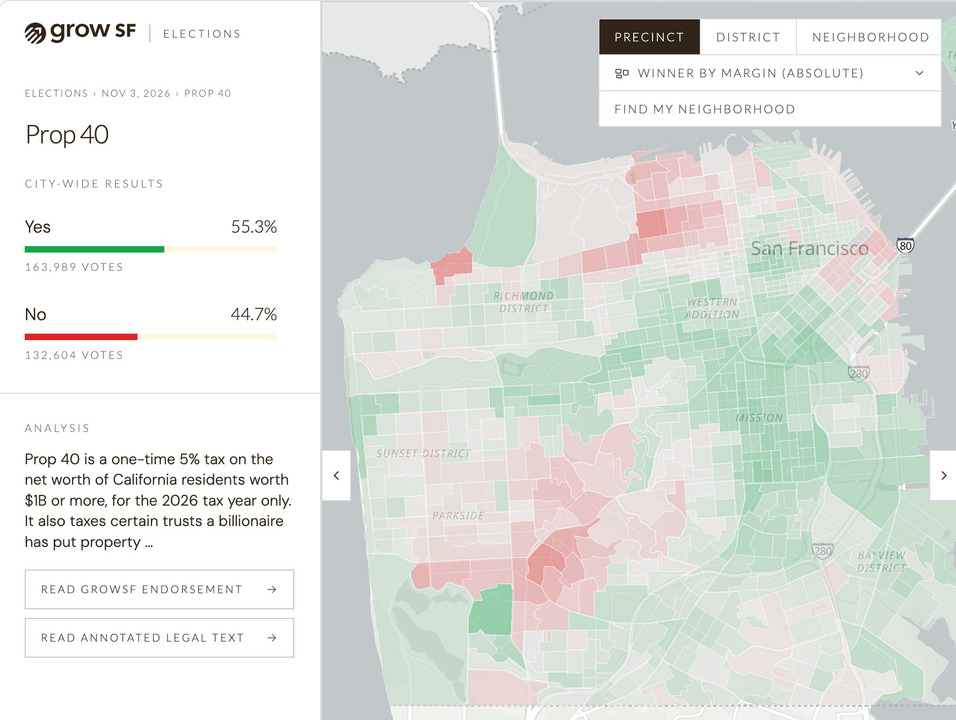
The "Billionaire Tax," a wealth tax on California billionaires (for the distinction between the English "billionaire" and the German "Milliardär," see Rundbrief 08/2017), on the other hand, was on everyone's lips, including in the international press. California voters were to decide on it through Proposition 40, a ballot initiative.
California is known for its progressive politics and for Silicon Valley, which has produced not only some groundbreaking innovations but also more than a few billionaires. When I asked my students a few years ago what they wanted to be when they grew up, many answered, "Like Elon Musk!" These days, that is rather frowned upon. In general, Americans were not particularly envious of the wealthy for a long time. After all, the notion that you could easily go from rags to riches in America was remarkably persistent. The idea behind it: Anyone can make it, and who knows, perhaps one day you will be one of them yourself. That attitude has changed considerably in recent years, however.
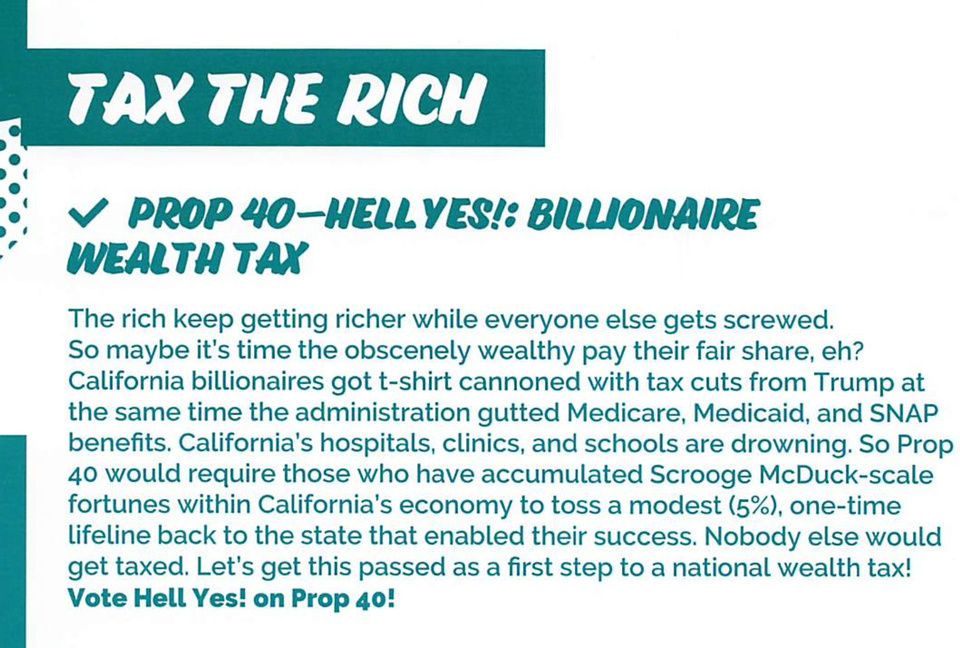
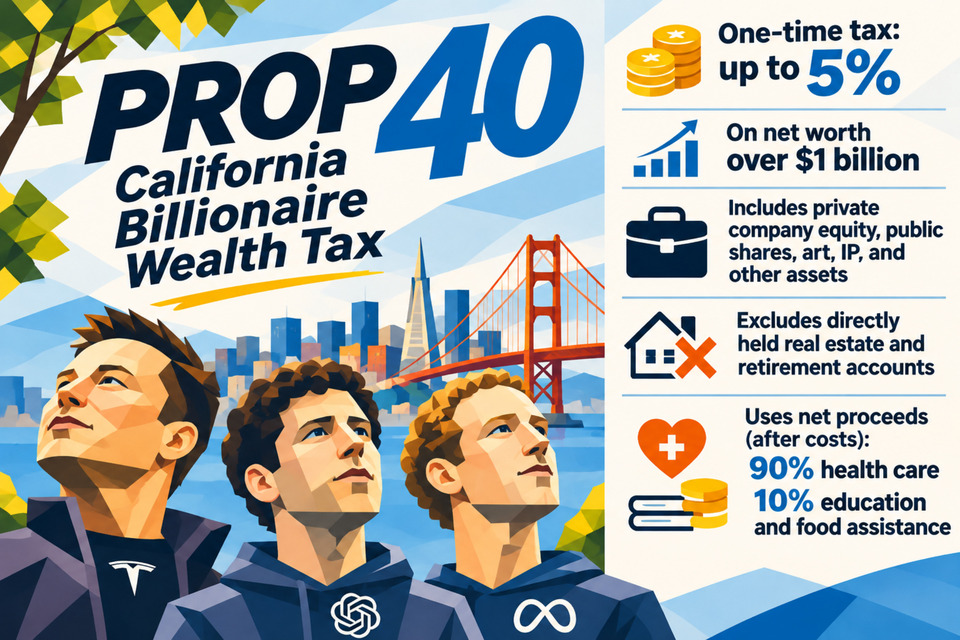
Proposition 40 proposed a one-time tax of five percent on the taxable net worth of California billionaires. The tax would apply to their property rather than their income: stocks, stakes in companies, artworks, and other assets, for example. Real estate and certain pension and retirement accounts were exempt. Proposition 40 thus proposed a one-time tax of five percent on the wealth of billionaires residing in California. It would have affected around 200 to 250 super-rich people. Now, I certainly support fairer taxation and tax laws with fewer loopholes. But unfortunately, nobody seems to have the patience for fundamental, well-considered reforms these days, politicians included.
One example of the absurdity of the American tax system is the ability to pledge stocks or other company holdings as collateral for a loan. No taxes are due on the loan proceeds because, under tax law, they are borrowed money rather than income. At the same time, the stocks are not sold, so no capital gains tax is due on the gains accumulated up to that point but not yet realized. Only the interest on the loan has to be paid. In the United States, this financing strategy is known as "Buy, Borrow, Die." If the loan remains outstanding until the owner's death, the heirs can benefit from a special provision in U.S. tax law: the so-called "step-up in basis." This generally raises the tax basis of the inherited stocks to their current market value at the time of death. The heirs can then sell some of the stocks to repay the loan without having to pay capital gains tax on the appreciation during the original owner's lifetime. Under certain conditions, gains accumulated over decades can thus remain permanently exempt from capital gains tax.
But back to Proposition 40: In my opinion, the proposed one-time tax was so poorly thought out and cobbled together that you could almost imagine the entire plan had been scribbled on a beer coaster in a bar after a night of heavy drinking. Initially, the money was primarily intended to offset substantial cuts to health care. What was behind those cuts? Obamacare, the health care law introduced under President Obama, had allowed states to expand their public health insurance programs to cover significantly more low-income people. In California, this program is called Medi-Cal. It is funded jointly by the state and the federal government.
With the federal law passed in July 2025, the so-called One Big Beautiful Bill Act, the Trump administration enacted substantial cuts to Medicaid, known in California as Medi-Cal. These include funding restrictions and new eligibility requirements. The effects will be felt over several years and place a considerable strain on California's budget. The "Billionaire Tax" was intended to make up for some of this lost federal funding. Ninety percent of the revenue was to go to health care, particularly Medi-Cal. The remaining ten percent was earmarked for education and food assistance. In my opinion, it is always a bad idea simply to plug a budget hole temporarily without coming up with a sustainable solution. After all, the cuts are not limited to a single year.
The "Billionaire Tax" was also backed by an extremely controversial figure: Dave Regan, president of the health care union SEIU-United Healthcare Workers West. His union had played a leading role in developing and promoting the tax initiative. Dave Regan is controversial mainly because he is accused of using his union's power and political campaigns as leverage to advance his own union's interests. According to those allegations, Regan offered Governor Newsom to withdraw the Billionaire Tax from the ballot in exchange for concessions benefiting his union. These supposedly included union contracts with certain hospitals and clinics. Shades of the Mafia.
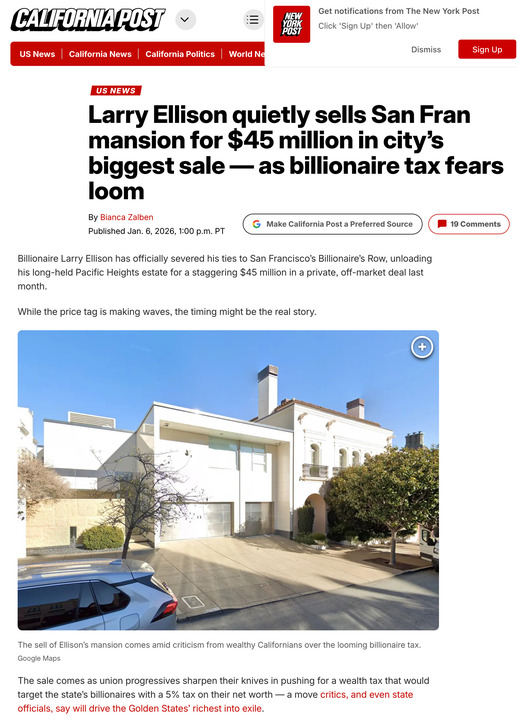
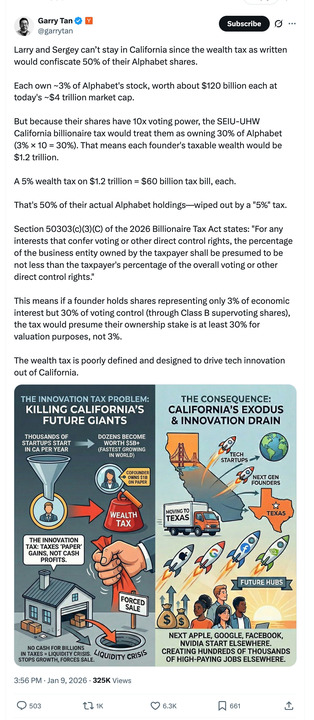
Our still-serving governor, Gavin Newsom, had in fact spoken out against the "Billionaire Tax." He feared the tax would do California's economy more harm than good, partly by prompting some of the affected billionaires to relocate their homes and businesses. After all, as we know, there is no wall around California yet, and everyone is free to come and go, including moving to another state. Google co-founder Sergey Brin, for example, simply moved his residence to Nevada. It was also very unclear how the value of the assets was supposed to be determined in the first place. Nobody had really thought that through. In the end, though, California voters surprisingly voted against Proposition 40. Around 53 percent rejected the tax, while 47 percent supported it.

On top of that, opponents of the Billionaire Tax had put their own initiative on the ballot, Proposition 42. It was intended to make it harder to introduce new taxes on certain personal assets as well as retroactive taxes. Proposition 42 passed, while Proposition 40 failed. The wealth tax was thus not only rejected in the vote on Proposition 40; an additional obstacle to similar tax plans was created at the same time.
In general, though, I have to say that I am growing tired of all this voting on propositions. The ballots keep getting longer, and some of these initiatives are worded in such complicated, convoluted language that even a person of perfectly normal intelligence can barely understand them after reading them several times. Sometimes I wonder whether this really is still the much-praised direct democracy, or whether someone simply wants to annoy voters.

A particularly fine example is the Great Highway along Ocean Beach in San Francisco. We have now had to vote on the future of this road for the third time in four years. First it was about temporarily closing it to cars, then permanently turning it into a park, and now partially reopening it to cars during the week. On November 3, Proposition G, which would have reopened it on weekdays, was once again rejected. Around two-thirds of voters voted against it. But at some point, enough is enough. Perhaps it is time simply to accept a decision.