![]() |
| Angelika/Mike Schilli |
|
|
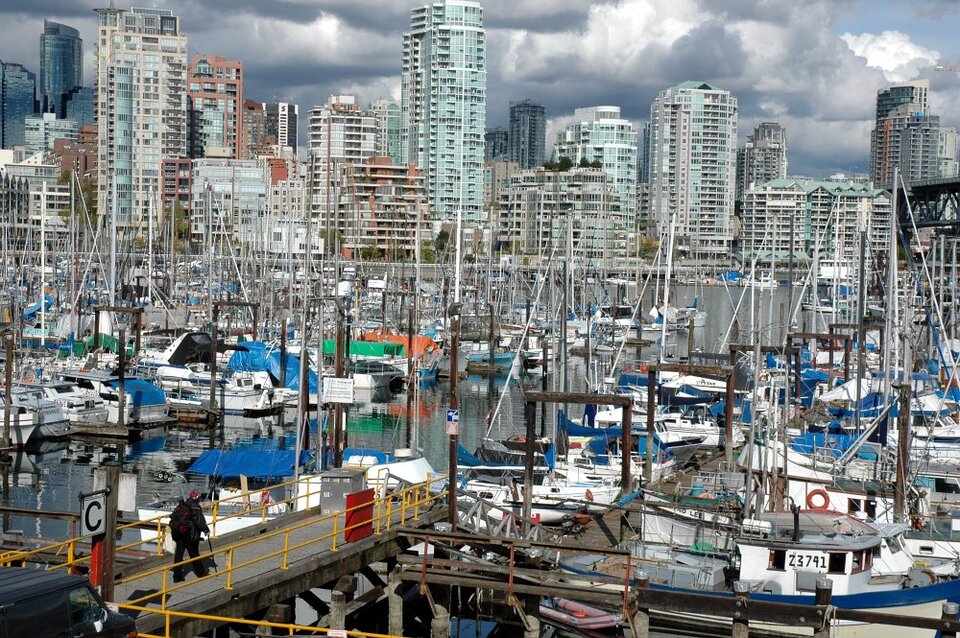
Angelika: For a long time, we wanted to pay a visit to our Canadian neighbors in the far north. In April, it finally happened. We boarded a plane and headed to Vancouver, Canada, as so many people had praised this city to the skies. Canada is often lumped together with the USA, which understandably annoys Canadians. It's true that many things are similar: for example, we were surprised that the English in Vancouver sounded just like it does in California--our ears couldn't detect a Canadian accent.
The tipping customs are also interchangeable. When you go out to eat, the guest patiently waits for the hostess to lead them to their table. The bad habit of not including taxes in the final price is something Canadians are familiar with as well. There are two different sales taxes: the federal one and the one for the respective Canadian province. If you drink alcohol in a restaurant, a dubious alcohol tax is added. Taxi drivers groan about the high taxes just like everywhere else in the world, and the obligatory American coffeehouse chain "Starbucks" can be found on every corner. On the other hand, Canadians have achievements like a national health insurance for everyone, and Vancouver offers a public transportation system that reliably runs on schedule. Upon arrival, we immediately noticed that Vancouver is much cleaner and less "run-down" than American cities of comparable size.
Despite these friendly conditions, we couldn't avoid the Canadian border control upon entry. Before the terrorist attacks in America, it was apparently quite easy for American citizens or Green Card holders to enter Canada. But those days are gone. So, we dutifully presented our German passports and American Green Cards. Otherwise, we behaved as if we had never stood before an officer of any immigration authority. When we were asked what brought us to Canada, we both initially remained stubbornly silent, only to start speaking at the same time, which immediately made the officer behind the counter suspicious, suspecting that we hadn't coordinated our stories. However, we quickly convinced her that we only wanted to enter Canadian soil for purely touristic purposes.
On the return trip, we immediately stumbled upon another "immigration trap." Right at the check-in counter for Alaska Airlines at the Vancouver airport, we noticed that there was no conveyor belt for our luggage next to or behind the counter. "Strange!" I thought to myself. And then the friendly lady, while handing us our boarding passes, asked us to step behind the counter with our luggage, exactly where the luggage usually disappears. There were no further explanations. So, we strolled down a corridor with our luggage until we stood in front of the duty-free shop, where another lady in uniform was standing, asking for our American customs declaration.
This completely confused us, because you usually fill these out at the earliest on the flight, since after all, we were still in Canada. She then pointed to small desks with the forms and instructed us to return to her with the completed form. Said and done. After she had examined the customs declaration, we were allowed to trudge through the duty-free shop with the customs declaration and our luggage and suddenly found ourselves in front of the counters of the American immigration authorities. At first, we thought we were in the wrong movie. Just to remind you: We were still in the Vancouver airport. But no! We were, so to speak, already entering the USA again in Vancouver. Behind the immigration counters, they finally took care of our luggage. In San Francisco, we thus saved ourselves the passport control and landed directly at the terminal for American domestic flights.
Otherwise, we were surprised by how hyper-modern Vancouver is. Everywhere, architecturally sophisticated skyscrapers tower into the sky, and construction is happening at a rapid pace. Vancouver, as we were repeatedly told, is booming, and everyone wants to live here. However, we missed a bit of the old and cozy charm. There is a tourist-oriented "Old Town" and also a Chinatown in Vancouver, but it doesn't quite compare to San Francisco's Chinatown. For us, the city's appeal lay in its natural beauty: surrounded by water, with mountains as a backdrop, and a huge park, Stanley Park, right in the center of the city. We particularly enjoyed cruising around on the water with the small ferries that operate like taxis, taking you from one point to another. And we had to admit without envy that Vancouver can certainly compete with San Francisco in terms of culinary offerings. The restaurants we visited were diverse and excellent.
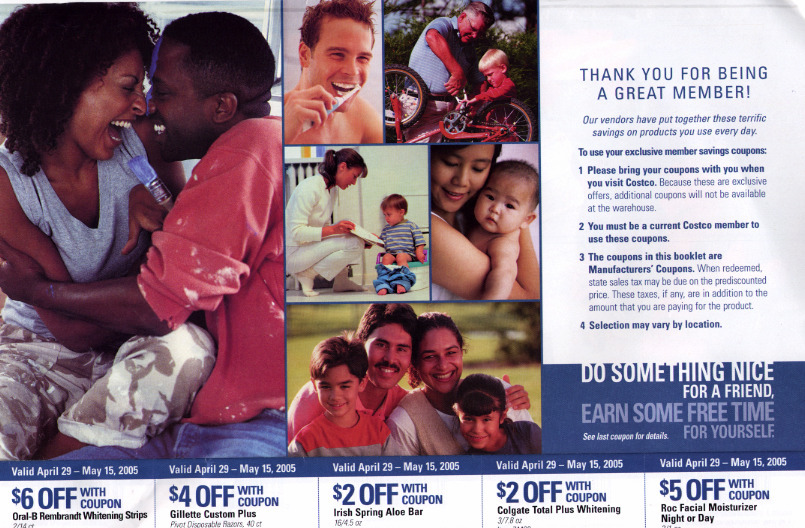
Michael: When a corporation advertises in a city like San Francisco, it must be careful to treat all population groups equally. In this diverse city, 44% of the population is White, 31% Asian, 14% Latino, and 8% Black (source: sfgov.org), it would be unrealistic to show only white models on an advertisement for underwear, for example. In illustration 5, you can see that the cover of a coupon booklet that arrived in the mail represents pretty much all the significant population groups: The cuddling couple on the left is black, the man with the foaming toothbrush is white, the grandpa with the bicycle is white and old, the mom in white in the middle is obviously working (due to the white clothing, obviously a doctor), the lady with the baby in the middle right is Asian, and the beaming family at the bottom left are Latinos. The sports catalog in illustration 6 also reflects all the significant population groups.
When you start working at a company, you fill out a form where you indicate your "ethnicity." This is not for the purpose of discrimination, but rather -- on the contrary -- to provide companies with statistics on how "diverse" (i.e., mixed) their workforce is. Companies that hire too few minorities or, for example, have only white people in leadership positions are frowned upon. On the form for ethnicity, as a white person, you have to enter "Caucasian." I didn't know this at my first job in America, but the friendly lady in the HR department discreetly helped me with it back then.
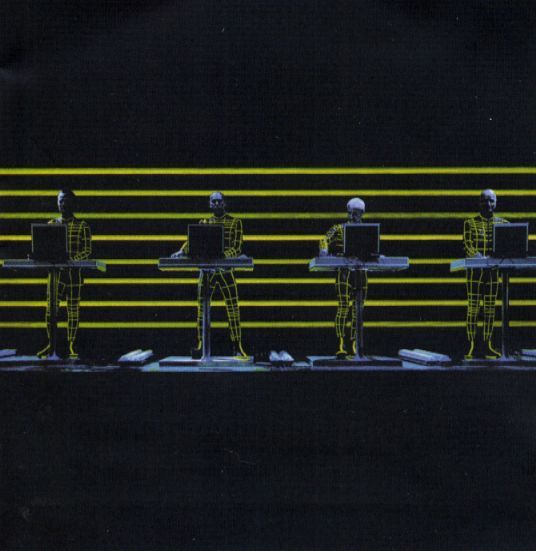
About the concert of the group Kraftwerk at the Warfield Theater in San Francisco last year, I had briefly reported in Rundbrief 05/2004. Recently, the double CD "Maximum-Minimum" was released, featuring recordings from various stops on the tour. Let me tell you, when I heard it for the first time, I was at work at Yahoo! listening with headphones, and during the first song "Mensch-Maschine," I got a pleasant chill down my arms, and my cubicle colleagues must have wondered why I suddenly started breathing so heavily. Man, it brought back memories of that fantastic concert. Highly recommended!
Angelika: People are known to like abbreviating or shortening long terms. The name of our city "San Francisco" is a particularly popular target for this: you often hear it referred to as S.F., San Fran, or Frisco.
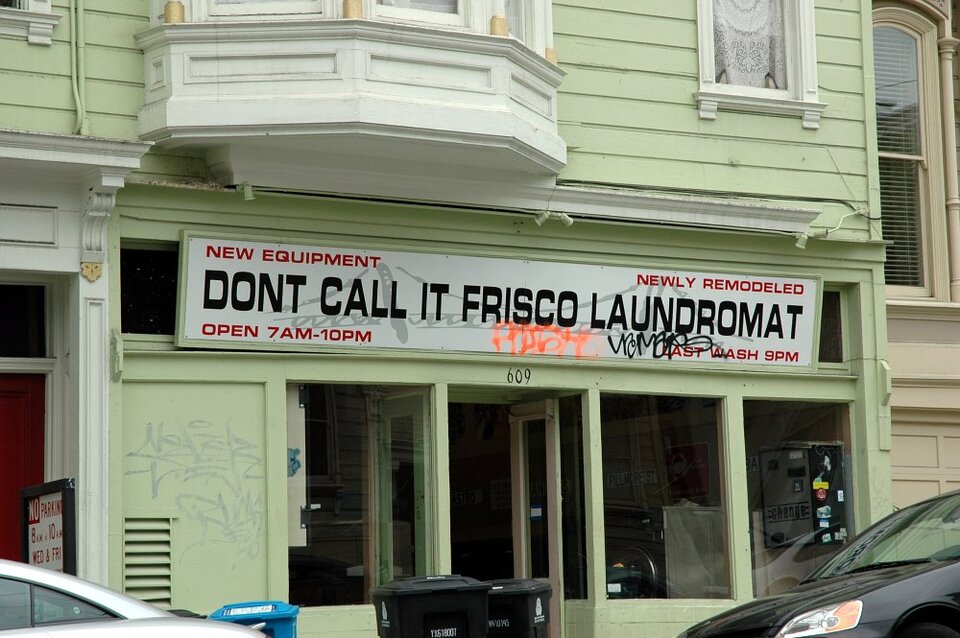
Until now, it was considered taboo among the locals of this city to call San Francisco "Frisco." Doing so would immediately mark you as a tourist. It was simply referred to as "the City." This was taken so seriously that there is even a laundromat named "Don't call it Frisco" on Hayes Street.
For quite some time, the term "Frisco" has been appearing in rap songs, and rather trendy T-shirts with the "Frisco" logo are growing in popularity. And I'm not talking about T-shirts that you can buy in cheap stores in Chinatown or the tourist trap hub "Fisherman's Wharf."
Quite the opposite, stores where the young and cool--think daring skateboarders, laid-back surfers, or graffiti artists--shop, are selling them. The term "Frisco" has undoubtedly made a comeback as a counter-movement to the establishment. Therefore, I wouldn't exactly advise those in their 30s (and older) to walk around wearing these T-shirts. Even Michael, who is known to prefer the casual Californian shorts and sneakers look with loose T-shirts, doesn't dare to wear them.
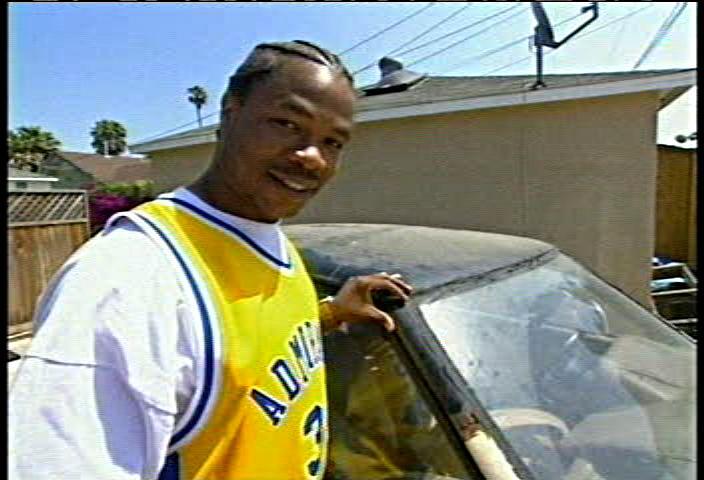
Michael: In the USA, there is no TÜV (the German Technical Car Inspection Association). You can really drive around in the most rusted-out junk car. As long as the fenders don't fly off on the highway, it's okay. The TV show "Pimp My Ride" with host Xzibit, which is also a big success in Germany, shows how to turn a falling-apart car into a good-looking ride.
In America, the condition of parked cars plays an important role in assessing a neighborhood. If there are only rusty old wrecks, it's better not to be there after nightfall.
It can certainly happen that someone who is selling their house asks that you don't park your junk car right in front of it. That lowers the price of the house. Our beloved PERLMAN has already driven house prices down and left real estate agents in despair.
Once a year in California, however, a notice from the Department of Motor Vehicles (DMV) arrives in the mail, requesting payment of the annual registration fee and proof of the vehicle's liability insurance. Illustration 11 shows our notice.
The registration fee depends on the type of vehicle and for our extremely sporty but materially undervalued PERLMAN, it is only 65 dollars. This is composed of a $40 registration fee, a $51 license plate fee, an $8 San Francisco surcharge, minus a $34 Arnold Schwarzenegger discount (Rundbrief 03/2004).
Because we have the personalized license plate PERLMAN instead of an anonymous number, we pay an extra $25. However, this goes to a good cause, like the conservation of the Grand Canyon or something similar.
And every two years, the notice includes a surprise message: You have to go for a smog test, the American version of the emissions test. There are two types of this test, the regular and the strict one. For the regular test, you simply go to any gas station with a "Smog Test" sign and pay about $60. However, if the notice states that you must go to a "Smog Test-Only" station, the options are more limited, and super-accurate inspectors will conduct the smog test.
To the "Smog-Test-Only" you are only invited if you drive a vehicle that a) has previously failed the smog check or b) is known to be not particularly environmentally friendly. And then there's a lottery where c) you draw the short straw and are randomly selected by the DMV. Detailed explanations and tips can be found at http://www.smogtips.com.
Newer cars, by the way, are being connected to a computer at the smog test station, and the test rig extracts values from it. A colleague of mine once had to have a new board computer installed in his perfectly functioning BMW M3 for over $1,200 because its smog test interface was broken. Otherwise, he wouldn't have passed the smog test, which is crazy! Fortunately, PERLMAN doesn't have an onboard computer yet. But he still received a certificate for passing the smog test, as shown in Figure 14. Passed with flying colors!
When you buy a used car in California, you have to pay California sales tax on it, approximately 8.5%, depending on the county. If you buy a car from a private individual, the DMV collects the tax amount when you register the vehicle. If the stated price is suspiciously low, the market value is used instead.
The value of a used car is determined by the so-called "Kelly Blue Book," which can now also be viewed http://www.kbb.com. It actually says there that our beloved PERLMAN, a 1991 Acura Integra with 170,000 miles on the clock, is only worth $1165. Outrageous! However, it has been running perfectly for years without any maintenance (just oil changes) and was very happy for the four new tires I recently bought for it for $320. We'll stay together until the fenders fall off, Perly!
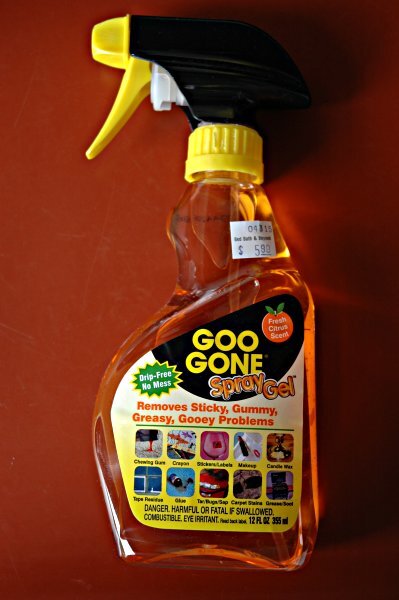
It often happens that you buy something with the price tag still attached. These small, pesky, cheap stickers are incredibly stubborn! Woe betide if you only tear off the surface of the label, because then the sticky residue won't come off ever, no matter how hard you try. Most of the time, you end up fiddling around for hours, treating the residue with foul-smelling substances like gasoline or turpentine, rubbing your thumb raw, and possibly even removing parts of the purchased product. Plastic, in particular, can quickly become dull doing this. But it doesn't have to be that way, because there's "Goo Gone," which removes everything powerfully and gently.
"Goo" is the American word for a stubbornly sticky substance. For example, if you don't clean a bathtub despite regular use, after a while, a thick mass settles at the bottom. "Goo" can perhaps best be translated with the Bavarian word "Baaz." And "Gone" means "disappeared," so "Goo Gone" means something like "Baaz disappeared." "Goo Gone" comes in a convenient spray bottle, is easy to apply, and has a pleasant scent reminiscent of a mix of tangerine and marzipan.
Take, for example, the padlock in Figure 20. There was a sticker on the back with the combination on it, and it didn't come off completely. A little "Goo Gone" was sprayed on, then I waited a few minutes, and it came off effortlessly. All that was left was attractively shiny metal and a mandarin-nut scent in the air. Hmm.
I know someone whose father runs a few movie theaters, and he always has to clean the floor and seats of stuck-on chewing gum and spilled coca cola after the show. He claims that there is a professional cleaner that dissolves stickiness even more powerfully than "Goo Gone," but that "Goo Gone" is pretty much the best thing the average person can buy. A nice gift from your next trip to America for your loved ones at home!
Angelika: You already know it: The neighborhood we live in is called Noe Valley and it has become one of the most popular residential areas in San Francisco. And although we have mentioned it in one of our newsletters from time to time and every somewhat better travel guide now lists it as worth seeing, we want to share a few things with you that hopefully aren't in the "Lonely Planet" yet.
San Francisco is known for its unique neighborhoods, and Noe Valley is no exception. The popularity of the neighborhood can also be seen in the housing prices. According to our neighborhood newspaper "Noe Valley Voice," the average price for a single-family home in April 2005 was a hefty $1,188,625. In May 2005, the average rent for a one-bedroom apartment was $1,489, while two-bedroom apartments averaged $2,286.
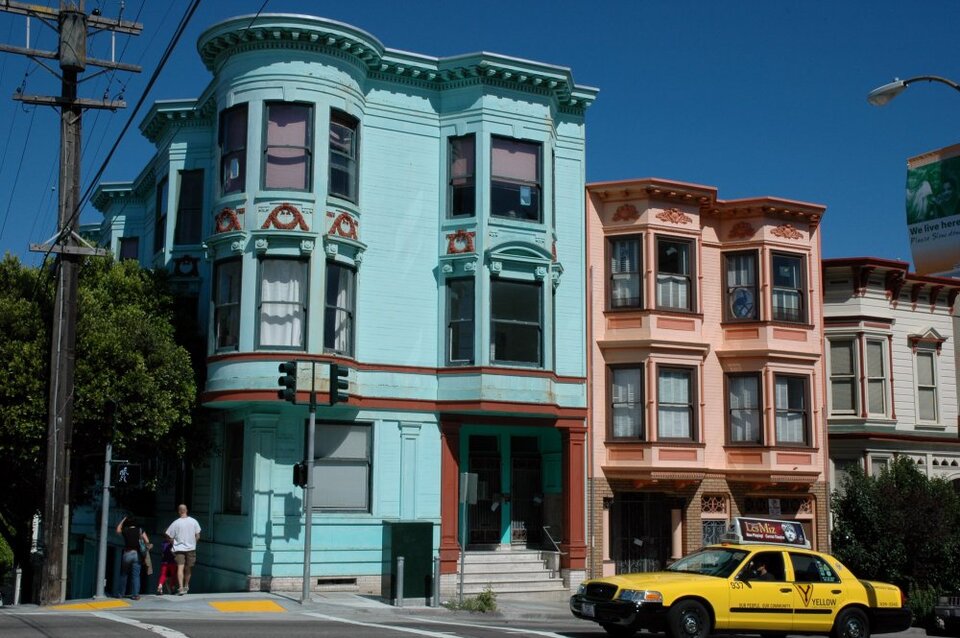
At first glance, the many Victorian wooden houses stand out, as the great earthquake of 1906 spared Noe Valley: The neighborhood is situated on rocky ground, and the fires following the quake were stopped before they reached Noe Valley. A solitary fire hydrant at Church St. and 20th St. provided the life-saving water and was therefore painted gold. We are also blessed with plenty of sunshine, as the fog is kept at bay by the Twin Peaks hills. Geographically, Noe Valley is in good and interesting company, as it is located between the Mission, the South American neighborhood, and the Castro, the stronghold of the gay movement.
What we appreciate most about this neighborhood, besides the countless restaurants, small shops, and good public transportation, is the cozy, family-like atmosphere with an international flair and almost without the American monotony (unfortunately, there is already a "Starbucks" - sigh). For example, when we go to Michael's favorite restaurant "Savor" on 24th St., which is known for its savory and sweet crepes, one of the waiters greets us like old friends.
Even with the owner of the Thai restaurant "Swatdee Thai," we always start with a chat about everything under the sun. At "Hamano," one of our favorite Japanese restaurants located on Castro St., I actually managed to snag a table for four in no time, despite the long line of people ahead of us, which would have meant at least an hour's wait. The owner recognized his loyal neighborhood customers and let us go ahead. Unfortunately, he has since sold his restaurant, but the place continues to operate under new management.
You can best capture the neighborhood's vibe at "Martha's": Not only do they serve good coffee, but customers also lounge around philosophizing on chairs and benches in front of the cafe in the sun. By the way, "Martha's" is still family-owned. However, there are now several branches in San Francisco. But Martha, originally from Nicaragua, opened her first coffee shop in 1987 on 24th St. in Noe Valley, and coffee lovers like me, who need their daily dose of caffeine, occasionally encounter the real Martha in her store.
An exotic shop by American standards is hidden behind the cheese shop "24th Street Cheese Company," where cheese enthusiasts can find a selection of cheese entirely in the European tradition. The phenomenon that in many parts of America, you can only find packaged "Cheddar" cheese and maybe a Camembert has always fascinated me, especially since there is no shortage of milk-giving cows here. Amusingly, the owner of the cheese shop is Asian. He is always terribly exasperated when American tourists from non-cheese regions come into the shop recommended by travel guides and then leave without buying anything. However, cheese is clearly trending, at least in San Francisco and the surrounding area. North of San Francisco, there are now several small cheese dairies (e.g., around the Point Reyes area). However, the prices for cheese are so steep they'll make you cry.
Regarding cows: they were once grazing in Noe Valley, as the land was part of the "Rancho de San Miguel" farm and was, back in the day, located on the outskirts of the city. The owner had the melodious name Jose de Jesus Noe. By the way, Noe is pronounced No-ee. For a short time, Noe Valley was also called "Horner's Addition," because in 1852, John Horner bought parts of the farm from Mr. Noe and began diligently building houses. However, the boom only occurred when the cable car started running from Market/Castro St. to the steep 26th St. in 1887. Today, a bus runs there, and the cable car operates elsewhere.
In the late 19th century, immigrants, mainly from Ireland, Germany, and Italy, arrived. The neighborhood developed into a traditional working-class district. Many Germans worked in butcher shops, as the long-time residents of the neighborhood can still recount today. The Irish pub "The Dubliner" and the German store "Lehr's" in Noe Valley bear witness to these roots. "Tuggey's Hardware," a store that sells all kinds of tools and screws, has existed since 1900, for example. And in our building, some people have been living here for over 30 years. "Rent Control" makes it possible (Rundbrief 08/2000). The Republican real estate agent on 24th St. has been delighting the neighborhood with his conservative views for over 50 years.
When the internet companies started booming a few years ago, many dot-commers flocked to Noe Valley because, with their high salaries and stock options, they could suddenly afford anything and drove the prices in the neighborhood even higher. This happened much to the chagrin of the residents who had been living in Noe Valley for decades. Since the bubble burst, everything has calmed down a bit.
Otherwise, a liberal spirit is blowing through the neighborhood, and the residents are politically and socially engaged. For example, when our organic supermarket "Real Foods" was taken over by a company in Utah and suddenly laid off all employees in the fall of 2003, there were protests. The official reason given was that renovations were planned for the store. The suspected real reason: the employees had wanted to unionize. Almost two years later, no renovations have taken place, but the very active community group "Friends of Noe Valley" organized a weekly market that takes place every Saturday from 8 AM to 12 PM, so that people in the neighborhood can continue to buy organic vegetables and fruits.
Or when the independent bookstore "Cover to Cover" faced closure in the summer of 2003 due to financial difficulties, enthusiastic book lovers from Noe Valley helped it get back on its feet by finding a smaller, more affordable store in the neighborhood. Loyal customers committed to spending $25 in the store every month. Forty people pooled together and provided a loan totaling $200,000 to pay off outstanding debts and restock the store. You wouldn't have thought that something like this could happen in capitalist America.
Funnily enough, it was more or less by chance that we settled in this neighborhood back then. We didn't know Noe Valley at all at the time. However, Michael wanted to live in a hilly area that reminded him of the series "The Streets of San Francisco." Well, thanks to "The Streets of San Francisco!"
Greetings from "Noe":
Angelika und Michael