![]() |
| Angelika/Mike Schilli |
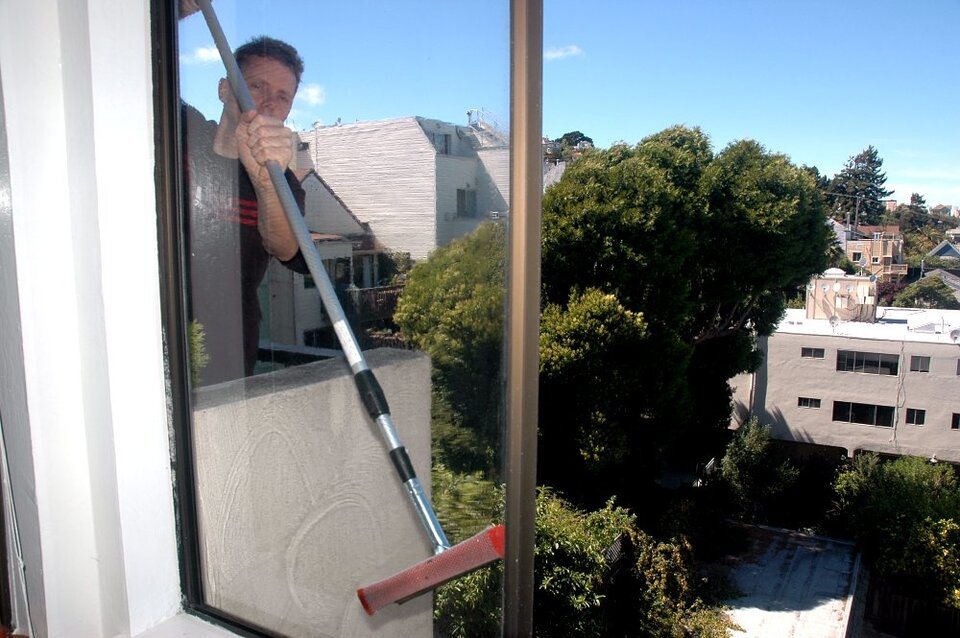
Angelika Recently, we were sitting with our German friends Conny and Roland, who have only been in San Francisco since last year, and we started talking about cleaning American windows. Now, this might seem a bit absurd to you, but we debated for quite a while. American windows are designed differently from German ones. They don't simply open inward with a lever; instead, they slide sideways or, as known from American TV shows, from bottom to top. This makes cleaning the outer panes almost impossible. Unless, of course, the window is adjacent to a fire escape or a balcony, where you can stand armed with cleaning supplies.
At first, I was puzzled by the question: How do Americans do it? Aren't they cleaning windows? Does a window cleaner come to the house? An American friend enlightened us back then. The windows can be removed from their frames. For cleaning, they are placed on the floor. This sounds brilliantly simple, but it isn't, because our windows, for example, are relatively high, and removing and reinstalling them becomes a juggling act. You have to be extremely careful that the window standing around in the apartment doesn't tip over and break the glass, as has happened to us before. In our apartment, there's an additional difficulty: We can only remove the sliding window; the other one is permanently fixed. And since we don't want to become part of the statistic "Most accidents happen at home," we have to use all sorts of tricks, like scrubbing with extendable telescopic rods. As you can tell, we don't clean our windows often. Only when the view from our windows gets clouded by a gray haze do we embark on this adventure.
Michael With the sales tax levied in many states, Americans are accustomed to goods costing more than the amount printed on the price tag. This also applies to restaurants, where meals in San Francisco actually cost about 25% more than what's on the menu. That's right, in addition to 8.5% tax, there's also a 15-20% tip. So if you only have $40 on you, you should only order dishes worth a maximum of $30, otherwise you won't have enough left for the tip, and the server will be upset.
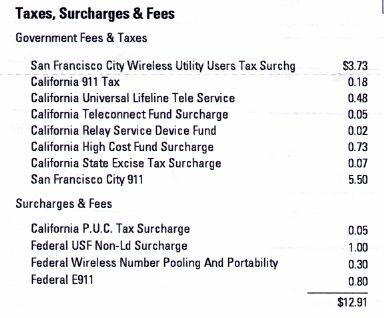
Recently, I've noticed that many companies have started adding completely outrageous fees and taxes to the bill amount. The mobile phone companies are also such big swindlers. In Figure 3, you can see a section of our mobile phone bill from last year. Two phones cost about $49.
In addition to the base amount, there is a $3.73 "San Francisco City Wireless Utility Users Tax Surcharge," then a $0.18 "California 911 Tax," and so on and so forth. There are a total of 12 items, and a total $12.91 is added to the bill amount in this way. Just like that, the monthly cell phone contract increases by 26%!
I certainly don't go along with such business practices, and some time ago we switched to prepaid phones. Our bill quickly dropped to a third! Of course, the phone companies advise against this method so they can comfortably exploit customers with now-common two-year contracts.
But it's not just the telephone companies that are being sneaky; hotels are also swindling more and more money from their guests through hidden fees. Recently, I went to a conference in Houston, Texas, and was quite surprised when absurd charges like "Sports Authority Tax" appeared on the bill. The room cost $114 per day. On top of that, there was a $6.84 "State Tax," a $7.98 "City Tax," and a $4.56 "Sports Authority Tax." No joke! So, $114 quickly turned into $134 per day (see Figure 4).
The magazine "Consumer Reports" recently stated that it is quite common for hotels to charge a "restocking fee" when you take something from the minibar. So, you not only pay $5 for a handful of peanuts but also an additional $5 for restocking the fridge! Fortunately, I never take anything from the minibar; I would rather drive 10 kilometers to the nearest supermarket.
A similar situation appeared recently on the bill for a rental car: Since it was a business trip, I had to book at corporate rates and ended up with a car at the exorbitant price of $44.25 per day. And that for a ridiculous vehicle like a Mitsubishi Eclipse! When I rent a car privately, I never pay more than $20 per day. But that's not all; absurd charges like $1.65 for "REIM Reg/Lic" and $3 for "CFC" were also added. Per day!
At the end of the bill, $4.49 was added for the airport shuttle, $18.40 for the "Concession Recovery Fee" (probably an airport fee), and $30.37 for tax, even though there is no sales tax in Texas. These are undoubtedly all fees that the rental company somehow has to pass on, but passing everything onto unsuspecting customers is somewhat criminal. By the way, the car rental company also provided a portable navigation system, which I gratefully accepted. The rude awakening came with the bill: $10.95 was charged for it. Per day! The device costs about $350 new on Amazon, so it pays for itself after just 30 days! The three-day car rental cost a total of $232.81. That's $75 a day. Insane. More than three times what I would pay privately.
According to my theory, the car rental business has become a losing game due to ruthless competition, and profits can only be made through crooked methods. We described the common tricks some time ago (Rundbrief 02/2002), but of course, those are old hats that we certainly don't fall for anymore. However, if some of you young foxes come to America and want to rent a car, you should definitely read the old post. Otherwise, the crooks at the car rental companies will be popping the champagne cork as soon as you sign the contract!
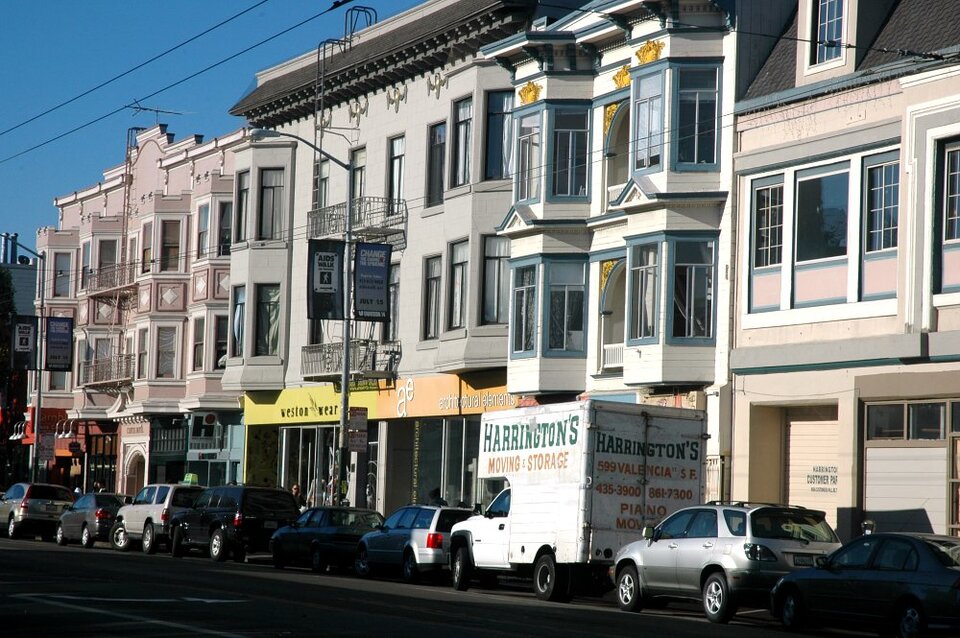
Angelika All of Germany seems to be in San Francisco in August, at least if we rely on our private statistics. And since we keep getting inquiries about what is worth seeing in San Francisco that isn't in every run-of-the-mill travel guide, today I would like to introduce you to Valencia Street, which is just around the corner from us.
If you've shopped till you dropped at all the factory outlet centers and GAP, Nike, and Levi's stores, and are looking for a different kind of shopping experience, head over to Valencia Street. Here, you'll find all sorts of interesting shops that you won't find in every commercial district around the world, along with great restaurants and cafes that aren't named Starbucks, all mixed with a unique San Francisco flair. Now, Valencia Street is not a grand boulevard prettily converted into a pedestrian zone for hordes of tourists. Quite the opposite, cars zoom back and forth, double park, or sometimes stop on the rather wide median strip, with cyclists whizzing along the bike path next to the street.
Ten years ago, Valencia Street, which officially belongs to the "Mission" district, was known as the boundary up to which one could safely walk at night before reaching the somewhat rougher, sometimes quite unsafe areas of the Mission neighborhood. Nowadays, the Mission is generally a trendy nightlife district, and on Friday evenings, it becomes very lively. For example, many shops on Valencia Street stay open late on Friday evenings to attract a crowd of night owls to the area. The homeless are also aware of this, and position themselves strategically along Valencia Street. Some locals are a bit nostalgic for the times when Valencia Street mainly consisted of thrift stores (shops that often sell used goods for a good cause), household appliance stores, and auto repair shops. However, a few of these businesses still call Valencia Street their home.
If you want to get to Valencia Street, the best way is to take the subway (BART) to 16th Street/Mission and walk up 16th Street to Valencia. Then, continue along Valencia Street towards 24th Street. One store you definitely shouldn't miss is "Paxton Gate" (between 19th Street and 20th Street). With its skeletons, non-living colorful beetles and butterflies, fossils, and stuffed animals, it always reminds me of a natural history museum. The difference is that you can actually buy the stuff there.
Right next door is the so-called Pirate Store (officially 826 Valencia). Here you can buy everything a good pirate needs these days, from eye patches, skull flags, to glass eyes. A huge pot of lard, which pirates supposedly can't do without, adorns the center of the store. This trip back to my childhood also serves a good cause. Everything you purchase in the store benefits the writing workshop for children located in the back of the store. Volunteers help children aged 6 to 18 put their thoughts on paper and develop a love for writing. The author Dave Eggers, who gained fame with his partly autobiographical novel "A Heartbreaking Work of Staggering Genius" (published in German as "Ein herzzerreißendes Werk von umwerfender Genialität"), founded this nonprofit organization. There are now branches in Los Angeles, Chicago, Seattle, New York, Michigan, and Boston.
Regarding literature, there is a considerable number of independent bookstores on Valencia Street that need all the support they can get to stand up against giants like Amazon, Barnes & Noble, and Borders. So, browse through "Dog Eared Books" or "Modern Times Bookstore" and buy something. In the latter, any old '68er will feel at home. There are plenty of political books from the leftist spectrum. But there are also other interesting and unusual books on the shelves. I recently discovered a memoir at "Modern Times Bookstore" by a substitute teacher ("Dave Roche - On Subbing") who had worked in various special education classes. And the book about Americans who turned their backs on their country and tried their luck abroad was also an exciting read ("Mark Ehrman - Getting Out"). For example, a German emigrant was delighted at her new home that friends she invited to a party actually showed up, and that dining out with friends in a restaurant could stretch on for hours, without the waiter immediately coming over with the bill.
But back to Valencia Street, in the store "X-21 Modern" (Valencia and 20th Street), you'll find not only quirky furniture but also unusual film props. Michael would love to purchase the life-sized Superman statue and set it up in our apartment. Diagonally across from "X-21 Modern" is the small store "Little Otsu," which at first glance appears to be a nice stationery shop. But we wouldn't be in San Francisco if only ordinary cards and notebooks like those in any Hallmark card store were sold here. At "Little Otsu," the cards are made from recycled paper or paper for which no tree was cut down. The inks used for printing are often soy-based. "Little Otsu" also offers T-shirts. Supporting local artisans by selling their products in the store is considered good practice.
If you're into designer clothing that isn't sewn together in China, Honduras, India, or the like, head to "House of Hengst" (between 20th and 21st Street). With the simple yet unusual pieces, you'll stand out in any German pedestrian zone. You can find the matching shoes for your outfit at "Shoe Biz" (877 Valencia Street), which carries well-known brands like Adidas, Puma, and Reebok, as well as comfortable casual shoes from the company Keen, founded in the Bay Area in 2003 and now headquartered in Portland, Oregon. If you're into Japanese designer bags by Hideo Wakamatsu: The store at number 563 is the only one in the USA that sells these wonderfully simple yet expensive pieces.
A San Francisco institution for 30 years, "Good Vibrations" is located on Valencia (corner of 17th Street). Anyone who thinks this is just an ordinary sex shop hidden away in a bad neighborhood is mistaken. The store is large and welcoming, and it is primarily aimed at women. Workshops focusing on sexuality are also offered.
If you work up an appetite from walking, head over to Valencia Street for dinner. There are a variety of restaurants to choose from. And because I'm feeling generous today, I'll share our personal favorite restaurants with you. At the top of the list is Yoyo (16th Street and Valencia), where you can get excellent sushi at reasonable prices. Interestingly, the interior looks more like a typical American diner than a Japanese restaurant. Guests can sit in a booth with red upholstery, sipping sake and enjoying their raw fish. The owner of Yoyo always laughs when we come because we usually have visitors from Germany in tow. Nearby is "Limon" (between 16th and 17th Street), which serves up Peruvian cuisine. There's plenty of fish and absolutely delicious ceviche. Ceviche is essentially a raw fish salad, prepared with herbs, lemon or lime, tomatoes, and onions.
If you're in the mood for Thai food, the best place to go is "Osha Thai" (between 19th and 20th Street). The place has this trendy vibe. You know, lots of chrome and metal and funky music. The service is a bit slow and inattentive, but the soups, for example, are super delicious. Plus, "Osha" is open all the time. For Spanish tapas and good sangria, head a bit off Valencia onto 22nd Street to "Esperpento." However, you should love garlic if you want to eat there, and make sure you don't have a dentist appointment the next day. At the "Last Supper Club" (Valencia and 23rd Street), you'll find Southern Italian home cooking waiting for you. After a meal there, we always have to roll ourselves a bit up the hill.
And if you're just in the mood for ice cream to go, stop by "Bombay Ice Creamery" (near 16th Street). The small shop sells exotic ice cream flavors like ginger, rose, fig, and cardamom. Ice cream is quite expensive in the USA, but the scoops are huge, so usually one is enough to fill you up. By the way, you should definitely avoid translating scoops as "balls," unless you want to get puzzled looks and raised eyebrows. "Balls" in expressive colloquial language refers to two parts of the male anatomy. An Ice cream portion is called "scoop." The ice cream vendor will also ask if you want the ice cream in a "cone" (waffle) or a "cup." Knock yourself out!
Angelika Recently, the annual statement from the federal German pension insurance arrived at our house. More precisely, it was sent to our German contact address, because supposedly the aforementioned authority does not send such documents abroad. However, since a clever official at the German pension insurance wanted to know why Michael hasn't paid into the German pension fund for ten years now, Michael's mother sent us the forms to be filled out to San Francisco.
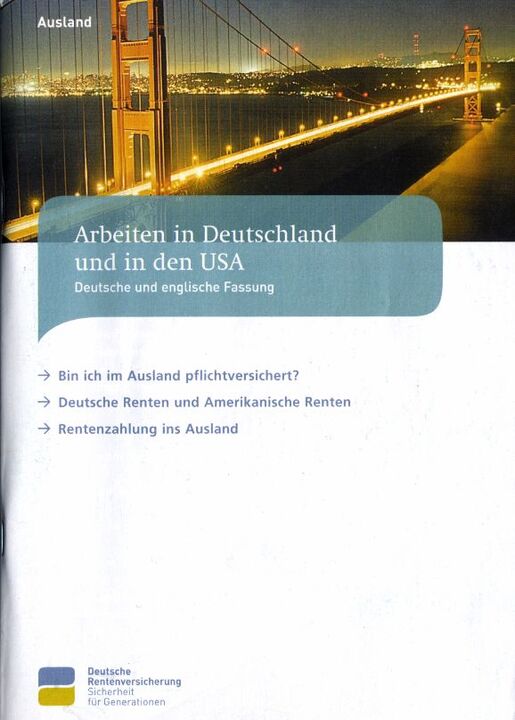
We promptly sent them back to Germany with a note that we now live and work in the USA, and therefore Michael pays mandatory contributions to the American pension insurance (called Social Security here). Soon, another letter arrived, this time even sent directly to San Francisco. The German authorities asked Michael to allow them to obtain information from the American Social Security Administration about Michael's already made contributions. Interestingly, the letter was written in both German and English. Michael initially grumbled a bit about the bureaucracy but eventually agreed to the data exchange between the two authorities.
Why do German authorities now want to know how much Michael has already paid into the federal pension fund in America? This is due to the German-American Social Security Agreement that came into effect in 1979. Since social security is one of the few mandatory insurances in the USA, an agreement could be reached. The agreement regulates how German and American contribution periods for pensions are combined. However, it does not go as far as to increase the future German pension with contributions made in America. But American insurance contributions can be used to shorten German contribution periods. In Germany, as is well known, one must pay contributions for at least five years to be eligible for a pension. But if, for example, Lieschen Müller, after working for four years at Karstadt in Munich, tries her luck in America, she does not have to give up her dream of a German pension. The period during which she pays into the American pension insurance is added to the four German years, and after one year she has completed her five years and is eligible.
Since Michael has already acquired both a German and an American pension entitlement, he will eventually receive a German and an American pension. If the population trend continues like this, however, this perhaps won't be happening, though, until he's 90, and it won't be much, but still. To receive American social security benfits, one must have paid into the system for at least 10 years on average.
Michael also benefits from the agreement, as the years contributing to the American system count towards the waiting periods in the German system, such as the 35 years required for the old-age pension for long-term insured individuals. However, Americans don't like it when someone receives an additional pension for which they haven't contributed to their own general Social Security fund. Therefore, they boldly reduce the American pension using the so-called "Windfall Elimination Provision" if someone also receives a German pension. "Windfall" roughly means "unexpected financial gain," a somewhat misleading term, if you ask me. By the way, the "Windfall Elimination Provision" applies to every American and has nothing to do with us being foreigners. For example, there are Americans who work for government agencies and contribute to their own pension funds (the U.S. Postal Service practiced this for years) or Americans who have acquired a German pension entitlement. In these situations, the red pen is also ruthlessly applied.
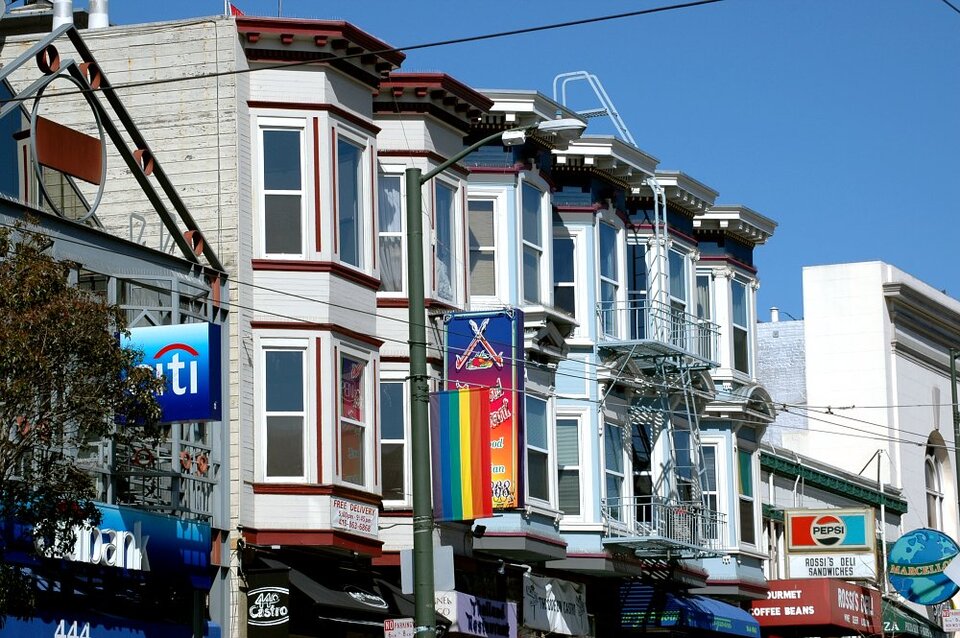
Angelika Every year at the end of June, the so-called "Gay Pride" festivities take place in San Francisco. With pride (hence the name "Pride") and in a colorful manner, the gay and lesbian movement of this city celebrates itself, and everyone joins in the festivities. The city is awash with a sea of rainbow flags (the symbol of the movement), and hotel rooms are hard to come by because everyone travels to San Francisco for the big party. One of the highlights of the festivities is the parade on Sunday, where decorated floats, people in costumes, activists, and politicians, including the mayor of San Francisco, are marching down Market Street. A classic feature is the "Dykes on Bikes," who traditionally open the parade with their heavy motorcycles, often topless. The "Dyke March," organized by lesbian women for (lesbian) women, is also very popular and begins with bands and speeches in Dolores Park. From the park, the march proceeds to the Castro District, where everyone (regardless of their sexual orientation) dances late into the night on Castro Street at the unofficial party "Pink Saturday."
And the large pink triangle, which is installed for a few days on the Twin Peaks hill high above the city, has now become a permanent part of the program. The pink triangle, which in Nazi Germany stood for the massive persecution and discrimination of homosexuals, has now become a more positively embraced international symbol of the gay movement. You might remember from history class that homosexuals had to wear the inverted triangle visibly on their clothing in concentration camps. The triangle on Twin Peaks hill is meant to ensure that historical and current discriminations are not forgotten. This year, Consul Rolf Schütte from the German Consulate General in San Francisco gave the speech at the annual opening ceremony of the triangle installation. It couldn't have been more symbolic, as Schütte is not only the German consul, but also openly homosexual.
Michael On our weekly tours through the culinary establishments of San Francisco's Japantown, we had discovered "Ichiban Kan" years ago. It's a kind of "Rudi's Reste Rampe," where almost everything costs just one dollar, but with a Japanese twist.
And Japanese and Germans have more in common than one might initially suspect: a love for all sorts of desk accessories, for example. Filing folders, expensive felt-tip pens, in/out trays for the desk--these are things sloppy Americans can't make sense of, but in Japanese offices, it apparently looks just like German desks.
Recently, I tried a quiz on the internet, and one question asked about typical features of a German apartment. Alongside obviously misleading suggestions like lederhosen hanging on the wall, there was: Leitz folders on the shelf. And it hit me like a ton of bricks: That's true, that is typically German!
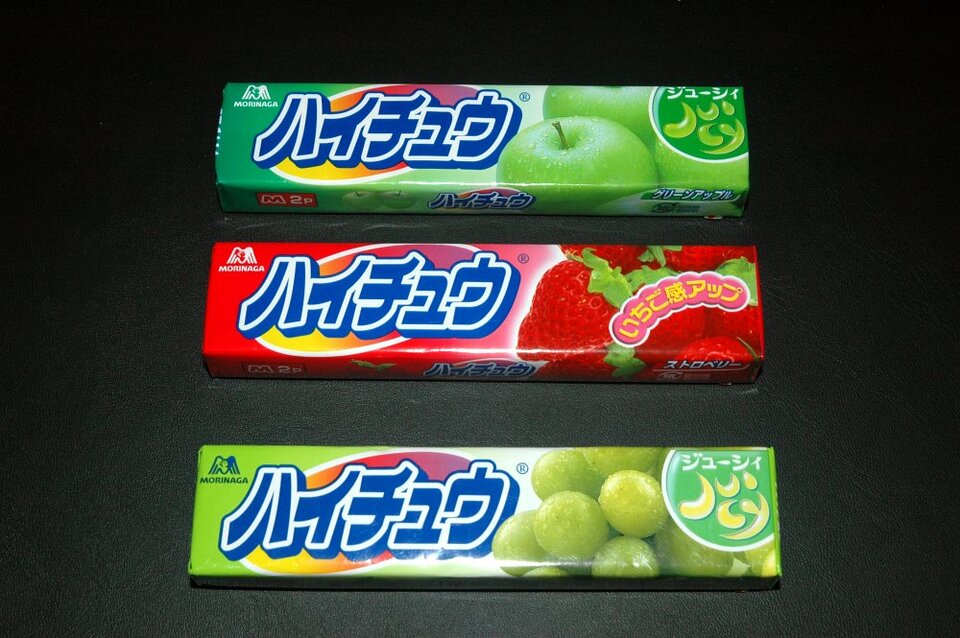
At "Ichiban-Kan," in addition to all sorts of plastic folders, there are certainly also two dozen different plastic baskets that you can use to tidy up your desk. Or hotel slippers with "Westin" and "Hilton" written on them. They cost a dollar at "Ichiban-Kan," and we always take our pairs with us when we stay in budget motels. Or Japanese soup bowls. Or Japanese sweets. In illustration 19, you can see the Japanese Ma-o-am. It tastes really good!
Recently, we were driving around south of San Francisco in the "Serramonte Mall" and accidentally discovered a new gem in this ugly suburban shopping center: the Japanese one-dollar store "Daiso." "Daiso" is certainly four times the size of "Ichiban Kan," a paradise for exotic bargain hunters! A huge selection of tools, stationery, organization systems, and almost everything costs $1.50. It really should be mentioned in every travel guide!
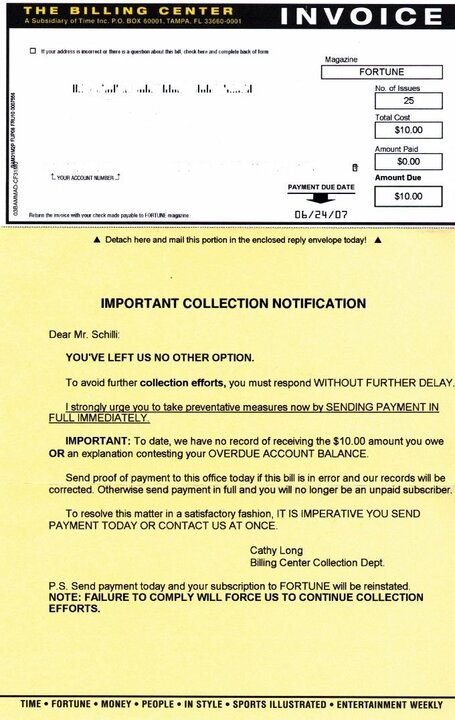
Michael Although there is surprisingly good consumer protection in America, there are occasionally some bad apples that spoil the bunch. One day, I received an offer in the mail to subscribe to the magazine "Fortune" for a year at the unbeatable price of $10. I'm always up for such bargains, so I quickly sent back the form with a check for $10 to Fortune magazine. For a year, I threw the issues away every month. Who has time to read such economic drivel! When letters eventually arrived begging for a renewal of the subscription, I ignored them just like the countless other offers that fill our mailbox day after day.
Until one day the threatening letter from illustration 23 arrived. It came from a not very trustworthy sounding institution called "The Billing Center" and inside it said "You've left us no other choice" and mentioned that I somehow owed someone 10 dollars. You have to be careful with such things because they can be reported to the American credit bureau and affect the credit report (Rundbrief 05/2004).
Someone less argumentative than me might have just paid the 10 dollars in God's name, but I got on the phone and to get to the bottom of it. Turns out, the Fortune Magazine crooks felt guilty about these aggressive fee collection methods and immediately canceled the whole thing. What I had overlooked is that the slip originally sent back with the check included a fine print clause stating that the subscription would automatically renew.
This is actually uncommon in America, although recently more and more companies are adopting this approach and enticing customers with extremely favorable conditions. Until now, magazine subscriptions could be paid annually by sending a check by mail, and if the check wasn't sent, the subscription would automatically lapse. Are we soon going to have German conditions here, or what?
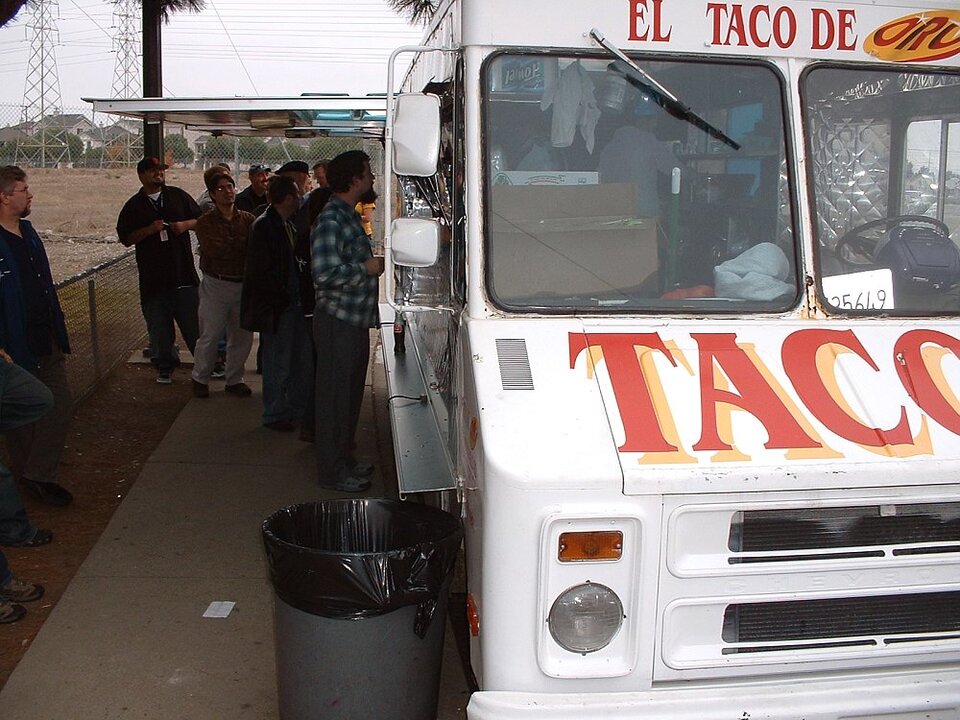
Michael I have already reported that our group often goes to a so-called taco truck at lunchtime to devour Mexican tacos (Rundbrief 10/2006). The truck is a van with a built-in kitchen, a kind of Mexican currywurst stand. In American slang, such vans are also jokingly called "roach coaches" and they're typically found near construction sites, so that hungry workers can have an inexpensive but hearty meal at lunchtime.
Tacos (corn pancakes called tortillas with fillings) at the Taco Truck are available with "Asada" (beef), "Pastor" (pork), "Carnitas" (pork cooked with fat and orange peels), "Cabeza" (cheek), "Lengua" (tongue), and they each cost about $1.50. However, they are so small that you need about four or five to get full.
The truck in Alviso is called "El Taco De Oro," which means "The Golden Corn Pancake." Alviso is a dreary little town on the edge of the highway, built on dirt that was dumped into the San Francisco Bay. On Flickr, I once posted some photos of our Lunch at the taco truck, captured with our group of Yahoos. Funnily enough, we discovered that the bus driver, who picks up the Yahoos from the train station in Mountain View in the morning and takes them to headquarters, simply drives the Yahoo bus to the taco truck in Alviso at lunchtime, to turn around and serve Mexican delicacies! Another thought just crossed my mind. In one of the upcoming newsletters, I'll be writing a lengthy essay about how Mexicans always eat Mexican food. It's true!
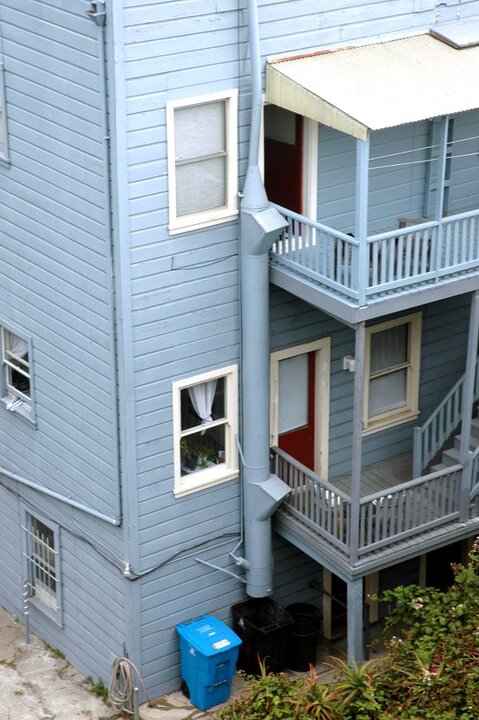
Michael Under the category "Inventions that deserved the Nobel Prize but never received one," today we present the so-called "Garbage Chute." Who hasn't cursed when they had to take out the stinking trash in the middle of the night? In America, you don't have to go down the stairs to the garage or the yard for this; you simply open a hatch that reveals a chute where the waste swiftly travels downward.
In illustration 26, you can see a classic implementation of the system on our neighbor's house. There, the pipe is attached to the exterior wall of the house (the house was probably 'retrofitted') and leads directly into a classic garbage bin located in the courtyard below.
Convenience is a big deal in America. So much so that our next door neighbor often doesn't even make it to the trash chute in our building. Sometimes he hangs the garbage bag on his doorknob, in order to take it to the chute in the morning. It's hard to believe!
Greetings from the land of the laziest people in the world:
Angelika und Michael