
Michael With the sales tax levied in many states, Americans are accustomed to goods costing more than the amount printed on the price tag. This also applies to restaurants, where meals in San Francisco actually cost about 25% more than what's on the menu. That's right, in addition to 8.5% tax, there's also a 15-20% tip. So if you only have $40 on you, you should only order dishes worth a maximum of $30, otherwise you won't have enough left for the tip, and the server will be upset.
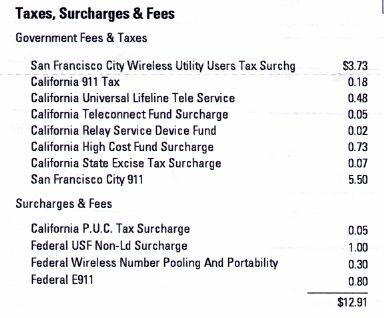
Recently, I've noticed that many companies have started adding completely outrageous fees and taxes to the bill amount. The mobile phone companies are also such big swindlers. In Figure 1, you can see a section of our mobile phone bill from last year. Two phones cost about $49.
In addition to the base amount, there is a $3.73 "San Francisco City Wireless Utility Users Tax Surcharge," then a $0.18 "California 911 Tax," and so on and so forth. There are a total of 12 items, and a total $12.91 is added to the bill amount in this way. Just like that, the monthly cell phone contract increases by 26%!
I certainly don't go along with such business practices, and some time ago we switched to prepaid phones. Our bill quickly dropped to a third! Of course, the phone companies advise against this method so they can comfortably exploit customers with now-common two-year contracts.
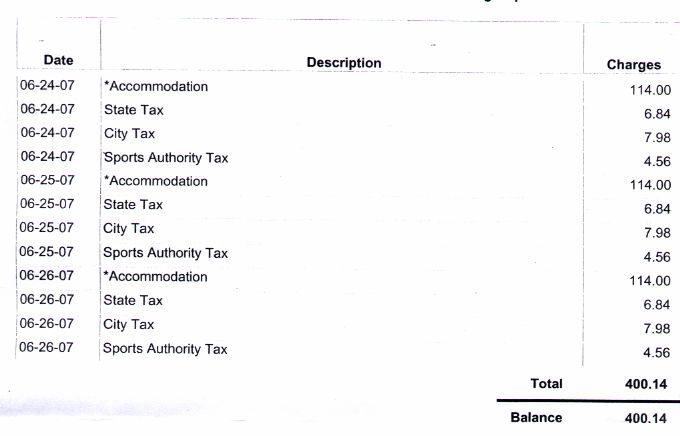
But it's not just the telephone companies that are being sneaky; hotels are also swindling more and more money from their guests through hidden fees. Recently, I went to a conference in Houston, Texas, and was quite surprised when absurd charges like "Sports Authority Tax" appeared on the bill. The room cost $114 per day. On top of that, there was a $6.84 "State Tax," a $7.98 "City Tax," and a $4.56 "Sports Authority Tax." No joke! So, $114 quickly turned into $134 per day (see Figure 2).
The magazine "Consumer Reports" recently stated that it is quite common for hotels to charge a "restocking fee" when you take something from the minibar. So, you not only pay $5 for a handful of peanuts but also an additional $5 for restocking the fridge! Fortunately, I never take anything from the minibar; I would rather drive 10 kilometers to the nearest supermarket.
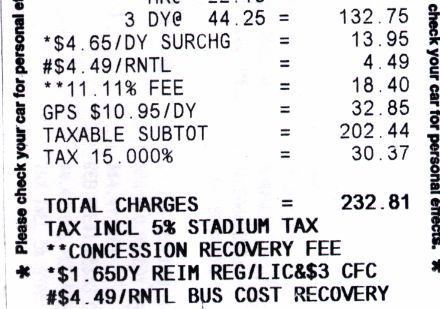
A similar situation appeared recently on the bill for a rental car: Since it was a business trip, I had to book at corporate rates and ended up with a car at the exorbitant price of $44.25 per day. And that for a ridiculous vehicle like a Mitsubishi Eclipse! When I rent a car privately, I never pay more than $20 per day. But that's not all; absurd charges like $1.65 for "REIM Reg/Lic" and $3 for "CFC" were also added. Per day!
At the end of the bill, $4.49 was added for the airport shuttle, $18.40 for the "Concession Recovery Fee" (probably an airport fee), and $30.37 for tax, even though there is no sales tax in Texas. These are undoubtedly all fees that the rental company somehow has to pass on, but passing everything onto unsuspecting customers is somewhat criminal. By the way, the car rental company also provided a portable navigation system, which I gratefully accepted. The rude awakening came with the bill: $10.95 was charged for it. Per day! The device costs about $350 new on Amazon, so it pays for itself after just 30 days! The three-day car rental cost a total of $232.81. That's $75 a day. Insane. More than three times what I would pay privately.
According to my theory, the car rental business has become a losing game due to ruthless competition, and profits can only be made through crooked methods. We described the common tricks some time ago (Rundbrief 02/2002), but of course, those are old hats that we certainly don't fall for anymore. However, if some of you young foxes come to America and want to rent a car, you should definitely read the old post. Otherwise, the crooks at the car rental companies will be popping the champagne cork as soon as you sign the contract!